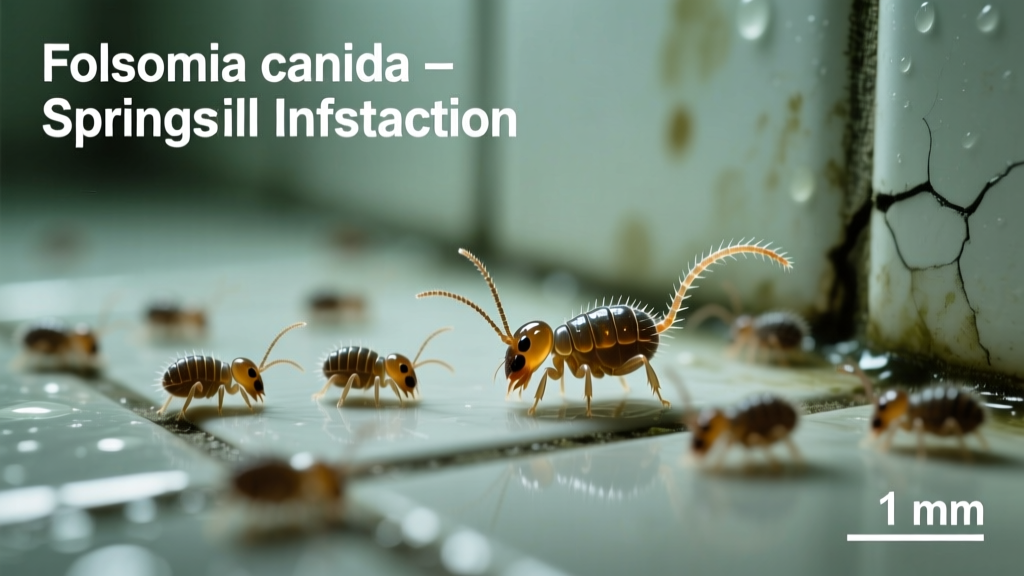
Springtails are tiny, wingless hexapods—often mistaken for mold, pepper flakes, or even fungal spores—that jump when disturbed using a forked appendage called a furcula. They don’t bite, spread disease, or damage structures, but their sudden appearance in bathroom grout lines, shower corners, or around drains signals persistent moisture issues that can worsen mold growth and attract other pests.
Identification
Springtails (Collembola) are typically 0.2–2 mm long, oval-shaped, and range from white and gray to bluish-black. Their most distinctive behavior is leaping—up to 10 cm—when startled, thanks to the furcula under their abdomen. Unlike gnats, they lack wings and never hover; unlike dust mites, they’re visible to the naked eye and move rapidly across damp surfaces.
| Pest | Size & Color | Movement | Key Clue |
|---|---|---|---|
| Springtail | 0.2–2 mm; white, gray, or charcoal | Jumping or quick scuttling on wet surfaces | Leaps when puffed with air; thrives only where moisture >90% RH |
| Fungus gnat | 1–3 mm; dark gray/black with wings | Flies erratically near drains or soil | Adults rest on walls/tiles; larvae feed in organic sludge |
| Dust mite | 0.2–0.3 mm; translucent | Slow, crawling only under microscope | Not visible without magnification; no jumping |
| Mold mite (Tyrophagus) | 0.3–0.5 mm; creamy white | Slow crawling in clusters on moldy surfaces | Associated with visible mold growth on caulk or drywall |
What Attracts Them
Bathrooms provide the perfect trifecta for springtails: constant humidity, organic debris (soap scum, hair, biofilm), and cool, shaded microhabitats. They don’t invade from outside—they explode locally when relative humidity stays above 90% for 48+ hours, often due to:
- Cracked or deteriorated silicone caulk trapping moisture behind tiles
- Clogged overflow drains or slow-draining sink/shower traps holding stagnant water
- Unvented exhaust fans running less than 20 minutes post-shower (per ASHRAE 62.2-2022)
- Water-damaged subflooring or drywall beneath tile that wicks moisture upward
According to the U.S. EPA’s 2023 Indoor Air Quality Guide, bathrooms account for 37% of residential high-humidity events linked to springtail outbreaks—more than basements or laundry rooms.
Treatment Methods
Natural Remedies
Start with non-toxic, moisture-focused interventions—springtails die within hours at <75% RH. First, wipe all visible clusters with a damp paper towel (discard immediately). Then:
- Apply 3% hydrogen peroxide directly into drain openings and grout lines—kills biofilm where springtails feed (University of Florida IFAS Extension, 2022)
- Replace cracked or blackened caulk with mildew-resistant silicone (e.g., GE Advanced Silicone II)
- Run exhaust fan 30 minutes after every shower and install a timer switch if it lacks one
- Place silica gel desiccant packs inside cabinets and under sinks for localized drying
Chemical Options
Only consider insecticides if springtails persist after 10 days of rigorous moisture control. Use residual sprays labeled for indoor crack-and-crevice use—not broad-spectrum foggers:
- Pyrethrin-based aerosols (e.g., CB-80) applied along baseboards and under vanities—effective for 3–5 days
- Boric acid dust (0.5% concentration) lightly puffed into inaccessible voids behind toilets—low mammalian toxicity but lethal to springtails on contact
- Avoid neonicotinoids indoors: they offer no advantage over simpler options and pose higher risk to beneficial insects if tracked outside
"Springtails aren't an infestation—they're a moisture meter with legs. If you treat the bug and ignore the leak, you'll see them again in 72 hours." — Dr. Lena Cho, Entomologist, National Pest Management Association, 2023
Prevention
Long-term prevention hinges on breaking the moisture cycle—not just killing individuals. Monitor humidity daily with a $12 hygrometer; aim for 40–60% RH in bathrooms. Replace standard bath mats with quick-dry microfiber versions that absorb 7x their weight and evaporate in under 2 hours. Seal gaps around pipes with expanding foam rated for interior wet locations (e.g., Great Stuff Pond & Stone).
- Inspect caulk every 6 months—replace if it’s discolored, cracked, or pulls away from tile
- Clean shower drains monthly with a stiff-bristled brush and hot vinegar solution (not boiling water, which degrades PVC)
- Install a smart exhaust fan (like Broan NuTone QTXE110) that auto-runs based on humidity readings
When to Call an Exterminator
Call a licensed pest professional only if:
- Springtails appear in multiple bathrooms *and* on upper floors despite working exhaust fans
- You find them inside wall cavities (e.g., behind outlets or light switches)
- There’s concurrent evidence of hidden water intrusion—bubbling paint, soft drywall, or musty odors not tied to visible mold
Most exterminators charge $120–$250 for inspection—and many will decline treatment unless structural moisture is verified. A better first step is hiring a certified moisture inspector (water damage inspection) to locate leaks behind walls or under floors.
Why do springtails gather around my bathtub drain?
Drains accumulate biofilm—a slimy matrix of bacteria, soap residue, and dead skin cells—providing both food and humidity. Springtails congregate there because the trapped moisture stays saturated longer than surrounding surfaces. Clean weekly with a pipe brush and enzyme-based drain gel (not chemical drain openers, which feed biofilm).
Can springtails come from my houseplants?
Rarely—but possible if pots sit in saucers holding standing water. Overwatered snake plants or peace lilies create ideal microclimates. Check soil surface for tiny jumping specks before ruling out plants. Repot with fast-draining mix and elevate pots on pebble trays instead of saucers.
Are springtails harmful to pets or kids?
No. They don’t bite, transmit pathogens, or trigger allergies. The CDC confirms zero documented cases of springtail-related illness in humans or animals (CDC Zoonoses Report, 2021). Their presence is purely an environmental red flag—not a health hazard.
Do they mean I have mold?
Not necessarily—but they strongly suggest conditions favorable for mold. Springtails feed on fungi and decaying organics, so their presence alongside discoloration, musty smells, or crumbling drywall warrants a mold inspection checklist.
Will bleach kill springtails?
Bleach may kill surface clusters but won’t penetrate biofilm or reduce ambient humidity—the root cause. Worse, sodium hypochlorite degrades grout and caulk over time, worsening moisture retention. Use hydrogen peroxide or vinegar instead.
Can they live in my walls?
Yes—if there’s chronic condensation or a hidden plumbing leak inside framing. Look for cold spots on walls, efflorescence on concrete subfloors, or rust on pipe straps. This requires thermal imaging or borescope inspection—see our guide on hidden leak detection.
Springtails aren’t pests to fear—they’re messengers. Spotting them means your bathroom’s moisture management system has failed, not that your home is overrun. Fix the humidity, clean the biofilm, seal the gaps, and they’ll vanish as quickly as they appeared—no fumigation needed.