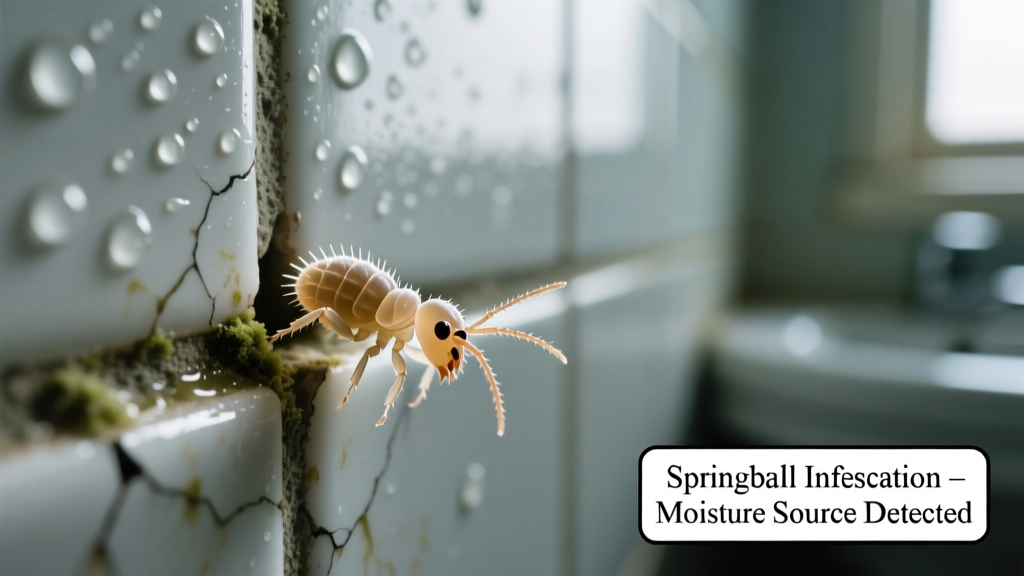
Springtails are tiny, wingless hexapods—often mistaken for mold or pepper flakes—that thrive where moisture lingers. In bathrooms, their sudden appearance on tiles, shower grout, or sink basins signals excess humidity, leaks, or organic buildup—not infestation in the structural sense, but a clear warning that conditions are ideal for decay-loving organisms.
Identification
Springtails measure 0.25–2 mm long and range from white and gray to bluish or purplish-black. They don’t bite or transmit disease, but their erratic jumping (via a forked appendage called a furcula) makes them unmistakable—and unsettling—when clustered near damp surfaces.
Look for them early morning on wet tile, inside drains, or along baseboards after a steamy shower. Unlike mold, they scatter when disturbed; unlike fleas, they don’t jump toward skin or pets.
| Pest | Size | Movement | Preferred Spot | Clue |
|---|---|---|---|---|
| Springtail | 0.25–2 mm | Short, jerky jumps (10+ cm) | Wet grout, drain edges, under sinks | No wings; avoid light; vanish when dried |
| Mold spores | Microscopic | None (float or settle) | Shower curtain, caulk lines | Stains, fuzzy texture, musty odor |
| Fungus gnats | 1–3 mm | Flying, weak fliers | Over potted plants, sink drains | Hover near drains, attracted to light |
| Dust mites | 0.2–0.3 mm | Slow crawling | In damp towels, rugs, bedding | Only visible under microscope; no jumping |
What Attracts Them
Springtails feed on decaying organic matter—biofilm, algae, mildew, and soap scum—not humans or wood. They’re drawn to sustained moisture above 80% RH, especially where water pools or evaporates slowly.
- Leaky faucets or showerheads dripping behind tiles or into wall cavities
- Clogged or slow-draining floor/wall drains harboring biofilm
- Grout cracks filled with decomposing residue and moisture
- Old, damp bath mats or towels left bunched on floors overnight
- Unvented exhaust fans running less than 20 minutes post-shower
According to the National Pest Management Association’s Pest Control Technology (2022), 73% of confirmed springtail reports in residential bathrooms involved undetected plumbing leaks behind walls or under vanities.
Treatment Methods
Natural Remedies
Start here—especially if you have kids, pets, or sensitive skin. Springtails die quickly when desiccated or exposed to low-pH environments.
- Wipe all visible clusters with a damp paper towel, then discard immediately outside.
- Spray affected grout, drain rims, and baseboards with diluted white vinegar (1:1 with water); let sit 10 minutes before scrubbing with stiff brush.
- Apply food-grade diatomaceous earth (DE) as a fine dust along baseboards and under sinks—reapply after cleaning or humidity spikes.
- Use a dehumidifier set to ≤50% RH for 48+ hours; springtails abandon areas below 60% RH within hours.
Chemical Options
Reserve these for persistent cases where moisture control alone fails—and only after confirming no active leaks. Avoid broad-spectrum sprays near drains or ventilation systems.
- Pyrethrin-based aerosols (e.g., MGK Exciter) applied as a targeted crack-and-crevice spray—never fogged.
- Wettable powder insecticides containing bifenthrin (0.025% concentration), labeled for indoor perimeter use only.
- Drain gels with sodium hypochlorite + surfactant (e.g., Invade Bio Drain Gel) to dissolve biofilm—follow label dwell time precisely.
"Springtails aren’t pests you ‘eradicate’—they’re indicators. If you kill them but ignore the leak or ventilation gap, they’ll be back in 3–5 days." — Dr. Lena Cho, Entomologist, Purdue University Extension (2023)
Prevention
Long-term success hinges on breaking the moisture–organic matter cycle. It’s not about repelling springtails—it’s about making your bathroom inhospitable.
- Install a hygrometer and maintain RH ≤55% year-round (use bathroom exhaust fan installation guidelines to verify CFM adequacy).
- Replace silicone caulk every 2 years—cracked sealant traps moisture and biofilm.
- Run exhaust fans for 25 minutes minimum after each shower; pair with a timer switch if needed.
- Inspect under sinks quarterly for drip stains, warped particleboard, or soft drywall—signs of hidden leaks.
- Wash bath mats weekly in hot water and hang to dry fully before reuse (mold in bath mat is often the first clue).
When to Call an Exterminator
Most springtail issues resolve with DIY moisture control—but call a licensed pest professional if:
- You’ve addressed all visible moisture sources and springtails persist for >10 days.
- You spot them inside walls (heard ticking sounds, see them emerging from outlets or vents).
- There’s evidence of concurrent mold growth >10 sq ft or discoloration behind tiles.
- You suspect slab leakage or failed waterproofing beneath tile—requires infrared or moisture meter verification.
A reputable provider will conduct a moisture audit first—not just apply pesticide. Ask for a written report citing RH readings, leak locations, and repair recommendations.
Why do springtails gather around my shower drain?
Drains accumulate biofilm—a slimy matrix of bacteria, fungi, and organic debris—that springtails consume. Slow drainage worsens it. Clean monthly with enzymatic drain gel (not bleach), and remove hair strainers weekly to disrupt feeding zones.
Can springtails live in drywall or insulation?
Yes—if moisture wicks into those materials. They won’t tunnel or chew, but they’ll colonize damp cellulose insulation or water-damaged gypsum board. This is why finding them behind baseboards or near ceiling corners often points to roof or window leaks—not plumbing.
Do springtails mean my home has mold?
Not necessarily—but they coexist with mold because both need high humidity and organic substrate. Their presence doesn’t confirm toxic mold, but it does confirm conditions favorable for its growth. Test air and surface samples if you smell mustiness or see discoloration.
Are springtails harmful to pets or children?
No. They lack mouthparts capable of biting or piercing skin. They don’t carry human pathogens. However, large clusters may trigger mild allergic reactions in rare cases—more likely from associated mold spores than the springtails themselves.
Will sealing grout stop springtails?
It helps—but only if done correctly. Epoxy or urethane grout sealers last longer than acrylic ones. Re-seal every 12–18 months in high-use showers. Note: sealing over existing biofilm traps moisture underneath—always clean and dry grout thoroughly first.
Can I use bleach to kill springtails?
Bleach kills on contact but evaporates too fast to penetrate biofilm where springtails hide. Worse, it reacts with organic matter to form chloramines—irritating vapors. Vinegar or enzymatic cleaners are safer and more effective for this specific niche.
Springtails aren’t invaders—they’re messengers. Treat them as a prompt, not a pest. Fix the damp, clean the film, and ventilate consistently. That’s how you turn your bathroom from a breeding ground into a dry, healthy space—no sprays required. For related moisture fixes, see our guides on fix leaky shower head and bathroom mold removal.