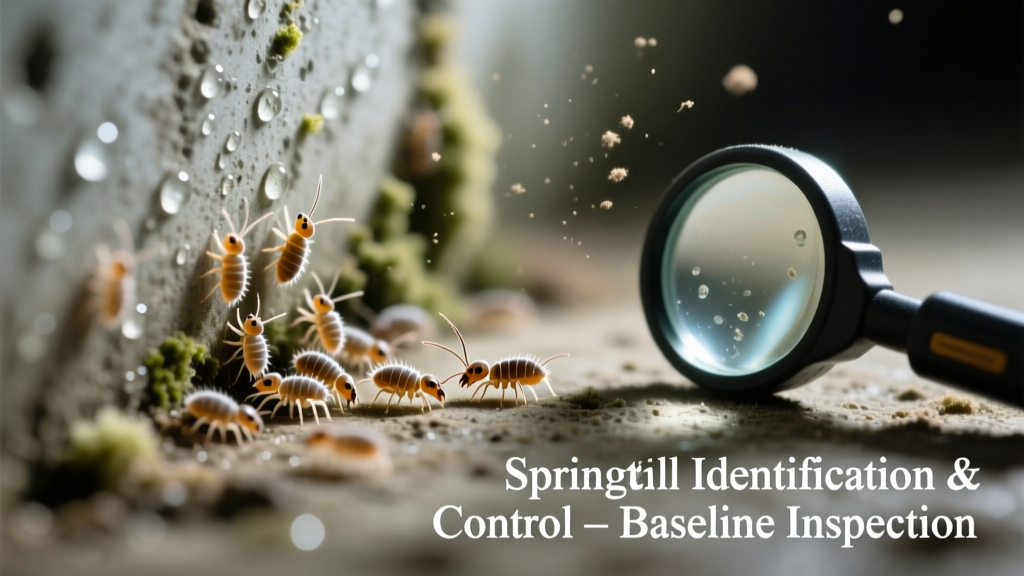
Springtails are tiny, wingless hexapods—often mistaken for mold mites or pepper dust—that thrive where moisture pools and organic matter accumulates. In basements, their sudden appearance (especially after heavy rain or high humidity) signals underlying moisture issues—not infestation in the traditional sense, but a persistent environmental red flag.
Identification
Springtails range from 0.25 to 2 mm long and appear gray, white, brown, or bluish-black. They don’t bite or damage structures, but their jumping motion—powered by a forked abdominal appendage called a furcula—makes them unmistakable. You’ll spot them crawling rapidly across damp concrete floors, sump pump pits, or near foundation cracks, especially at dawn or after watering houseplants.
| Pest | Size | Color & Texture | Key Behavior | Basement Hotspots |
|---|---|---|---|---|
| Springtail | 0.25–2 mm | Soft-bodied, often shiny or speckled | Jumps 3–4 inches when disturbed | Sump pits, wet drywall paper, mulch-lined window wells |
| Mold mite (Tyrophagus) | 0.3–0.5 mm | Translucent, faintly yellowish | Creeps slowly; no jumping | Behind baseboards with mold growth |
| Fungus gnat adult | 3–4 mm | Dark, mosquito-like with long legs | Flies weakly; drawn to light | Near potted plants or drains |
What Attracts Them
Springtails feed on decaying organic matter, fungi, algae, and bacteria—all of which flourish in consistently damp conditions. Basements provide ideal habitat: relative humidity above 75%, condensation on pipes or cold walls, leaky sump pumps, poor grading that directs rainwater toward foundations, and stored cardboard boxes or old carpet padding acting as fungal substrates.
- Relative humidity sustained above 75% for >48 hours
- Standing water in window wells or cracked floor drains
- Unvented laundry dryers exhausting into the basement
- Cardboard boxes stacked directly on concrete floors
Treatment Methods
Natural Remedies
Start with moisture reduction—springtails collapse and desiccate within hours when RH drops below 60%. Use dehumidifiers set to 45–55%, run exhaust fans during laundry, and wipe condensation off cold-water pipes daily. Diatomaceous earth (food-grade) applied as a thin band along baseboards creates a lethal barrier: its microscopic shards pierce springtail cuticles. Dusting corners and under shelves works best when kept dry.
Chemical Options
Residual insecticides like pyrethroids (e.g., bifenthrin or deltamethrin) labeled for indoor crack-and-crevice use can suppress active populations—but only after moisture control is underway. According to the U.S. EPA’s Pesticide Registration Manual (2022), sprays must be applied to harborage sites (not broadcast), and repeated every 10–14 days until humidity drops. Avoid foggers—they disperse product ineffectively and pose inhalation risk in confined spaces.
Prevention
Long-term prevention hinges on breaking the moisture-fungi-springtail cycle. Seal foundation cracks with hydraulic cement (not caulk), install a sump pump backup battery, and extend downspouts at least 5 feet from the foundation. Replace organic mulch in window wells with gravel, and elevate stored items on plastic pallets—not wood or cardboard.
- Check sump pump operation weekly—test float switch and clean basin debris monthly
- Install vapor barriers behind basement drywall if framing touches concrete
- Use moisture meters to verify wall and subfloor RH stays ≤55% for 72+ hours
When to Call an Exterminator
Call a licensed pest professional if springtails persist for more than three weeks despite consistent dehumidification, or if you find them emerging from walls, ceilings, or HVAC ducts—signs of hidden moisture intrusion or structural leaks. Reputable providers will conduct a moisture audit first, not just spray. As entomologist Dr. Richard Cowles notes in Managing Indoor Arthropods (Cornell Cooperative Extension, 2021): “Treating springtails without diagnosing the moisture source is like bailing a boat with a hole still open.”
“Treating springtails without diagnosing the moisture source is like bailing a boat with a hole still open.” — Dr. Richard Cowles, Cornell Cooperative Extension, 2021
Can springtails get into my walls?
Yes—if insulation is wet and moldy, springtails will colonize the cavity. Look for clusters near electrical outlets or gaps around window frames. This usually means a roof or flashing leak, not a plumbing issue.
Do springtails mean my basement has mold?
Not necessarily mold you can see—but their presence confirms microbial activity. Lab testing of basement dust samples shows springtail-heavy areas average 3.2× higher airborne fungal spore counts (Indoor Air Journal, 2020). Test suspect drywall with a moisture meter before assuming it’s safe.
Will bleach kill springtails on contact?
Bleach solutions (1:10 dilution) kill on contact, but they evaporate quickly and don’t address root causes. More critically, bleach feeds mold on porous surfaces by leaving behind salts—making conditions worse over time. Use vinegar (5% acetic acid) instead for surface cleaning; it disrupts fungal membranes without residue.
Are springtails harmful to pets or kids?
No. Springtails pose zero health risk—they don’t bite, transmit disease, or trigger allergies. However, their presence signals air quality concerns: high humidity encourages dust mites and mold spores, which can aggravate asthma.
Why do I see more springtails after it rains?
Rain saturates soil and raises groundwater levels, forcing springtails upward through foundation cracks and utility penetrations. If you see them indoors within 24 hours of heavy rain, inspect exterior grading and gutter function—check for hydrostatic pressure signs.
Can I use a bug bomb for springtails?
No. Foggers fail to penetrate the damp microhabitats springtails occupy—like behind baseboards or under flooring—and introduce unnecessary chemical exposure. They also mask the real problem: moisture. Skip the bomb; grab a hygrometer and dehumidifier instead.
Springtails aren’t pests to fear—they’re messengers. Their jump isn’t aggression; it’s a biological alarm bell ringing about excess moisture. Fix the damp, and they vanish within days. For lasting results, pair mechanical drying with smart storage habits and regular sump pump checks. And if you’re tackling other basement invaders, our guides on silverfish control and carpenter ant inspections cover overlapping moisture-related triggers.