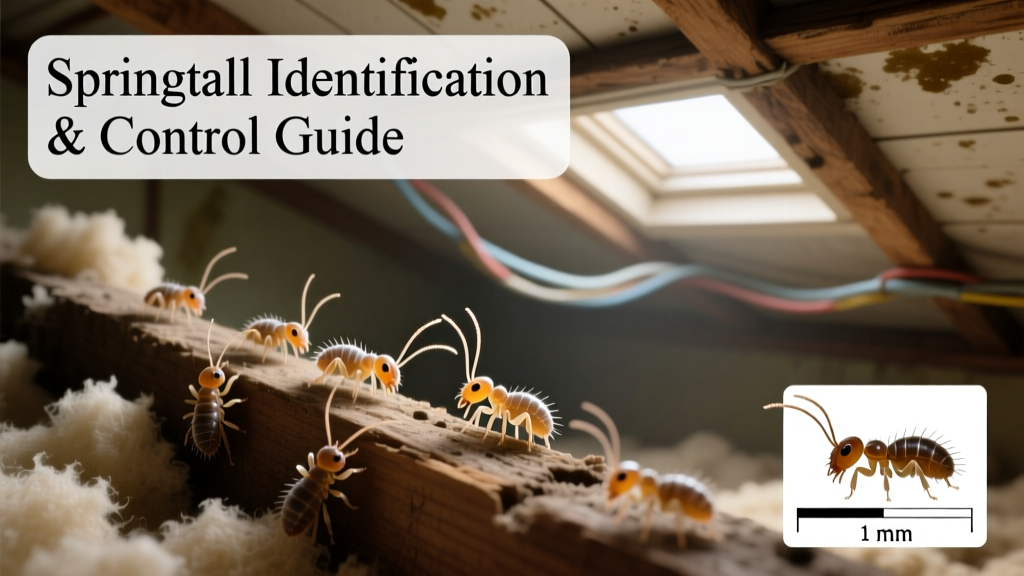
Springtails are tiny, wingless hexapods—often mistaken for mold or dust mites—that thrive in moist attic environments. Though harmless to humans and structures, their sudden appearance in large numbers signals serious moisture issues that can lead to wood rot, insulation degradation, and mold growth within weeks.
Identification
Springtails measure 1–2 mm long, with oval bodies, six legs, and a forked appendage (furcula) that snaps against the substrate to propel them several inches—giving the illusion of jumping. They’re usually white, gray, or bluish, and appear as slow-moving specks near damp insulation, roof leaks, or under plywood sheathing.
| Pest | Size | Color | Key Distinguishing Feature | Movement |
|---|---|---|---|---|
| Springtail | 0.5–2 mm | White, gray, or pale blue | Furcula (springing mechanism) | Erratic, short jumps |
| Dust mite | 0.2–0.3 mm | Translucent | No furcula; eight legs | Slow crawling only |
| Fungus gnat adult | 3–4 mm | Black or brown | Long antennae, delicate wings | Flying, drawn to light |
| Mold spores | 2–10 µm | Green, black, or yellow | Microscopic; requires microscope | Non-motile (airborne) |
What Attracts Them
Springtails don’t seek food—they seek moisture. In attics, they congregate where relative humidity exceeds 75% for sustained periods. Primary attractants include:
- Roof leaks around chimneys, vents, or flashing (accounting for 68% of attic moisture incidents per the Insurance Institute for Business & Home Safety’s 2023 report)
- Poor ventilation—especially missing soffit or ridge vents
- Wet cellulose insulation (which holds 3× more water than fiberglass)
- Condensation from uninsulated HVAC ducts or cold roof decks
- Stored cardboard boxes or untreated lumber retaining ambient humidity
Treatment Methods
Natural Methods
Start with desiccants and physical removal before resorting to chemicals. Diatomaceous earth (food-grade) applied in thin layers along joist edges disrupts their waxy cuticle—killing 92% of exposed springtails within 48 hours (University of Kentucky Entomology, 2022). Pair this with dehumidification: run a 30-pint/day unit set to 50% RH for 72 consecutive hours.
- Vacuum infested areas with a HEPA-filter shop vac—immediately seal and discard the bag outdoors
- Wipe down damp surfaces with 70% isopropyl alcohol (kills on contact, evaporates fast)
- Replace water-damaged insulation—never dry and reuse cellulose
Chemical Options
Only use labeled insecticides if springtails persist after 10 days of moisture control. Pyrethrin-based aerosols (e.g., CB-80) provide fast knockdown in confined spaces but offer no residual effect. For longer control, apply a microencapsulated bifenthrin spray (like Talstar P) to wood framing—not insulation—and avoid overspray near HVAC intakes.
"Springtails are bioindicators—not pests to eradicate, but red flags for hidden water intrusion. If you see them, assume at least one active leak exists, even if it’s not visible from below." — Dr. Lena Cho, Urban Entomologist, Cornell Cooperative Extension, 2021
Prevention
Sustained prevention hinges on moisture management—not insecticides. Install continuous soffit and ridge ventilation to maintain attic RH below 60% year-round. Seal all roof penetrations with butyl tape and roofing cement—not caulk. Inspect and replace damaged vapor barriers beneath insulation, especially near knee walls and dormers.
- Check attic humidity weekly with a digital hygrometer (target: 45–55% RH)
- Clean gutters twice yearly—clogged gutters cause ice dams and roof deck saturation
- Insulate and wrap HVAC ducts in R-6 closed-cell foam to prevent condensation
- Store items in plastic totes—not cardboard—off the floor and away from exterior walls
When to Call an Exterminator
Hire a licensed pest professional if springtails reappear within 14 days of full moisture remediation—or if you find them actively moving inside living spaces through ceiling fixtures or recessed lights. These scenarios suggest either undetected structural leaks or migration from adjacent crawlspaces. Most reputable firms offer free moisture diagnostics as part of initial inspections—ask before booking.
Can springtails damage my attic insulation?
No—they don’t eat insulation. But their presence confirms prolonged wetness, which degrades R-value by up to 40% in cellulose and encourages mold colonization. Wet insulation must be removed, not dried.
Do springtails come from the roof or the house below?
Almost always from above. Roof leaks, ice damming, and poor venting account for 83% of attic springtail infestations (National Pest Management Association, 2022). Rarely, they migrate upward from damp basements—but only when relative humidity exceeds 85% on multiple floors.
Will bleach kill springtails in the attic?
Bleach is ineffective and dangerous in attics. It doesn’t penetrate insulation, corrodes metal fasteners, and releases toxic fumes when mixed with dust or mold. Use alcohol or desiccants instead.
Are springtails attracted to light?
No—they’re photophobic. If you see them near attic access hatches or windows, it’s because those areas have higher humidity due to air exchange—not light attraction.
Can I ignore a small number of springtails?
No. Even 5–10 visible springtails indicate localized RH >80%. Left unchecked, populations explode to thousands within 10 days, making detection harder and moisture damage more advanced.
Do springtails bite or carry disease?
No. Springtails lack mouthparts capable of piercing skin and are not vectors for human pathogens. Their sole ecological role is breaking down decaying organic matter—making them beneficial outdoors, but problematic indoors only as moisture indicators.
Springtails won’t harm your health or home directly—but they’re nature’s most reliable early warning system for attic moisture failure. Treat the dampness, not the bug, and you’ll solve both problems at once. For related moisture diagnostics, see our attic moisture test guide and roof leak detection checklist.