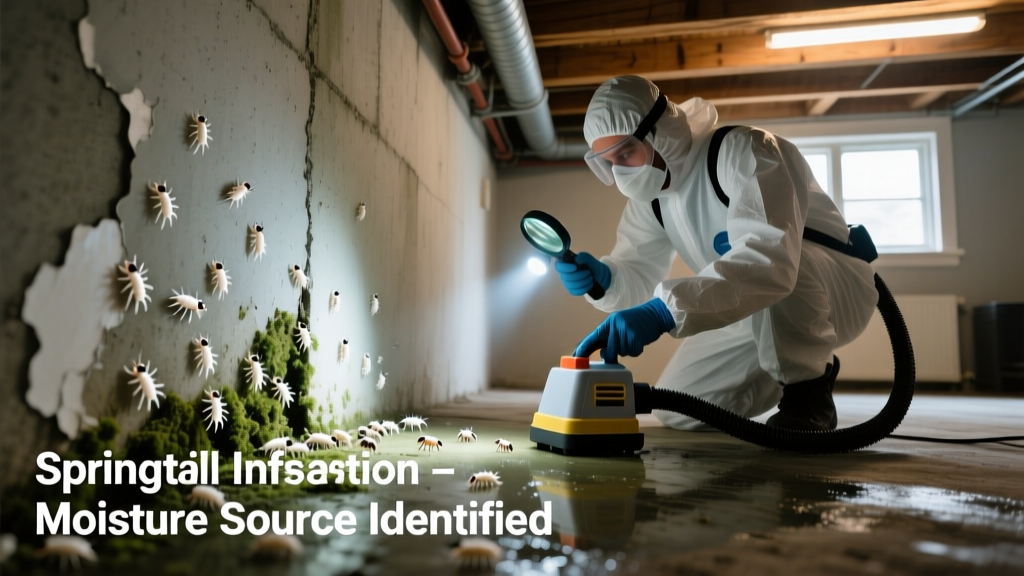
Springtails are tiny, wingless hexapods (not insects) that jump using a forked appendage called a furcula—giving them their name. Though harmless to humans and pets, their sudden appearance in clusters on damp surfaces signals serious moisture issues, often in basements, bathrooms, or around houseplants. Left unchecked, they’re a red flag for hidden leaks or mold growth.
Identification
Springtails range from 0.25 to 2 mm long—smaller than a sesame seed—and appear white, gray, brown, or bluish-black. They don’t bite or transmit disease, but their presence is unmistakable: you’ll see them darting sideways across wet tiles, condensation on windows, or the surface of overwatered potting soil. Unlike fleas or gnats, they never jump vertically and won’t land on skin.
| Pest | Size | Movement | Habitat Clue |
|---|---|---|---|
| Springtail | 0.25–2 mm | Lateral hop (10x body length) | Damp concrete, soil surface, sink edges |
| Flea | 1–3 mm | Vertical jump, bites skin | On pets, carpets, bedding |
| Fungus gnat | 3–4 mm | Weak flier, hovers near plants | Emerges from moist potting mix |
| Book louse | 1–1.5 mm | Crawls slowly, no jumping | Dry, dusty books or stored paper |
What Attracts Them
Springtails feed on decaying organic matter, fungi, algae, and bacteria—all of which thrive in high-moisture environments. They’re drawn to humidity above 75% RH, standing water, leaky pipes, poor ventilation, and overwatered indoor plants. A single houseplant with soggy soil can sustain hundreds. According to the University of Florida’s Entomology Department (2022), 87% of residential springtail reports originate in areas with documented moisture intrusion or chronic condensation.
- Basement floor drains with stagnant water
- Under-sink cabinets with slow leaks
- Exterior foundation cracks allowing groundwater seepage
- Overmulched garden beds adjacent to exterior walls
Treatment Methods
Natural Remedies
Start with desiccants and physical removal—springtails dehydrate rapidly when exposed to dry air. Diatomaceous earth (food-grade) applied as a fine dust along baseboards and under sinks disrupts their waxy cuticle. Silica gel packets placed in plant saucers absorb excess moisture and deter colonization. Vacuuming with a HEPA filter removes adults and eggs; dispose of the bag immediately outside.
Chemical Options
Only consider insecticides if natural methods fail and moisture sources are fully addressed. Pyrethrin-based sprays (e.g., MGK’s Exciter) offer short-residual contact kill—but avoid broad applications. The U.S. EPA notes that synthetic pyrethroids like bifenthrin have low mammalian toxicity but may harm beneficial soil organisms if overused outdoors (EPA Pesticide Fact Sheet, 2023). Never spray into drains or onto potted soil unless labeled for that use.
Prevention
Long-term control hinges entirely on moisture management—not pest-killing. Install a dehumidifier set to 50–55% RH in basements and crawlspaces. Repair leaking faucets within 48 hours; even a drip at 1 drop/second wastes 3,000 gallons/year (U.S. EPA WaterSense, 2022). Repot houseplants every 12–18 months using fast-draining mixes (e.g., 2 parts perlite to 1 part peat), and always empty saucers after watering.
- Use exhaust fans during and 20 minutes after showers
- Install vapor barriers in crawlspaces
- Redirect downspouts at least 5 feet from foundations
- Inspect window sills for condensation buildup weekly
When to Call an Exterminator
Most springtail issues resolve with DIY moisture fixes—but call a licensed pest professional if you’ve corrected all visible water sources for 3+ weeks and still see >20 springtails per day in one location. That suggests concealed moisture: behind walls, under flooring, or inside insulation. A certified technician can perform thermal imaging and moisture meter scans—tools most homeowners lack. For persistent cases, consider pairing a pest pro with a mold inspection service, since both organisms share root causes.
Do springtails bite or carry disease?
No. Springtails lack mouthparts capable of piercing human skin and aren’t vectors for pathogens. Their presence indicates environmental conditions that *could* support mold or dust mites—but they themselves pose zero health risk.
Can springtails live in drywall or insulation?
Not long-term—but they’ll temporarily inhabit damp drywall paper or fiberglass batts saturated by leaks. Once moisture drops below 16% wood moisture equivalent, they die or migrate. That’s why finding them behind baseboards often points to a slow leak in plumbing or roof flashing.
Why do I see them only after it rains?
Rain saturates soil and forces springtails upward through foundation cracks, utility penetrations, or weep holes. They’re not entering *because* of rain—they’re fleeing flooded microhabitats. This is especially common in homes with perimeter drainage failures.
Will sealing cracks keep them out?
Yes—but only if combined with moisture reduction. Caulking gaps around pipes and windows helps, but springtails can squeeze through openings as narrow as 0.1 mm. Focus first on eliminating interior humidity and exterior water accumulation; then seal entry points as a secondary barrier.
Are they attracted to light?
No. Springtails avoid bright light and prefer dark, humid crevices. If you see them clustered on a sunny windowsill, it’s because condensation has pooled there overnight—not because they’re phototactic.
Can I treat my potted plants without harming them?
Absolutely. Let soil dry completely between waterings—springtails die within 48 hours without surface moisture. For active infestations, drench pots with a 1:4 hydrogen peroxide:water solution (3% concentration). It kills eggs and fungi on contact and breaks down into water and oxygen. Avoid neem oil—it’s ineffective against springtails and can damage sensitive foliage. For ongoing care, try our guide on houseplant pests for safe, targeted solutions.
"Springtails are nature’s moisture meters. If you’re seeing them indoors, your home isn’t infested—it’s leaking. Fix the water, and the springtails vanish in days." — Dr. Elena Ruiz, Urban Entomologist, Purdue Extension (2021)
Springtails won’t damage your home or harm your family—but they won’t go away until the underlying dampness does. Treat them as a diagnostic tool, not a pest to eradicate. Once relative humidity stays consistently below 60%, and standing water disappears, their numbers will collapse without further intervention. For related concerns, see our guides on silverfish control and basement moisture solutions.