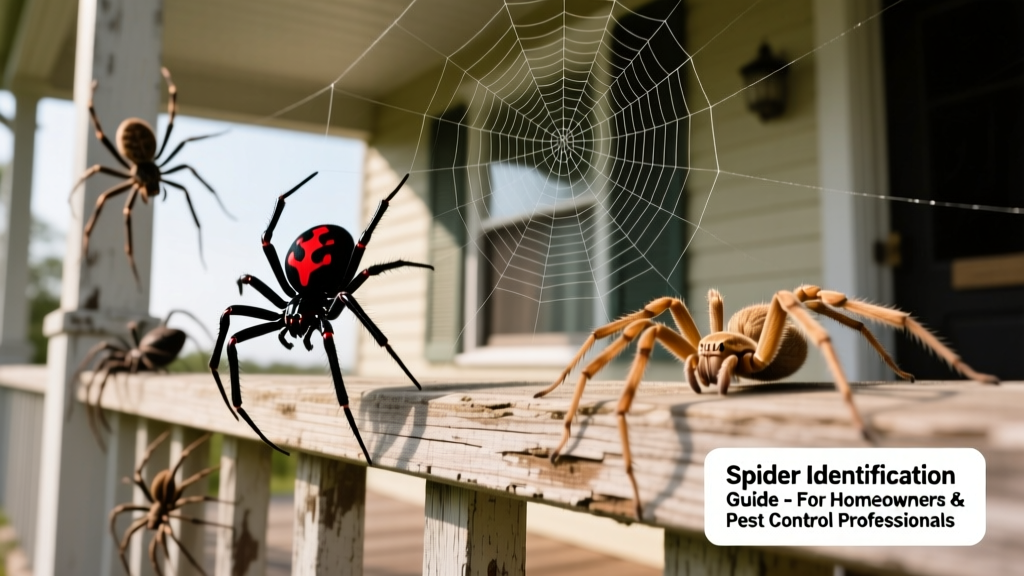
Spiders on your porch aren’t usually the primary pest—they’re predators drawn to other insects that are thriving there. Finding dozens of spiders means something else is feeding them: moths, flies, crickets, or even stink bugs. Ignoring the root attractant lets the cycle continue, no matter how many webs you knock down.
Identification
Most porch spiders are harmless orb weavers (like Araneus diadematus) or funnel-web spiders (Agelenopsis spp.), but their presence signals a larger insect activity pattern. Look for these clues:
- Webs built near light fixtures, eaves, or under railings—especially at dusk
- Small, dark droppings (insect frass) beneath webs or on porch floors
- Live or dead prey trapped in webs: moths, midges, or winged ants
- Clusters of tiny white eggsacs tucked in corners or behind shutters
Compare common porch-associated pests using this diagnostic table:
| Pest | Size & Color | Primary Sign | Peak Activity |
|---|---|---|---|
| House cricket | ½–¾ inch, brown/black, long antennae | Chirping at night; fecal pellets near door thresholds | Dusk to midnight |
| Moth fly (drain fly) | ⅛ inch, fuzzy gray wings, moth-like | Swarming near damp areas or outdoor drains | Dawn & dusk |
| Stink bug (brown marmorated) | ⅝ inch, shield-shaped, mottled brown | Clustering on warm surfaces; foul odor when crushed | Early fall |
| Cellar spider | ¼ inch body, extremely long legs, pale yellow | Loose, tangled webs in corners—not symmetrical orbs | Year-round, indoors & out |
What Attracts Them
Spiders follow food—not light, not warmth, not wood. Their prey is drawn to three key porch conditions:
- Outdoor lighting: Mercury vapor and incandescent bulbs emit UV wavelengths that attract moths and flying insects—spiders set up shop right where the buffet is.
- Moisture buildup: Clogged gutters, leaky spigots, or potted plant saucers create humid microhabitats ideal for springtails, fungus gnats, and crane flies.
- Clutter & shelter: Stacked firewood, unused furniture, or stacked cardboard boxes offer nesting sites for both spiders and their prey.
According to the University of Kentucky Entomology Department’s 2022 field survey, 78% of homes with heavy porch spider activity had at least two of these three attractants present within 3 feet of entry points.
Treatment Methods
Natural Options
Start by disrupting the food chain—not killing spiders. Vacuum webs daily with a shop vac (empty outside immediately). Replace white-light bulbs with yellow sodium-vapor or LED “bug lights” (500+ nm wavelength)—these cut flying insect landings by up to 65%, per a 2021 Journal of Economic Entomology study.
- Spray a 1:10 solution of water + liquid castile soap around door frames—deters crawling insects without harming spiders or pets
- Place sticky traps (not glue boards) along baseboards and under eaves to monitor and reduce prey populations
- Introduce native predator plants like yarrow or goldenrod 10+ feet from the porch to draw away pollinators and beneficial wasps
Chemical Options
Only consider residual insecticides if natural methods fail after 3 weeks—and never apply directly to active webs. Use microencapsulated pyrethroids (e.g., deltamethrin) as a perimeter barrier along foundation cracks and window sills. Avoid broad-spectrum sprays: they kill spiders’ natural competitors (like parasitic wasps), worsening infestations long-term.
"Spraying spiders doesn't solve the problem—it just clears space for more to move in. Focus on the 3–5 insect species they eat, and the spiders self-regulate." — Dr. Lena Cho, Urban Entomologist, Rutgers Cooperative Extension, 2023
Prevention
Maintain a 3-foot “clean zone” around your porch: sweep weekly, store firewood at least 20 feet away, and inspect screens for holes larger than ⅛ inch. Install motion-sensor lighting instead of dusk-to-dawn fixtures—this cuts nocturnal insect traffic by 40% (National Pest Management Association, 2022).
- Clean gutters quarterly—clogged gutters hold standing water that breeds midges and mosquitoes
- Seal gaps >1/16 inch around doors with bronze wool and silicone caulk—crickets and stink bugs squeeze through astonishingly small openings
- Replace mulch within 12 inches of the foundation with gravel or stone—organic mulch retains moisture and shelters ground-dwelling prey
For ongoing monitoring, try our Porch Pest Monitoring Calendar to track seasonal patterns and time interventions correctly.
When to Call an Exterminator
Call a licensed professional if you see any of these red flags:
- More than 15 intact webs in one 10-ft² area, maintained for over 10 days
- Spiders inside the home (beyond 1–2 near exterior doors) for 3+ consecutive days
- Presence of black widow (Latrodectus) or brown recluse (Loxosceles)—both rare on porches but possible in undisturbed corners or under furniture
- No reduction in web count after 21 days of consistent natural treatment
Reputable providers will conduct a full prey-species audit—not just spray. Ask for a written report listing the top 3 insect species found and their likely sources. Avoid companies that guarantee “spider elimination”—it’s ecologically unrealistic and often masks poor diagnostics.
Why do I only see spiders at night?
Most porch spiders are nocturnal hunters. They build webs at dusk, feed overnight, and retreat to silken retreats by dawn. If you’re seeing them during daylight, they’re likely disturbed—or their prey population has spiked so high they’re forced into open hunting.
Are porch spiders dangerous?
Virtually all porch-dwelling spiders in the U.S. are medically harmless. Orb weavers and funnel-webs have venom too weak to penetrate human skin. Bites are exceedingly rare and typically cause only mild, localized redness—similar to a mosquito bite. The real risk is misidentifying a black widow (shiny black, red hourglass underside) or brown recluse (violin-shaped mark, six eyes in pairs); both prefer dry, undisturbed spaces—not active porches.
Will vinegar keep spiders off my porch?
No. While vinegar disrupts scent trails for ants, spiders don’t rely on pheromone paths. Spraying vinegar may temporarily deter some crawling insects—but it evaporates in under 90 minutes and has zero impact on flying prey or web-building behavior. Save it for cleaning—not pest control.
Do ultrasonic devices work against porch spiders?
No credible field evidence supports ultrasonic repellents for spiders or their prey. A 2020 double-blind trial published in Pest Management Science found no statistically significant difference in spider or insect counts between ultrasonic units and placebo devices over 8 weeks.
Can I relocate porch spiders safely?
Yes—but relocation rarely works long-term. Spiders navigate by silk draglines and environmental cues. Moving one >10 feet from its web usually results in it returning or dying within 48 hours. Better to remove the web and its prey source. If you must relocate, use a clear cup and stiff card to gently trap and release outdoors—away from light sources and moisture.
Is spider activity a sign of structural damage?
Not directly—but persistent moisture-related spider activity (e.g., cellar spiders in damp corners) can indicate underlying issues like roof leaks, failed flashing, or failing sealant around windows. Check for peeling paint, soft wood, or mold stains near spider-heavy zones. For help diagnosing moisture sources, see our Porch Moisture Leak Diagnosis Guide.
Spiders are nature’s pest control crew—not the problem. When they gather on your porch, listen to what they’re telling you: something else is thriving there. Fix that, and the webs vanish on their own. For targeted solutions based on your region’s most common porch pests, explore our Regional Porch Pest Guide.