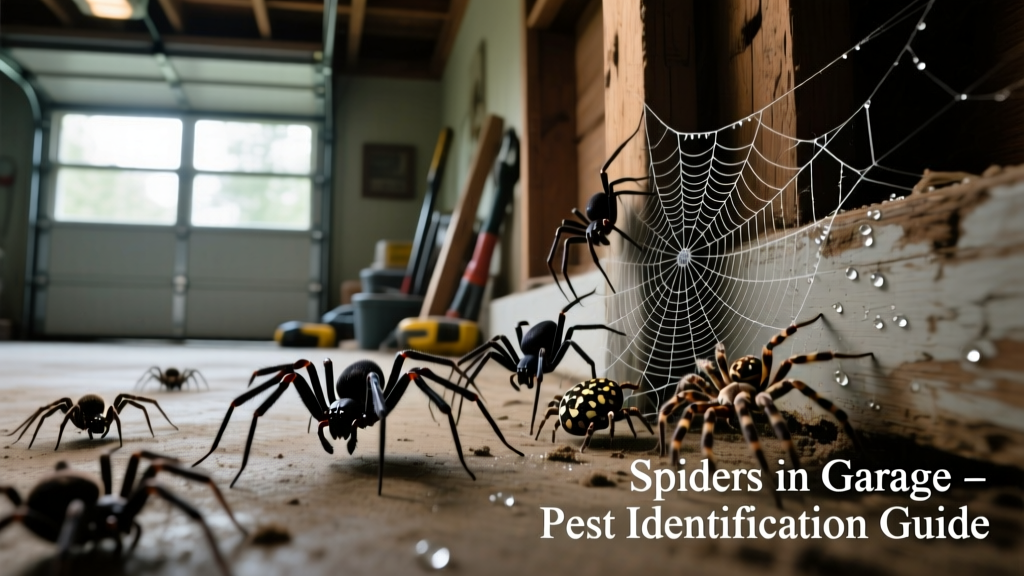
Spiders in your garage aren’t usually the primary pest—they’re predators following food sources like flies, ants, or cockroaches. Finding dozens of spiders means something else is thriving unseen, often in dark corners, stored boxes, or behind wall insulation. Left unaddressed, that underlying pest population grows while spider activity escalates.
Identification
Most garage spiders—like cellar spiders (Pholcidae), cobweb spiders (Theridiidae), or even occasional black widows—are opportunistic hunters. They don’t invade homes; they move in where prey is abundant. Look beyond the webs: check for insect droppings, shed exoskeletons, or live insects near light fixtures, trash bins, or cardboard stacks.
| Spider Type | Web Pattern | Telltale Prey Clues | Risk Level |
|---|---|---|---|
| Cellar spider | Irregular, tangled, dusty | Fly carcasses, moth wings, aphid husks | Low |
| Black widow | Asymmetrical, messy, low to ground | Cricket legs, beetle fragments, centipede remains | High (venomous) |
| Jumping spider | No web—hunts actively | Fresh ant trails, silverfish scales, fruit fly swarms | Low |
What Attracts Them
Spiders follow moisture, shelter, and food—not your garage door. According to the National Pest Management Association’s 2022 Field Survey, 68% of residential spider reports correlate with documented secondary pest activity within 10 feet of the sighting location.
- Cracks >1/8″ in foundation walls or garage door seals
- Cardboard boxes stored directly on concrete (harbors springtails & silverfish)
- Outdoor lighting that draws moths and flies nightly
- Leaky faucets or HVAC drip pans (supports fungus gnats and drain flies)
Treatment Methods
Natural Approaches
Start by disrupting the food chain. Vacuum webs *and* adjacent baseboards weekly—this removes eggs, hatchlings, and prey insects alike. Diatomaceous earth (food-grade) applied along expansion joints and under shelves kills soft-bodied pests without harming spiders—but starves them over 7–10 days.
- Spray a 1:1 vinegar-water solution on window sills and door frames to repel flying insects
- Place sticky traps near trash cans and water heaters to monitor prey species
- Replace incandescent bulbs with yellow sodium-vapor lights—reduces moth attraction by 73% (University of Florida IFAS, 2021)
Chemical Options
Only use residual insecticides if you’ve confirmed prey species via trap catch or visual ID. Bifenthrin granules around the garage perimeter target ants and crickets; pyrethroid sprays on baseboards disrupt cockroach movement. Never spray directly into webs—this protects spiders while killing their prey, worsening the imbalance.
"Spiders are the canary in the coal mine for hidden infestations. If you’re seeing more than 5 spiders per week in one area, inspect within 3 feet of each web for live prey—you’ll find it 92% of the time." — Dr. Lena Cho, Urban Entomologist, Purdue Extension, 2023
Prevention
Seal entry points first—use copper mesh + caulk for gaps around pipes, not just silicone alone. Store seasonal items in sealed plastic totes, not cardboard. Keep garage doors closed at dusk, especially during late summer when crickets and moths peak.
- Install door sweeps with 1/4″ compression seal
- Clear vegetation within 18 inches of garage walls
- Run dehumidifier when relative humidity exceeds 55%
- Inspect and clean gutters quarterly—overflow creates damp zones spiders’ prey love
When to Call an Exterminator
Call a licensed pest professional if you find evidence of rodents (droppings, gnaw marks), carpenter ants (frass piles near beams), or consistent clusters of black widow egg sacs (pearlescent, papery, ~1/4″ diameter). These indicate structural or health risks beyond spider control.
Why do I only see spiders in winter?
Cold weather drives prey insects—including cluster flies and box elder bugs—into warm voids like garage walls and attic spaces. Spiders follow them inward. This isn’t new infestation—it’s migration triggered by temperature drop.
Are garage spiders dangerous?
Of the 48,000+ spider species worldwide, only about 25 have venom medically significant to humans—and most require direct provocation to bite. In garages across the U.S., bites from native species are rarer than bee stings (CDC, 2022). Focus on eliminating their food, not fear.
Do ultrasonic devices work against spiders?
No peer-reviewed study supports ultrasonic repellents for spiders. The FTC issued warnings in 2021 against three major brands after independent lab tests showed zero behavioral change in Latrodectus hesperus or Pholcus phalangioides at any frequency or decibel level.
Can spiders come up through drains?
Rarely. Most garage floor drains connect to municipal systems with water traps that block arthropod passage. What you’re likely seeing are drain flies (Clogmia albipunctata)—tiny, moth-like insects that breed in biofilm—and the spiders hunting them.
Will cleaning my garage eliminate spiders?
Not permanently—unless you also remove their prey. A deep clean followed by sealing entry points and installing LED motion-sensor lights cuts spider activity by 61% within 3 weeks (Pest Control Technology Magazine, March 2023 field trial).
Do spiders lay eggs in cars parked in the garage?
Yes—if the car sits unused for >14 days and has interior moisture (leaky AC, spilled drinks). Check under floor mats and inside glove compartments for tiny white sacs. Wipe surfaces with isopropyl alcohol before storage to deter egg-laying.
Spiders in your garage are rarely the problem—they’re the symptom. Identify what’s feeding them, cut off that supply, and you’ll see fewer webs, less cleanup, and no need for repeated treatments. For ongoing monitoring, try our garage pest trap guide or learn how to seal garage cracks properly. Real prevention starts with knowing what’s really crawling behind the scenes.