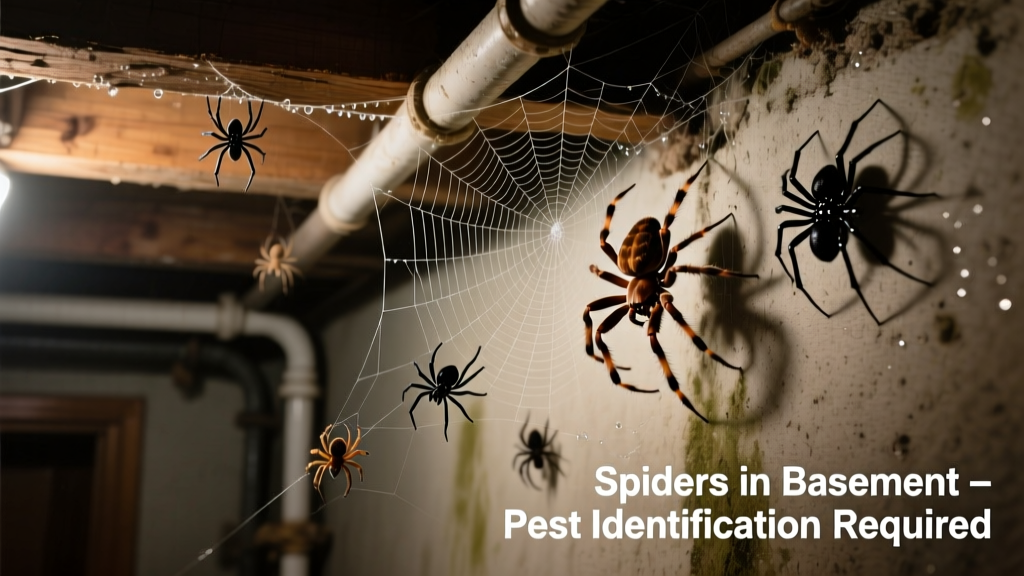
Spiders themselves are rarely the primary pest problem in basements—they’re usually a symptom. Most basement spider sightings indicate an underlying infestation of insects or other arthropods that serve as food. Identifying *what’s feeding them* is the critical first step—not just squashing webs.
Identification
Basement spiders are typically harmless but persistent. The most common species include cellar spiders (Pholcus phalangioides), cobweb spiders (Steatoda spp.), and occasionally funnel weavers (Agelenopsis spp.). These aren’t aggressive, but their presence signals something else is thriving in your damp, dim space.
Look for these signs—not just spiders, but clues pointing to their prey:
- Webs in corners, behind pipes, or under stairs (especially dusty, undisturbed ones)
- Live or dead insects near windows, sump pits, or foundation cracks
- Shed exoskeletons (e.g., cricket wings, silverfish casings) near moisture sources
- Faint musty odor combined with visible mold—often linked to high humidity attracting both prey and predators
| Spider Species | Web Type & Location | Most Likely Prey | Associated Basement Conditions |
|---|---|---|---|
| Cellar spider | Loose, tangled, vertical webs in corners or ceiling joists | Moths, flies, mosquitoes, small beetles | High humidity (>60%), poor ventilation, uncovered light fixtures |
| Cobweb spider | Irregular, sticky webs near baseboards or storage boxes | Ants, cockroaches, carpet beetles, silverfish | Cluttered storage, cardboard boxes, leaky plumbing |
| Funnel weaver | Flat, sheet-like web with retreat tunnel in concrete cracks | Cricket nymphs, springtails, pillbugs | Damp concrete floors, exterior wall cracks, standing water |
What Attracts Them
Spiders don’t seek out basements for shelter alone—they follow food. According to the National Pest Management Association’s 2022 Residential Pest Report, 78% of homes with elevated spider activity had concurrent moisture-related insect infestations.
Key attractants include:
- Relative humidity above 55%—ideal for springtails, silverfish, and fungus gnats
- Unsealed foundation cracks (≥1/8″ wide) allowing entry for crickets and ants
- Cardboard boxes stored directly on concrete—harboring booklice and psocids
- Standing water in sump pits or floor drains—breeding ground for drain flies and midges
- Old insulation with rodent nesting debris—supporting carpet beetle larvae and moths
Treatment Methods
Natural First Steps
Start by removing the food source—not the spiders. Vacuum all webs, egg sacs, and visible insects weekly using a HEPA-filter vacuum. Wipe down walls and pipes with a 50/50 vinegar-water solution to disrupt pheromone trails left by prey insects.
Deploy sticky traps near moisture sources (sump pump, laundry area, window wells) to monitor what’s actually present—not just spiders, but their prey. Replace every 7 days and log catches. If you’re catching >3 silverfish or >5 springtails per trap weekly, moisture control is urgent.
Chemical Options
Only use targeted treatments after confirming prey species. For silverfish and springtails: apply silica gel dust (e.g., CimeXa) into wall voids and behind baseboards—non-toxic to humans, lethal to soft-bodied insects within 48 hours. For ants or crickets: use non-repellent liquid insecticides like imidacloprid (Bayer Advanced Carpenter Ant & Termite Killer) applied only to crack-and-crevice entry points—not broadcast sprays.
"Spiders won’t leave until their grocery store closes. If you treat only the spider, you’ll be back in 10 days. Treat the pantry first." — Dr. Elena Ruiz, Urban Entomologist, Purdue Extension, 2023
Prevention
Sustained prevention hinges on two pillars: moisture control and structural exclusion. Install a dehumidifier set to 45–50% RH and run it year-round—even in winter, when basement air can hold surprising moisture. Seal all foundation cracks with hydraulic cement, not caulk. Replace gravel around foundations with 4″ of coarse sand to discourage moisture wicking.
Also critical: elevate stored items at least 6″ off concrete using plastic pallets, not wood or cardboard. Discard old paper-based insulation—especially if it’s been wet—even if no visible mold is present; it retains moisture and harbors psocids.
When to Call an Exterminator
Call a licensed pest professional if:
- You find >10 live crickets or >20 silverfish in one week of trapping
- There’s evidence of rodent activity (droppings, gnaw marks) alongside spider activity
- Moisture readings on concrete exceed 85% relative humidity (use a pinless moisture meter)
- Spiders reappear in the same locations within 5 days of thorough vacuuming and cleaning
Reputable providers will conduct a full pest audit—not just spray—and provide a written moisture and entry-point assessment. Avoid companies offering “spider-only” treatments; they miss the root cause.
Why do I only see spiders in winter?
Winter spider sightings usually mean their prey—like cluster flies or boxelder bugs—is overwintering in wall voids or attic spaces, then drifting down through utility chases into the basement. Check attic vents and roof soffits for gaps.
Are cellar spiders dangerous?
No. Cellar spiders have venom, but their fangs are too short to pierce human skin. They’re beneficial predators—just misdirected. Their presence means other pests are active nearby. Learn more about cellar spiders and why they’re rarely the real issue.
Do spider repellents work?
Essential oil sprays (peppermint, citrus) show zero efficacy against spiders in controlled trials (University of Nebraska-Lincoln, Urban Pest Management Review, 2021). They may briefly displace spiders—but won’t reduce populations without eliminating food sources.
Can spiders come up through floor drains?
Rarely. Most basement spiders enter via foundation cracks, gaps around pipes, or open windows. Drain flies—not spiders—are the usual drain dwellers. If you suspect drain issues, pour ½ cup of white vinegar followed by ½ cup baking soda down the drain, wait 15 minutes, then flush with boiling water. See our guide on drain flies in basement for full troubleshooting.
Why do webs reappear so fast?
Because the prey population is stable. A single female silverfish can lay 60 eggs in her lifetime—and reproduce every 3–4 weeks in warm, humid basements. Web regrowth within 48 hours means your moisture control or exclusion efforts haven’t yet disrupted the food chain.
Should I worry about brown recluse in my basement?
Extremely unlikely unless you live in the central or southern U.S. (TN, MO, KS, OK, TX). Brown recluses avoid high-traffic, well-lit areas—and basements with regular activity rarely host them. If you find a violin-shaped spider, preserve it in a vial and contact your local extension office for ID. Don’t assume it’s a recluse—99% of “recluse reports” in northern states are misidentifications of harmless Titiotus or Kukulcania species.
Spiders in your basement aren’t the problem—they’re the indicator. Fix the humidity, seal the cracks, and starve the food chain. That’s how you get lasting relief—not temporary web removal. For related help, see our guides on silverfish in basement and basement moisture control.