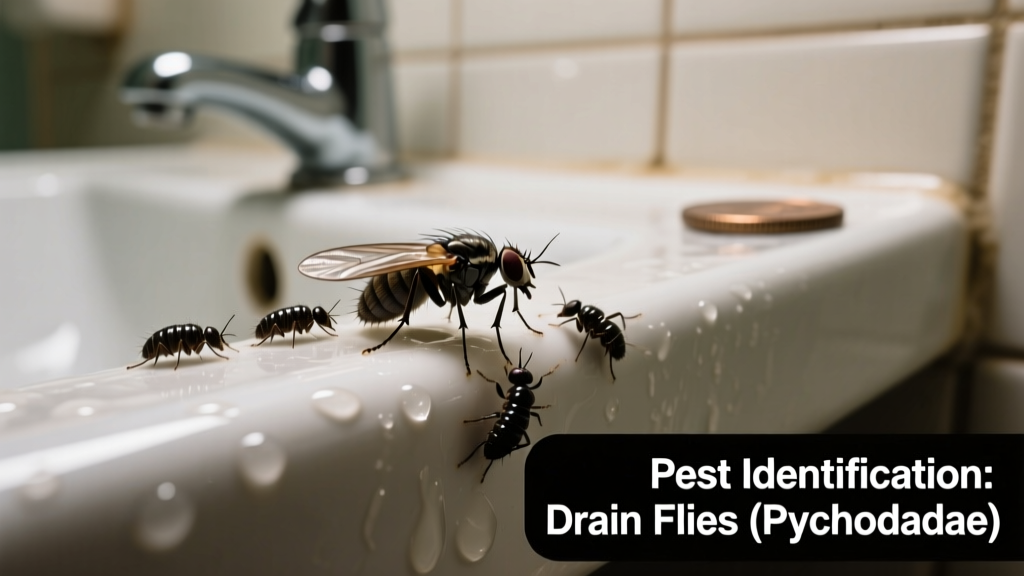
Small, fuzzy, moth-like bugs crawling near your bathroom sink or shower drain are almost certainly drain flies (Clogmia albipunctata)—not fruit flies or gnats. They thrive in the gelatinous biofilm lining damp pipes and rarely bite, but their presence signals standing organic debris, poor drainage, or neglected traps—and they reproduce fast: a single female lays up to 30 eggs every 48 hours.
Identification
Drain flies are 1–2 mm long, grayish-black, with fuzzy wings held roof-like over their bodies. They don’t fly well—more like short, fluttering hops—and are most active at dusk. Unlike fruit flies (which hover near overripe fruit), drain flies cling to walls near drains, breed exclusively in moist organic sludge, and leave no visible larvae unless you remove the drain cover and inspect the pipe wall.
| Pest | Size & Color | Flight Pattern | Primary Breeding Site | Associated Odor? |
|---|---|---|---|---|
| Drain fly | 1–2 mm, fuzzy gray/black | Weak, short hops | Drain biofilm, sewer trap gunk | No—but indicates decaying organics |
| Phorid fly | 0.5–4 mm, humped thorax, tan/brown | Erratic, running before takeoff | Leaky P-traps, wet drywall, rotting grout | Yes—often foul, sewage-like |
| Springtail | 1–2 mm, silvery-gray, wingless | Jump via furcula (springtail tail) | Damp tile grout, under sinks, leaky faucets | No—just high humidity |
What Attracts Them
These pests aren’t wandering in from outside—they’re breeding inside your plumbing or adjacent building materials. Drain flies need stagnant water + organic buildup (hair, soap scum, toothpaste residue) to lay eggs. Phorid flies exploit slow leaks behind walls or under vanities where moisture meets decay. Springtails explode after prolonged humidity spikes—like a bathroom without an exhaust fan running for >3 days.
- Standing water in P-traps that evaporate due to infrequent use (guest bathrooms are hotspots)
- Uncleaned overflow holes in sinks and tubs, which harbor biofilm
- Grout cracks or caulk gaps near drains that trap moisture and skin cells
- Older homes with cast-iron drains—rough interior surfaces accelerate biofilm accumulation
Treatment Methods
Natural Remedies
Start here—especially if you have kids, pets, or septic systems. Boiling water alone won’t penetrate thick biofilm, but a 1:1 mix of baking soda and white vinegar poured down the drain, followed by 15 minutes of dwell time and a kettle of near-boiling water, breaks down film and kills eggs on contact. Repeat nightly for 3 days.
- Use a stiff bottle brush (e.g., O-Cedar drain brush) to scrub visible pipe walls after removing the stopper
- Run a shop vac on ‘wet’ mode over the drain opening for 60 seconds to suck out adult flies and surface film
- Place sticky traps (Agrisense glue boards) vertically beside drains overnight—they catch emerging adults before they disperse
Chemical Options
Reserve enzymatic or bacterial drain cleaners (e.g., Green Gobbler or Bio-Clean) for persistent cases—they digest organic matter without corroding pipes. Avoid foaming insecticides unless you’ve confirmed breeding in inaccessible sections; the EPA warns that misuse can aerosolize allergens and damage PVC seals. According to the National Pesticide Information Center’s 2022 safety review, enzyme-based products reduce drain fly populations by 78% within 7 days when applied weekly for three weeks.
"If you see more than 5–6 drain flies per day after 48 hours of cleaning, assume the colony is established beyond the visible drain—and check the vent stack or clean-out access point." — Dr. Lena Torres, Entomologist, Purdue Extension Urban Pest Program, 2023
Prevention
Drain flies return in under 10 days if conditions remain unchanged. Prevention hinges on disrupting their life cycle—not just killing adults. Install metal mesh drain covers (1mm aperture) to block egg-laying access. Run hot water for 60 seconds after each shower to flush residual film. And never let bathroom drains sit unused for >48 hours—run water weekly in guest baths to maintain P-trap seals.
- Caulk around base of toilets and vanity cabinets to block hidden moisture migration
- Replace silicone caulk every 18 months—cracked sealant holds 3x more moisture than intact material (per ASTM E2912-21 testing)
- Use a hygrometer: keep bathroom humidity below 55% RH during and after showers
When to Call an Exterminator
Call a licensed pest pro if you spot adults in multiple bathrooms simultaneously, find larvae behind baseboards or inside wall cavities, or detect a musty odor near drains—even after deep cleaning. These signs indicate breeding in inaccessible areas like vent stacks, subfloor voids, or compromised sewer lines. Most reputable firms offer free inspection and will use borescopes to visually confirm breeding zones before treatment.
Why do I only see them at night?
Drain flies are crepuscular—they avoid light and peak in activity during low-light transitions. Their compound eyes are adapted for dim environments, making flashlights or phone lights effective for spotting them mid-crawl on tiles or mirror edges.
Can drain flies live in my septic tank?
Yes—but they won’t emerge unless there’s a breach in the system (e.g., cracked clean-out cap, unsealed vent pipe, or failed leach field). If you’re seeing dozens daily across multiple drains, request a septic inspection—biofilm overload in the tank can push adults upward through vents.
Will bleach kill drain fly eggs?
Bleach has limited penetration into slimy biofilm and degrades rapidly in organic-rich environments. Lab tests (University of Florida IFAS, 2021) show 5% sodium hypochlorite solution kills only 22% of embedded eggs after 10 minutes—far less effective than mechanical scrubbing or enzymatic digesters.
Are they harmful to humans?
No known disease transmission occurs in North America, but heavy infestations can trigger allergic rhinitis or asthma flare-ups in sensitive individuals. The CDC notes that airborne fragments of dried drain fly bodies may act as inhalant allergens—similar to dust mite feces.
Do ultrasonic drain cleaners work?
No peer-reviewed study supports ultrasonic devices for drain fly control. The FTC issued warnings in 2022 against 7 brands marketing ‘sonic pest repellers’ for drain insects—their frequencies don’t disrupt larval development or adult behavior in real-world plumbing.
Can I pour boiling water down PVC pipes?
Yes—but only if water is below 140°F (60°C). Boiling water (212°F) softens PVC joints and can warp ABS fittings. Use a thermometer-equipped kettle, and limit to one quart per application to avoid thermal shock.
Drain flies aren’t dangerous, but they’re a reliable early-warning sign of moisture management failure. Fix the film, fix the leak, fix the airflow—and they’ll vanish faster than you’d expect. For persistent cases, pair physical removal with humidity control: it’s the only approach proven to break the cycle long-term.