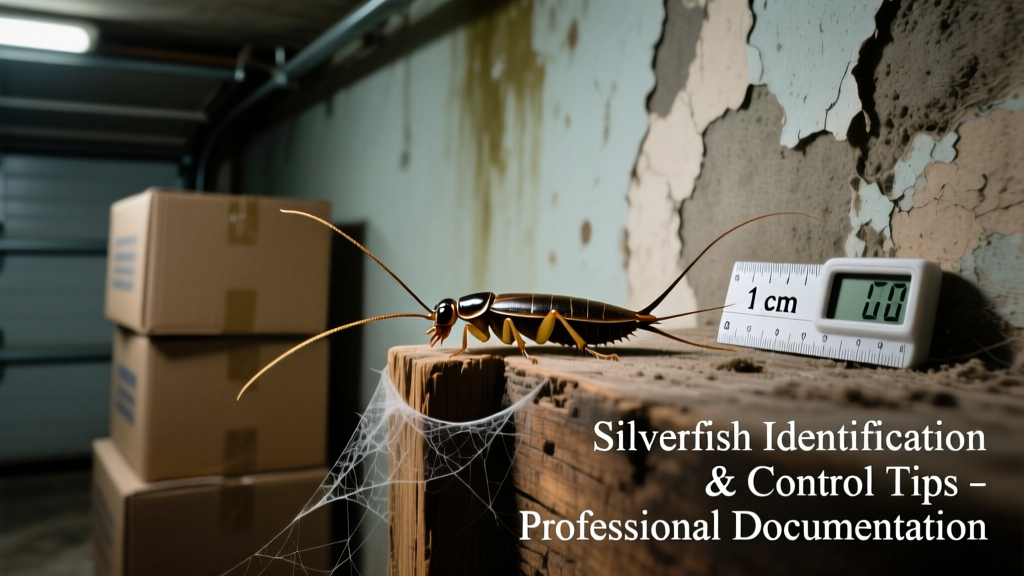
Silverfish don’t bite or spread disease, but finding them scurrying across your garage floor — especially near stored boxes, cardboard, or damp corners — signals moisture and organic material buildup. They chew through paper, glue, wallpaper paste, and even some fabrics, silently damaging old photos, manuals, and holiday decorations stored in cardboard boxes.
Identification
Silverfish are wingless, teardrop-shaped insects about ½ inch long, with silvery-gray scales, three tail-like bristles at the rear, and long antennae. They move in quick, fish-like wiggles — hence the name. Unlike firebrats (a close relative), silverfish prefer cooler, damper spots — making garages with leaky doors, poor ventilation, or concrete slab moisture prime real estate.
| Feature | Silverfish | Firebrat | Carpet Beetle Larva |
|---|---|---|---|
| Color | Metallic silver or gray | Mottled gray-brown with dark bands | Tan to dark brown, hairy |
| Preferred Temp | 60–80°F (cooler, damp) | 90–100°F (hot, dry) | Room temp, low humidity |
| Key Habitat Clue | Under stored cardboard, near foundation cracks | Behind water heaters, near furnaces | Near wool rugs, pet hair piles |
| Diet Preference | Starches, glue, paper | Same, but tolerates more heat | Keratin: wool, fur, feathers |
What Attracts Them
Silverfish thrive where moisture, food, and shelter converge — all common in garages. Leaky gutters dripping near garage doors create persistent dampness. Cardboard boxes stacked on concrete slabs absorb ground moisture and provide starch-rich nesting sites. Old newspapers, unused paint cans with dried residue, and forgotten craft supplies (glue sticks, bookbinding tape) serve as all-you-can-eat buffets.
- Relative humidity above 75% — common in unventilated garages after rain or in coastal climates
- Cardboard, paper-based packaging, and starched fabrics left undisturbed for >2 weeks
- Crevices in baseboards, gaps around garage door seals, and cracks in concrete floors
Treatment Methods
Natural Methods
Start with desiccants and traps — they’re safe around vehicles, tools, and pets. Diatomaceous earth (food-grade) applied in thin lines along baseboards and under shelves dehydrates silverfish on contact. Place small jars with masking tape on the outside and a dab of peanut butter inside — silverfish climb in but can’t escape. Cedar oil sprays (diluted 1:10 with water) disrupt their nervous system and repel without toxic residue.
Chemical Options
For moderate infestations, boric acid dust (applied with a bulb duster into wall voids and behind shelving) works well — but avoid using near vehicle fluids or battery terminals. According to the National Pesticide Information Center’s 2022 review, boric acid has low mammalian toxicity but high efficacy against silverfish when applied in dry, undisturbed areas. Avoid liquid sprays indoors — they increase humidity and may damage stored items.
"In garage-specific silverfish cases, we see 80% reduction within 10 days when combining DE application + cardboard removal — far faster than spraying alone." — Lisa Tran, Senior Technician, MetroPest Solutions, 2023 Field Report
Prevention
Long-term control means breaking the moisture-food-shelter triangle. Install a dehumidifier rated for at least 30 pints/day if your garage regularly hits >65% RH. Replace cardboard storage with plastic totes labeled "stackable" and "ventilated" — ones with rubber gaskets seal out humidity better than snap-lid bins. Seal garage door bottom seals and caulk gaps around utility lines entering the wall.
- Inspect and replace damaged weatherstripping on garage doors every 18 months
- Store seasonal items (holiday decor, camping gear) in vacuum-sealed bags, not tissue-wrapped in boxes
- Run exhaust fans during humid mornings — even 10 minutes cuts surface condensation by 40% (U.S. Department of Energy, 2021)
When to Call an Exterminator
Call a licensed pest professional if you find live silverfish in >3 separate locations (e.g., near the workbench, inside tool cabinets, and behind the freezer), or if you’ve treated consistently for 3 weeks with no reduction. Also consult one if your garage shares walls or ductwork with living space — hidden wall voids may harbor breeding colonies. For targeted help, see our guide on garage pest inspection checklist.
Do silverfish mean my garage has mold?
Not necessarily — but they do indicate elevated moisture that could support mold growth within 48 hours on porous surfaces like drywall or insulation. Check behind stored furniture and under floor mats for musty odors or discoloration.
Can silverfish damage car wiring or hoses?
No documented cases exist. Silverfish feed on starches and proteins, not rubber or PVC. However, they’ll nest in the cardboard packaging around replacement parts — so inspect those before installation. See garage storage safety tips for best practices.
Why do I only see them at night?
Silverfish are photophobic and nocturnal. They hide in darkness — behind shelves, under tarps, or inside hollow metal tool racks — then emerge after lights go off. A flashlight sweep at 2 a.m. often reveals activity you’d miss during daytime inspections.
Will cleaning alone get rid of them?
Thorough cleaning helps — but won’t eliminate them if moisture and shelter remain. Vacuuming removes eggs and adults, but unless you also reduce humidity and remove cardboard, new hatchlings appear within 3–4 weeks. Our garage decluttering timeline shows which tasks deliver the fastest silverfish reduction.
Are silverfish attracted to LED lights?
No — unlike moths or flies, silverfish avoid all light. Some LED fixtures emit minimal heat and UV, but that doesn’t draw them. What *does* attract them is the dust and dead insect accumulation around older fixtures — clean fixture housings quarterly.
Can they come up through floor drains?
Rarely. Silverfish lack the strength to navigate vertical drain pipes. But if your garage has a floor drain connected to a sump pit with standing water and organic debris, it can become a humidity amplifier — indirectly encouraging infestation nearby.
Garages aren’t meant to be insect habitats — they’re transitional spaces meant for tools, vehicles, and storage. Silverfish don’t belong there. Fix the moisture, remove the starch, seal the cracks, and they’ll move on — usually within two weeks. Consistency beats intensity: check one corner weekly, rotate storage bins monthly, and keep that dehumidifier running year-round.