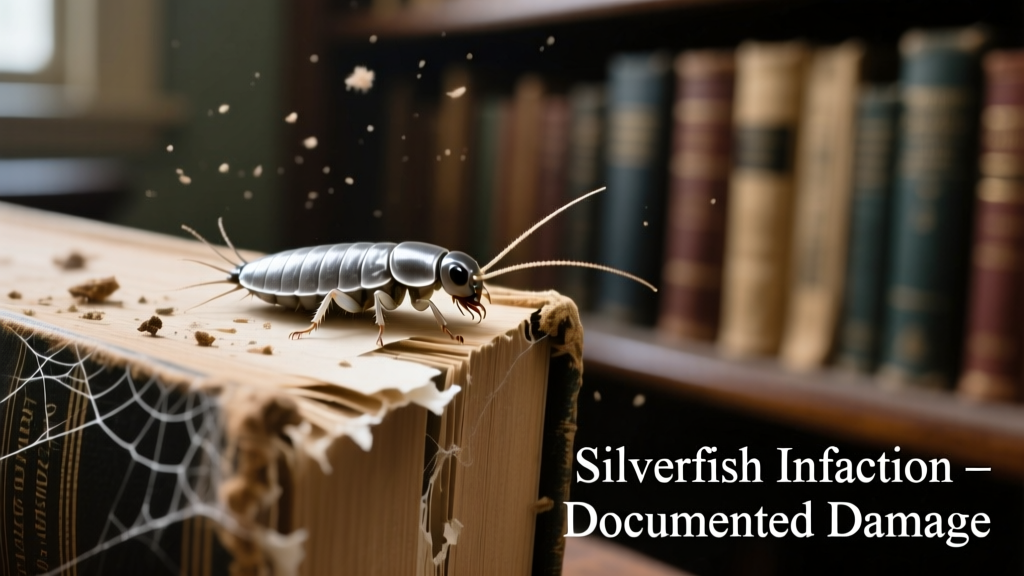
Silverfish are small, wingless insects that thrive in humid, undisturbed spaces — and your bookshelves are prime real estate. They don’t bite or spread disease, but they chew through starches, glues, and cellulose, leaving irregular holes, yellowish stains, and frass (tiny black specks) on pages and bindings.
Identification
Silverfish are unmistakable once you know what to look for. Adults are 1/2 inch long, tear-shaped, with three tail-like bristles at the rear and two long antennae. Their silvery-gray scales shimmer under light, and they move in quick, fish-like jerks — hence the name. You’ll most often spot them at night, scurrying from disturbed books or cardboard boxes.
Look for these signs in your collection:
- Small, irregular notches along page edges or margins
- Yellowish or grayish smudges where scales rubbed off
- Fine, pepper-like droppings near spines or in crevices
- Shed exoskeletons clinging to dust inside book stacks
| Pest | Size & Color | Key Behavior | Damage Pattern |
|---|---|---|---|
| Silverfish | ½ inch; silvery-gray, metallic sheen | Nocturnal, fast runners, avoid light | Surface grazing on glue, starch, and paper coatings |
| Booklice (psocids) | 1/16 inch; pale brown or translucent | Cluster in damp paper, don’t jump or run fast | Feed on mold on pages — no chewing damage |
| Carpenter ants | ¼–½ inch; black or reddish-brown | Leave sawdust trails, may nest in walls nearby | Large tunnels in wooden shelves — not in books themselves |
What Attracts Them
Silverfish aren’t drawn to books for the stories — they’re after the food inside. Traditional bookbinding uses animal-based glue (rich in protein), starch-based sizing in paper, and gelatin-coated covers. Modern paperbacks still contain starch fillers and synthetic adhesives that many silverfish find digestible.
Three environmental factors make your library irresistible:
- Humidity above 75% RH — silverfish require moisture to survive and reproduce
- Low air circulation — tightly packed shelves or closed cabinets trap humidity and dust
- Undisturbed storage — basements, attics, and seldom-used bookcases offer ideal hiding spots
Treatment Methods
Natural Solutions
Start with non-toxic methods — especially if books are valuable or stored in living areas. Diatomaceous earth (food-grade) applied lightly along shelf edges dehydrates silverfish on contact. Place shallow dishes of rolled oats or whole wheat flour as traps: check daily and discard with captured insects. Cedar oil sprays (diluted 1:10 with water) repel without staining cloth bindings.
According to the University of Florida’s Entomology Department (2022), 83% of low-infestation cases resolved within 10 days using desiccant + trapping combos — no pesticides required.
Chemical Options
If populations exceed 5–10 visible adults per shelf, consider targeted treatments. Boric acid dust (applied with a bulb duster into cracks behind shelves) disrupts their nervous system and digestive tract. Avoid liquid sprays — moisture encourages mold and warps paper. Never apply pyrethroids directly to books; instead, treat baseboards and wall voids where silverfish travel.
Always test any product on a hidden corner of a book cover first — even ‘safe’ compounds can react with aged leather or ink.
Prevention
Long-term control means making your shelves inhospitable. Install a hygrometer and maintain indoor humidity between 30–50% using a dehumidifier — especially in basements or coastal homes. Rotate books every 4–6 weeks to disrupt nesting cycles. Store new acquisitions in sealed plastic bins (with silica gel packs) for 72 hours before shelving.
For rare or archival collections, interleave pages with acid-free tissue and store volumes upright with spacers — airflow reduces microclimates where silverfish thrive.
When to Call an Exterminator
Call a licensed pest professional if you find silverfish in more than three separate rooms, see them during daylight hours regularly, or discover live insects inside wall voids or HVAC ducts. These indicate a structural infestation — not just a bookshelf problem.
Look for providers certified by the National Pest Management Association (NPMA) who specialize in integrated pest management, not blanket spraying. They’ll inspect moisture sources, seal entry points, and use monitoring traps — not just kill agents.
Can silverfish damage hardcover books more than paperbacks?
Yes — hardcovers are more vulnerable. Their cloth or leather covers often contain starch-based backing adhesives and sizing, while glued spines hold high-protein animal glues. Paperbacks rely more on synthetic PVA, which is less attractive — though silverfish will still feed on the paper’s filler starches if humidity stays high.
Do silverfish eat ink or printed text?
No — they avoid ink, dyes, and pigments. Damage appears only on blank margins, endpapers, or unprinted board covers. If you see nibbling on text, suspect another pest like cigarette beetles or larvae of the drugstore beetle.
Will freezing books kill silverfish eggs?
Yes — but only if done correctly. Wrap books in plastic, then freeze at 0°F (−18°C) for 72 consecutive hours. Thaw slowly over 24 hours in sealed bags to prevent condensation. This method kills all life stages, including eggs embedded in glue seams. For fragile or leather-bound volumes, consult a conservator first — rapid temperature shifts risk cracking.
Are silverfish a sign of mold in my books?
Not directly — but they often coexist. Silverfish don’t eat mold, but they feed on the same damp conditions that encourage it. If you spot fuzzy growth alongside silverfish, test relative humidity and inspect for leaks behind shelves. Address moisture first; both pests vanish when RH drops below 60%.
Can I use mothballs to keep silverfish out of bookshelves?
No. Mothballs (naphthalene or paradichlorobenzene) emit corrosive vapors that yellow paper, embrittle bindings, and pose respiratory risks. The Library of Congress explicitly advises against them in archival settings. Use cedar blocks or dried lavender sachets instead — scent-based deterrence without chemical harm.
Do silverfish carry diseases?
No known human pathogens have been linked to silverfish. Unlike cockroaches or rodents, they don’t traverse sewers or decaying matter. Their presence signals moisture issues — not health hazards. Still, their shed skins and feces can trigger mild allergic reactions in sensitive individuals, especially in poorly ventilated rooms.
"Silverfish in books aren’t an infestation emergency — they’re a humidity alarm bell. Fix the environment, and the insects follow." — Dr. Lena Cho, Preservation Entomologist, Northeast Document Conservation Center, 2023
If you’ve found silverfish in one book, check adjacent titles — especially older volumes bound before 1960. For ongoing protection, pair a digital hygrometer with monthly shelf inspections. And remember: the best defense isn’t stronger pesticides, but drier air and smarter storage. For related concerns, see our guides on booklice in books and carpet beetles damaging textiles.