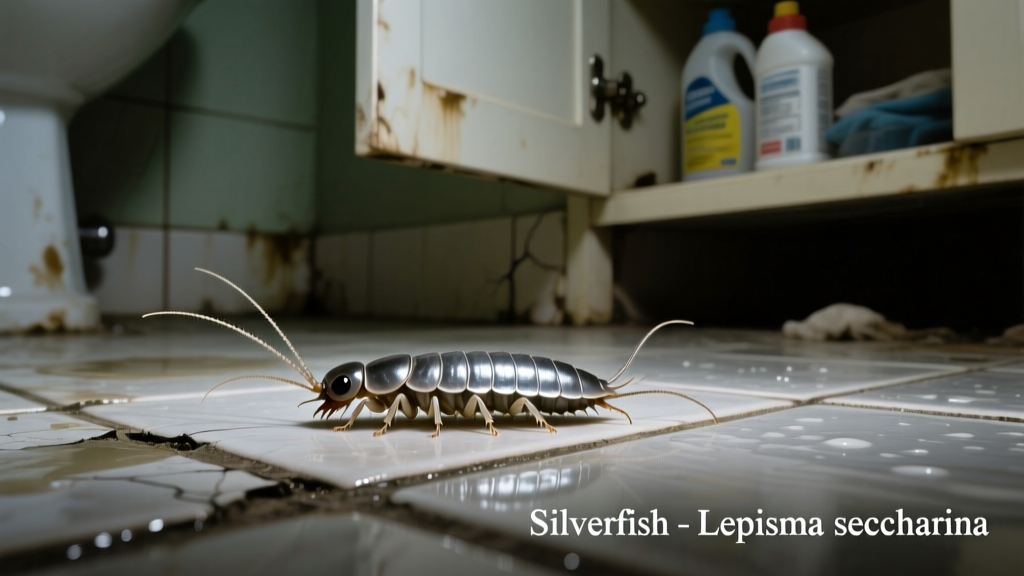
Silverfish are ancient, wingless insects that thrive where moisture and starchy materials converge—making your bathroom a prime target. They don’t bite or spread disease, but their presence signals high humidity, hidden mold, or deteriorating paper-based materials like drywall tape or shampoo labels.
Identification
Silverfish are small (½–1 inch), tear-shaped, and covered in silvery-gray, metallic scales that shimmer under light. They move in quick, fish-like wiggles—hence the name. You’ll spot them at night near sinks, tubs, or inside cabinets, especially after turning on lights suddenly.
- Three long tail-like appendages (two cerci + one filament) at the rear
- No wings; six legs; antennae longer than body
- Leave behind tiny black pepper-like feces or irregular notches on book edges, wallpaper glue, or cardboard boxes
| Pest | Size & Color | Key Distinguishing Feature | Typical Location |
|---|---|---|---|
| Silverfish | ½–1 inch; silvery-gray | Fish-like motion; three tail filaments | Bathroom cabinets, shower grout lines, under sinks |
| Firebrats | Similar size; mottled gray-brown | Prefer temps >85°F; often near water heaters or furnaces | Basement utility rooms, laundry rooms |
| Booklice | 1/16 inch; pale yellow/brown | Only 6 legs; no tail filaments; feed on mold spores | Damp books, window sills with condensation |
| Carpet beetles | ⅛ inch; black/white/orange patterns | Rounder body; hard shell; fly as adults | Closets, rugs, pet bedding |
What Attracts Them
Silverfish aren’t wandering in randomly—they’re responding to measurable environmental cues. According to the National Pest Management Association’s 2022 Urban Pest Survey, 68% of confirmed silverfish infestations occurred in bathrooms with relative humidity above 75% and visible water damage.
- Relative humidity consistently above 60% (bathrooms often hit 80–90% post-shower)
- Starchy residues: shampoo labels, toothpaste tubes, soap scum, wallpaper paste
- Dark, undisturbed crevices: behind baseboards, under loose tiles, inside vanity plumbing access panels
- Older homes with plaster walls or paper-faced drywall (they eat the glue binding paper layers)
Treatment Methods
Natural Solutions
Start here—especially if you have kids, pets, or prefer low-toxicity options. Diatomaceous earth (food-grade) is highly effective when applied as a fine dust along baseboards and behind toilets. It dehydrates silverfish on contact, with zero residual fumes.
- Boric acid gel bait placed in corners (not accessible to children/pets)
- Small jars with masking tape-lined interiors + mashed banana or oatmeal lure—silverfish climb in but can’t escape
- Essential oil sprays (cinnamon + clove oil in 1:10 dilution with water) disrupt pheromone trails when misted weekly in damp zones
Chemical Options
Residual insecticide sprays containing deltamethrin or lambda-cyhalothrin work best when applied precisely—not broadly. The U.S. EPA notes that overuse of pyrethroid sprays indoors contributes to resistance development in silverfish populations (EPA Pesticide Fact Sheet, 2023). Always follow label instructions and ventilate thoroughly.
- Apply only to cracks, behind fixtures, and inside cabinet voids—not open surfaces
- Avoid foggers: they disperse product inefficiently and rarely reach silverfish hiding spots
- Repeat treatment every 10–14 days for three cycles to catch newly hatched nymphs
Prevention
Eliminating silverfish requires fixing the conditions—not just killing individuals. A 2021 study in the Journal of Economic Entomology found that reducing bathroom humidity below 55% for 72+ consecutive hours halted silverfish reproduction entirely.
- Run exhaust fans for 20 minutes post-shower—and clean fan grilles monthly to maintain airflow
- Fix leaky faucets immediately; even a slow drip adds ~3 gallons of moisture per day to your space
- Replace paper-based caulk around tubs with silicone caulk (silverfish can’t digest silicone)
- Store toiletries in sealed plastic bins—not cardboard boxes or paper-wrapped soaps
"Silverfish are moisture canaries—if they’re thriving in your bathroom, your ventilation system isn’t keeping up. Treat the symptom (bugs) and the cause (humidity) simultaneously, or you’ll be back in 3 weeks." — Dr. Lena Cho, Urban Entomologist, Purdue Extension (2022)
When to Call an Exterminator
Call a licensed pest professional if you see more than 5 silverfish in a single week—or if you find them in multiple rooms beyond the bathroom. That usually means breeding populations exist in wall voids or under flooring, which require specialized inspection tools like borescopes and targeted dusting equipment.
- Infestation persists after 3 weeks of consistent DIY treatment
- You spot silverfish during daylight in open areas (not just at night near moisture sources)
- There’s visible water staining, peeling paint, or soft drywall—indicating structural moisture issues
Do silverfish mean my home has mold?
Not necessarily—but they strongly prefer environments where mold grows. Their primary food source is polysaccharides found in mold, starches, and cellulose. If you’re seeing silverfish alongside musty odors or discolored grout, test for mold in bathroom with a certified inspector.
Can silverfish damage my home?
Yes—slowly. They feed on the adhesive in drywall tape, book bindings, and wallpaper paste. Over months or years, this weakens structural integrity in older homes. In one documented case in Portland (2020), silverfish activity contributed to ceiling collapse in a 1920s apartment due to degraded plaster lath adhesion.
Why do I only see them at night?
Silverfish are photophobic and avoid light. Their compound eyes are adapted for low-light navigation, and bright light triggers rapid retreat into cracks. Use a flashlight with red filter film to observe them without startling them away.
Are silverfish dangerous to pets or kids?
No. They don’t bite, sting, or transmit pathogens. However, their presence may indicate elevated allergens—like mold spores or dust mites—that trigger respiratory symptoms in sensitive individuals.
Will bleach kill silverfish?
Bleach may kill individuals on contact, but it evaporates too quickly to act as a repellent or residual barrier. More importantly, bleach reacts dangerously with ammonia-based cleaners sometimes used in bathrooms—and does nothing to reduce the humidity or food sources they need.
How fast do silverfish reproduce?
Females lay 1–3 eggs per day in cracks, up to 200 total in their 2–8 year lifespan. Eggs hatch in 2–8 weeks depending on temperature and humidity. Nymphs mature in 3–4 months and begin breeding immediately—so early detection matters.
Fixing the moisture problem is the most reliable long-term solution—not chasing individual bugs. Pair mechanical fixes (exhaust fans, dehumidifiers) with targeted treatments, and monitor with sticky traps near drains and cabinets. For persistent cases, consider upgrading to a bathroom ventilation upgrade with humidity-sensing controls—it pays for itself in reduced pest pressure and mold remediation costs within 18 months.