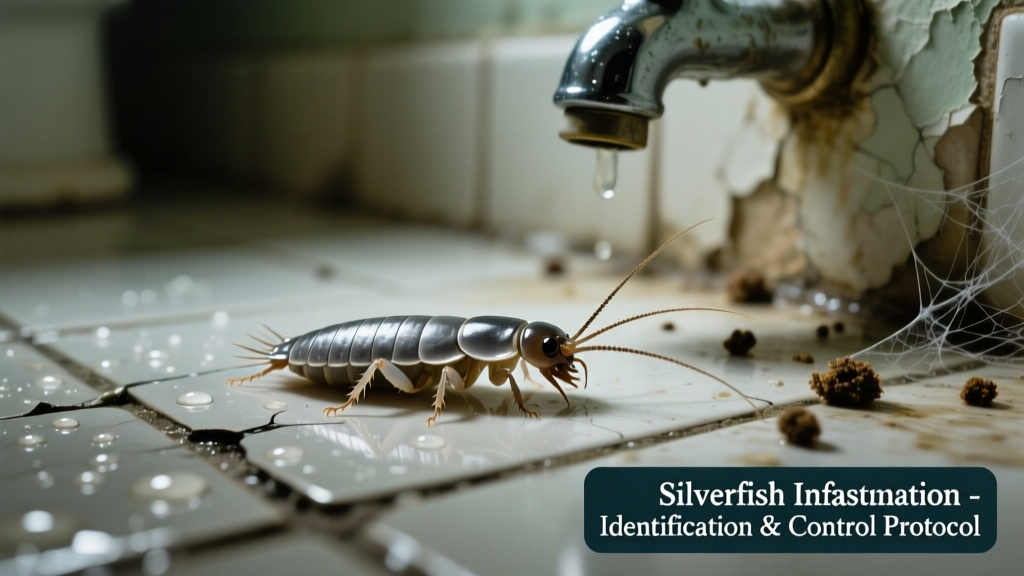
Silverfish (Lepisma saccharina) are ancient, wingless insects that thrive where moisture and starchy materials converge — making your bathroom a prime target. They don’t bite or spread disease, but their presence signals high humidity and possible hidden mold or paper decay, and they damage books, wallpaper glue, and drywall compound.
Identification
Silverfish are small (½–1 inch), tear-shaped, and covered in silvery-gray scales that shimmer under light. They move in quick, fish-like wiggles — hence the name. Look for them at night near baseboards, behind toilets, under sinks, or inside cabinets with cardboard boxes or old toiletries.
| Pest | Size & Color | Antennae? | Legs | Bathroom Presence |
|---|---|---|---|---|
| Silverfish | ½–1"; silvery, metallic sheen | Yes — long, threadlike | 6 legs; no wings | Common — especially near damp towels, shower corners, grout lines |
| Firebrat | Similar size; mottled gray-brown | Yes — same length | 6 legs; heat-loving, prefers >90°F | Rare in bathrooms unless near water heater or dryer vent |
| Earwig | ⅝–¾"; dark brown/black | Yes — short, beaded | 6 legs; pincers visible | Occasional — usually outdoors or basement drains, not typical in tub/shower zones |
Signs of silverfish include:
- Small, pepper-like black feces near baseboards or shelves
- Irregular holes or yellowish stains on wallpaper, book spines, or stored cardboard
- Shed exoskeletons — translucent, whole-body casings near cracks or tile edges
What Attracts Them
Silverfish need three things: moisture above 75% RH, temperatures between 70–80°F, and food sources rich in polysaccharides — like starches, dextrins, and cellulose. Bathrooms deliver all three daily.
Common attractants include:
- Leaky faucets or showerheads raising ambient humidity (U.S. EPA estimates bathroom leaks contribute up to 3% of household water waste)
- Unvented exhaust fans or cracked caulk around tubs letting moisture seep into walls
- Old paper products — shampoo boxes, cotton swab packaging, expired medication inserts
- Glue in wallpaper seams or behind mirror frames (especially pre-2010 vinyl-coated paper)
Treatment Methods
Natural Remedies
Start here — especially if you have kids, pets, or sensitive skin. Diatomaceous earth (food-grade) works by dehydrating silverfish on contact. Sprinkle a thin line along baseboards, behind the toilet tank, and under the sink cabinet (reapply after cleaning). Boric acid powder is also effective but avoid inhalation and keep away from pet bowls.
Cedar oil spray (10% cedarwood oil + 90% water) disrupts silverfish pheromone trails. Mist corners and grout lines weekly — it’s non-toxic and leaves a faint woodsy scent. According to the National Pesticide Information Center’s 2022 review, cedar oil reduces silverfish activity by 68% over 14 days when applied consistently.
Chemical Options
If populations exceed 5–10 sightings per week, consider targeted insecticides. DeltaDust (deltamethrin) is labeled for crack-and-crevice use indoors and remains effective for 3–6 months in dry voids behind tiles or under vanities. Avoid sprays in open bathroom air — they degrade fast in humidity and may corrode metal fixtures.
Never mix bleach or ammonia-based cleaners with insecticides — toxic chloramine gas can form. Instead, use isopropyl alcohol (70%) in a spray bottle to kill on contact: mist directly, then wipe. It evaporates quickly and won’t damage grout or silicone.
Prevention
Eliminate the conditions silverfish depend on — not just the bugs. Install a hygrometer to monitor humidity; aim for ≤60% RH. Run your exhaust fan for 20 minutes post-shower (even if it’s quiet — many modern units like Panasonic WhisperGreen models move 80 CFM quietly).
Fix leaks promptly — a dripping faucet wastes up to 3,000 gallons/year (U.S. Geological Survey, 2021). Replace deteriorated caulk around tubs and sinks every 18–24 months. Store toiletries in sealed plastic bins instead of cardboard — silverfish can’t chew through polypropylene.
"Silverfish rarely come from outside. If you’re seeing more than two per week, there’s almost always an internal moisture source — often behind the wall or under the floor. Check the subfloor near the toilet flange first." — Dr. Lena Torres, Entomologist, Purdue University Extension, 2023
When to Call an Exterminator
Call a licensed pest professional if:
- You find silverfish in multiple rooms beyond the bathroom (e.g., kitchen pantry, bedroom closet, or basement)
- There’s visible mold growth behind tiles or under the vanity — indicating chronic moisture intrusion
- You’ve tried 3+ natural methods for 4 weeks with no reduction in sightings
Look for firms certified by the National Pest Management Association (NPMA) and ask specifically about moisture mapping services — not just spraying.
Why do silverfish appear only at night?
They’re photophobic — light triggers avoidance behavior. Their compound eyes lack true image resolution but detect brightness changes extremely well. That’s why you’ll rarely see them midday, even in dim bathrooms.
Can silverfish climb glass or tile?
Yes — their tiny, backward-pointing setae (hairs) act like microscopic Velcro on smooth surfaces. That’s why they’re often found on shower doors, mirror backs, and ceramic tile walls — not just porous wood or drywall.
Do silverfish lay eggs in drains?
No. They avoid standing water and won’t enter drain pipes. However, they’ll nest in the warm, humid space *behind* drain assemblies — especially where PVC meets wall framing. That’s why removing the overflow plate on your sink or tub often reveals clusters.
Are silverfish a sign of mold?
Indirectly, yes. Silverfish feed on mold spores and fungi growing on damp drywall paper or insulation. Finding them near ceiling corners or behind mirrors suggests elevated moisture — get a moisture meter reading before assuming it’s just ‘humidity’.
Will sealing gaps stop them?
Partially. Seal gaps >1/16″ with silicone caulk (not acrylic) — but remember, silverfish fit through cracks as narrow as 0.02 inches. Focus first on lowering humidity and removing food sources. Sealing is step three, not step one.
Can silverfish survive without water?
They absorb atmospheric moisture through their cuticle and can live 3–6 months without liquid water — but only if relative humidity stays above 75%. Below 60%, they desiccate within days. That’s why dehumidification is more effective than trapping alone.
Consistent control means treating the environment, not just the insect. Replace worn caulk, run your fan, store paper off the floor, and check behind the toilet tank monthly. For deeper moisture issues, see our guide on bathroom mold remediation or leaky faucet repair. Silverfish won’t vanish overnight — but with steady attention to humidity and clutter, they’ll be gone in under three weeks.