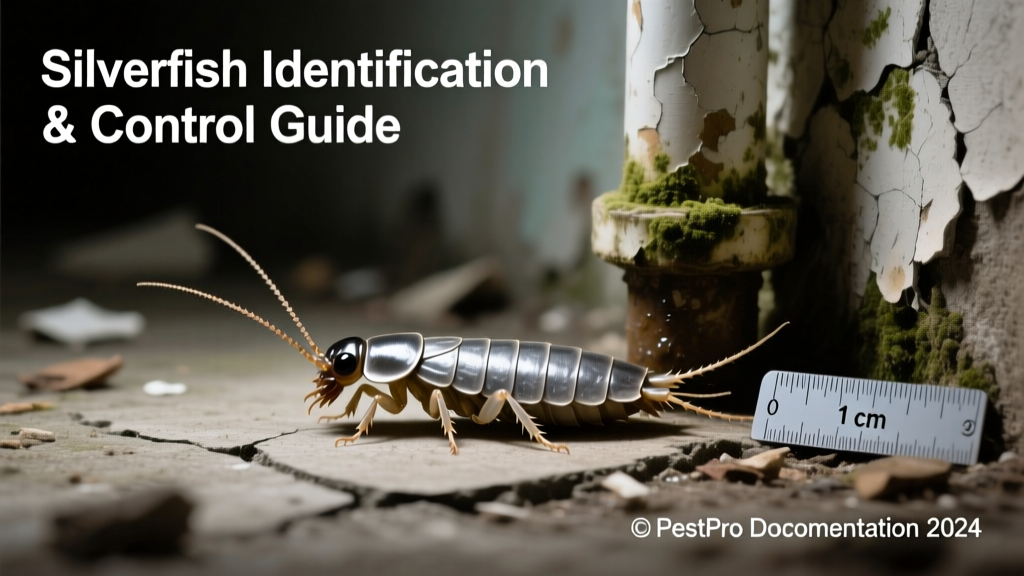
Silverfish (Lepisma saccharina) are ancient, wingless insects that thrive where moisture, starch, and darkness converge—making basements their favorite U.S. habitat. They don’t bite or spread disease, but they damage books, wallpaper paste, carpet glue, and stored clothing—and their presence signals underlying moisture issues that can lead to mold or structural decay.
Identification
Silverfish are small (½–1 inch), teardrop-shaped, and covered in silvery-gray scales that shimmer under light. They move in quick, fish-like wiggles—hence the name. Look for them at night near baseboards, behind stored boxes, or inside cardboard boxes and old paperbacks. Their shed skins resemble tiny, translucent shrimp shells.
| Pest | Size & Color | Antennae | Key Distinguishing Feature |
|---|---|---|---|
| Silverfish | ½–1 inch; silvery-gray or pearl | Long, threadlike (3x body length) | Three tail-like appendages (cerci + median filament) |
| Furniture beetle (Anobium punctatum) | ⅛ inch; reddish-brown | Elbowed, shorter | Round exit holes in wood; no tail filaments |
| Firebrat | Similar size; grayish-brown with mottled pattern | Long, threadlike | Prefer warmer temps (>90°F); often near furnaces or water heaters |
What Attracts Them
Basements offer the perfect storm: high humidity (above 75% RH), poor ventilation, organic debris, and undisturbed clutter. Silverfish feed on polysaccharides—starches, dextrin, and cellulose—so they’re drawn to glue in book bindings, wallpaper, cardboard boxes, cotton fabrics, and even some shampoos and toothpaste residues left on towels.
- Relative humidity consistently above 75% (common in unvented, concrete-floored basements)
- Cardboard storage boxes—especially if damp or stacked directly on concrete
- Old newspapers, magazines, or photo albums stored in corners or under stairs
- Leaky pipes or sump pump failures that go unnoticed for days
Treatment Methods
Natural Remedies
Start here—especially if you have kids, pets, or prefer low-toxicity options. Diatomaceous earth (food-grade) works by dehydrating silverfish on contact. Sprinkle a thin line along baseboards, behind shelves, and under storage racks. Reapply after cleaning or if dampness returns. Boric acid powder (not for pet-accessible zones) is another desiccant option—but never use it near food prep areas or where children play.
Chemical Treatments
For persistent infestations, targeted insecticide dusts like DeltaDust (deltamethrin) provide residual control for up to 8 months in dry, undisturbed areas. According to the National Pesticide Information Center’s 2022 Insecticide Fact Sheet, deltamethrin has low mammalian toxicity but is highly effective against silverfish when applied as a crack-and-crevice treatment. Avoid broad-spectrum sprays—they rarely reach hidden harborages and degrade quickly in humid basements.
Prevention
Eliminating silverfish means eliminating their environment—not just killing individuals. The most effective long-term fix is reducing relative humidity to below 60%. Use a dehumidifier rated for your basement’s square footage (e.g., a 70-pint unit for 1,500 sq ft) and run it year-round. Pair it with proper air circulation: install a ceiling fan or exhaust vent near the sump pit, and avoid sealing off basement windows entirely during mild weather.
- Replace cardboard boxes with plastic totes labeled and sealed—silverfish can’t chew through polypropylene
- Store books and documents in climate-controlled rooms or elevated, ventilated shelving—not on concrete floors
- Fix foundation cracks and install vapor barriers under slab floors if moisture intrusion is chronic
- Wipe down sump pump pits weekly and inspect for algae or standing water
When to Call an Exterminator
Call a licensed pest management professional if you spot silverfish more than twice per week over three consecutive weeks—or if you find them upstairs, in bedrooms, or bathrooms. That indicates a larger population and possible entry points beyond the basement. Also consult one if DIY efforts fail after six weeks of consistent humidity control and treatment. Most reputable companies offer free inspections and moisture assessments, not just spraying.
Do silverfish mean my basement has mold?
Not necessarily—but they share the same root cause: excess moisture. Silverfish won’t grow mold themselves, but their presence strongly correlates with conditions favorable for Stachybotrys and Aspergillus. If you see both silverfish and musty odors or black specks on drywall, test humidity levels with a hygrometer and consider a mold inspection. Learn more about basement mold remediation.
Can silverfish climb walls or ceilings?
Yes—they’re exceptional climbers thanks to tiny hooks (tenent setae) on their feet. They scale concrete, plaster, and painted drywall with ease, especially when surfaces are slightly damp. That’s why you’ll often find them high on basement walls near ceiling joists or behind suspended ceiling tiles.
How fast do silverfish reproduce in basements?
Under ideal basement conditions (75–95% RH, 70–80°F), females lay 1–3 eggs daily in crevices, hatching in 2–4 weeks. They reach maturity in 3–4 months and live up to 3 years—meaning unchecked populations can triple in under six months. The U.S. Department of Agriculture’s Pest Biology Handbook, 2021 edition, notes that basement infestations often go unnoticed until populations exceed 200 individuals per room.
Will sealing basement windows keep silverfish out?
No—silverfish rarely enter from outside. They’re almost always established indoors and move upward from floor drains, expansion joints, or utility penetrations. Sealing windows may trap humidity, worsening the problem. Focus instead on sealing gaps around plumbing pipes, HVAC ducts, and sump pump lids using silicone caulk or copper mesh.
Are silverfish attracted to LED lights?
No—they’re photophobic and avoid all light sources. What you might mistake for attraction is their movement toward cooler, shaded edges of illuminated areas. Unlike moths, silverfish have no positive phototaxis. Use motion-sensor LED lighting to reduce unnecessary ambient light without encouraging activity.
Can I use vinegar to repel silverfish?
Vinegar’s acidity disrupts their sensory receptors temporarily, but it evaporates in under 2 hours and offers zero residual effect. A 2020 study published in Journal of Economic Entomology found diluted white vinegar reduced silverfish movement by 37% for 90 minutes—but had no impact on egg hatch rates or population growth. Better to invest that time in dehumidifying.
"Silverfish aren't an 'infestation' problem—they're a 'moisture management' problem in disguise. Fix the humidity, and the silverfish disappear within 3–4 weeks—even without pesticides." — Dr. Lena Cho, Urban Entomologist, Purdue Extension, 2023
Basement silverfish are less about bugs and more about balance—humidity, airflow, and storage habits working in concert. Tackle the conditions, not just the critters, and you’ll break the cycle for good. For related concerns, see our guides on carpet beetles in basement and how to dry out a wet basement.