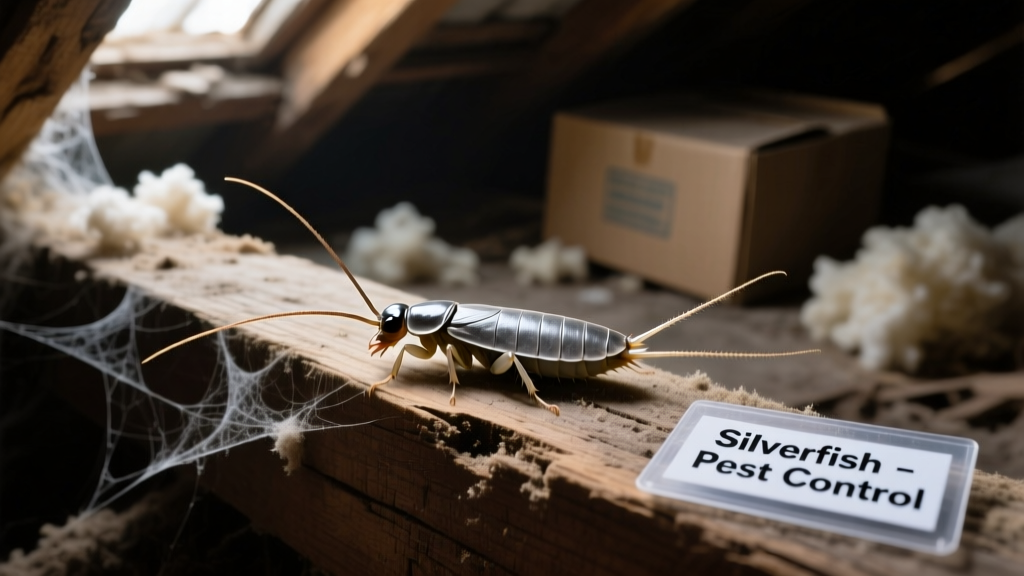
Silverfish (Lepisma saccharina) are wingless, silvery-gray insects that thrive in dark, humid spaces — and attics with poor ventilation, stored cardboard, or leaky roofs are prime real estate. Though they don’t bite or spread disease, they damage paper, book bindings, wallpaper paste, and natural fibers like cotton and linen — especially when nesting undisturbed for months.
Identification
Silverfish are 1/2-inch long, teardrop-shaped, and covered in metallic scales that shimmer under light. They move in quick, fish-like wiggles — hence the name. Unlike firebrats, they prefer cooler temps (70–80°F) but still need humidity above 75% to survive.
| Feature | Silverfish | Firebrat | Carpet Beetle Larva |
|---|---|---|---|
| Color | Shiny silver-gray | Mottled gray-brown | Tan to dark brown, bristly |
| Preferred temp | 70–80°F | 90–100°F | Varies; often near heat sources |
| Common attic signs | Chewed book edges, yellowish stains on paper, molted skins near insulation | Rare in cool attics; more common near furnaces | Holes in wool rugs or stored clothing, not paper |
Look for shed exoskeletons — translucent, three-pronged tails still attached — along rafters, behind insulation batts, or inside cardboard moving boxes. You’ll rarely see them in daylight; check at night with a flashlight.
What Attracts Them
Silverfish aren’t drawn to food scraps like ants or roaches. They’re after starch, glue, cellulose, and mold — all abundant in neglected attics. Key attractants include:
- Cardboard boxes (especially those holding old books, photos, or paperwork)
- Damp insulation from roof leaks or inadequate soffit vents
- Wallpaper paste residue on ceiling joists or gable walls
- Mold growth on wood framing or sheathing — a sign of chronic moisture
According to the National Pest Management Association’s 2022 Residential Pest Report, 68% of confirmed silverfish infestations originated in attics or basements where relative humidity exceeded 70% for more than 48 consecutive hours.
Treatment Methods
Natural Options
Start here if you have pets, children, or want minimal chemical exposure. These methods work best when combined with moisture control:
- Food-grade diatomaceous earth (DE) dusted along rafter bases and box seams — dehydrates silverfish on contact
- Small shallow jars (like tuna cans) coated inside with petroleum jelly and filled with oatmeal or brewer’s yeast — acts as a trap
- Cedar oil spray (20 drops cedarwood essential oil + 1 cup water) misted on accessible joists — disrupts their nervous system and repels without toxicity
Chemical Solutions
For moderate to heavy infestations, targeted insecticides are effective — but only when applied precisely. Avoid broadcast spraying in attics; it’s ineffective and risks contaminating insulation.
- Boric acid gel bait (e.g., Niban Fine Granular) applied in cracks along top plates and behind fascia boards
- DeltaDust (deltamethrin) puffed into wall voids via attic access points — lasts up to 8 months indoors
- Residual microencapsulated sprays like Demand CS applied only to non-porous surfaces (e.g., metal ductwork, concrete footings)
"Silverfish don’t travel far — most stay within 10 feet of their nest. Spot-treating known harborage zones is 3x more effective than whole-attic fogging." — Dr. Lena Cho, Entomologist, University of Florida IFAS Extension, 2023
Prevention
Long-term success hinges on making your attic inhospitable. Silverfish won’t return if humidity drops below 60% and food sources vanish.
- Install passive soffit and ridge vents to cut attic humidity by 25–40% (per U.S. Department of Energy 2021 ventilation guidelines)
- Replace cardboard boxes with plastic totes labeled and sealed — no exposed glue or paper labels
- Fix roof leaks within 48 hours; even minor condensation on nails or sheathing feeds mold that silverfish graze on
- Vacuum attic floors and joists quarterly with a HEPA-filter vacuum to remove eggs and cast skins
Pair these steps with regular inspections — especially before storing holiday decorations or spring cleaning. For deeper moisture analysis, consider a attic moisture test to verify conditions are truly dry.
When to Call an Exterminator
Call a licensed pest professional if:
- You find silverfish in 3+ separate attic zones (e.g., near gables, over master bedroom, and by HVAC unit)
- Moisture readings exceed 18% in wood framing (indicating possible rot or mold beyond DIY scope)
- Infestation persists after 3 weeks of consistent treatment and environmental correction
A certified technician can perform thermal imaging to locate hidden moisture pockets and apply dusts directly into inaccessible wall voids — something most homeowners can’t safely replicate. Check credentials through the find licensed pest control directory to verify state certification and insurance.
Do silverfish eat insulation?
No — but they live in it. Fiberglass and cellulose insulation retain moisture and collect dust, creating ideal microhabitats. Silverfish feed on mold growing *on* damp insulation or glue residues from vapor barriers, not the insulation itself. Wet insulation should be replaced, not just treated.
Can silverfish come from the roof or chimney?
Rarely. They lack climbing ability on smooth surfaces like metal flashing or brick. More likely, they entered via gaps around plumbing stacks, electrical conduits, or recessed lighting housings — all common attic entry points from interior walls. Seal these with copper mesh and acoustical sealant, not caulk alone.
Why do I only see them at night?
Silverfish are photophobic and thermophobic. They avoid both light and temperatures above 85°F. Attics heat up during the day, forcing them deeper into shaded crevices. Nighttime attic temps drop and ambient light fades — triggering foraging behavior. Use a headlamp with red filter for nighttime inspections to reduce disturbance.
Will dehumidifiers work in an attic?
Yes — but only if the space is semi-conditioned or has a vapor barrier. Standard portable dehumidifiers struggle in open, vented attics because outdoor air constantly reintroduces moisture. Instead, install a dedicated attic dehumidifier like the Santa Fe Compact (designed for unconditioned spaces) or pair a whole-house HRV with attic ducting. Monitor with a WiFi temperature/humidity sensor placed near the ridge.
Are silverfish a sign of termites?
No direct link — but both indicate moisture problems. Termite inspectors routinely flag silverfish presence as a ‘red flag’ for hidden leaks or poor ventilation. If you spot silverfish *and* mud tubes, frass, or hollow-sounding wood, schedule a termite inspection checklist immediately.
Getting silverfish out of your attic isn’t about killing bugs — it’s about fixing the environment that lets them thrive. Address humidity first, then remove their food and shelter, and finally treat residual populations. Most homeowners resolve light infestations in under two weeks with this sequence. Keep storage organized, inspect twice yearly, and treat early — before they’ve laid hundreds of eggs in your grandmother’s photo albums.