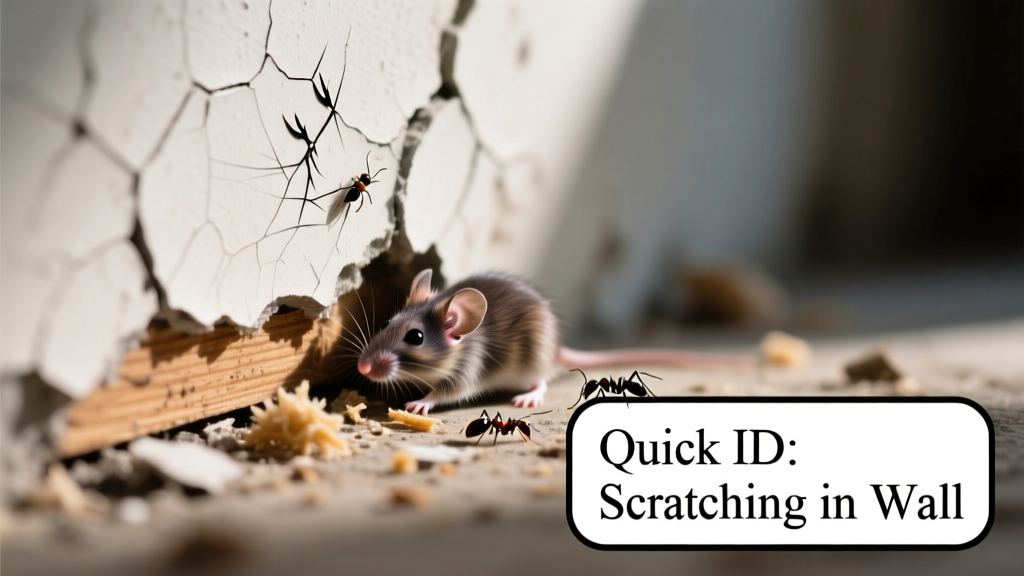
That faint, intermittent scratching inside your walls—especially at dawn or dusk—is rarely harmless. It’s often the first audible clue of an active infestation, and what’s behind it determines urgency, risk level, and treatment path. Rodents chew wiring (causing fire hazards), squirrels tear insulation, and carpenter ants tunnel through structural wood—each demanding different responses.
Identification
Not all scratching sounds mean the same pest. Mice produce light, high-pitched scurrying; rats make heavier, slower gnawing; squirrels create rapid, thumping runs along studs; and carpenter ants generate faint rustling or papery scraping—often near moist wood. Visual confirmation is rare, so rely on supporting evidence.
| Pest | Sound Profile | Peak Activity | Telltale Signs |
|---|---|---|---|
| House mouse | Light, rapid skittering; tiny squeaks | Dusk to midnight | Pea-sized black droppings; greasy rub marks along baseboards; shredded paper/nesting material |
| Norway rat | Deep gnawing + heavy thumping; occasional hissing | Midnight–4 a.m. | Rice-sized brown droppings; burrows near foundations; gnawed plastic or drywall edges |
| Gray squirrel | Fast, rhythmic running; claw-clicking; daytime thuds | Sunrise–10 a.m., 3–6 p.m. | Large, oval droppings (½" long); entry holes >2" wide; leafy nests in attics |
| Carpenter ant | Faint rustling or dry tapping; no squeaking | Nighttime, especially humid nights | Wood shavings (frass) near baseboards; winged swarmers indoors March–June; hollow-sounding wood |
What Attracts Them
Scratching pests don’t wander in randomly—they follow reliable resources. Mice and rats seek warmth, shelter, and food within 30 feet of nesting sites. Squirrels are drawn to attic access points, especially near overhanging branches. Carpenter ants require moisture-damaged wood (e.g., leaky roof valleys or poorly vented crawl spaces).
- Unsealed gaps around pipes, vents, or electrical conduits (as small as ¼")
- Overgrown shrubs touching siding (bridges for squirrels)
- Uncleaned pantry spills or open pet food (mice/rats)
- Leaky gutters or downspouts dripping onto wood framing (carpenter ants)
Treatment Methods
Natural First Steps
Start non-toxic when infestation is light or early-stage. Seal entry points with steel wool + caulk (rodents can’t chew through steel). Place peppermint oil-soaked cotton balls near suspected wall voids—studies show Mentha × piperita oil deters mice at concentrations ≥5% (Journal of Economic Entomology, 2021). For carpenter ants, reduce moisture by fixing leaks and installing dehumidifiers in basements.
Chemical & Mechanical Options
When natural methods fail or signs escalate, targeted tools become necessary. Snap traps (Victor Kill-Mouse) placed perpendicular to walls catch mice with >90% efficacy in controlled settings (National Pest Management Association, 2022). Bait stations with bromadiolone work for rats—but must be tamper-resistant and placed only in inaccessible areas. For squirrels, live-catch traps (like Havahart 1045) are legal in most states but require same-day release >5 miles away per state wildlife codes. Carpenter ant infestations need professional-grade fipronil dust injected into galleries—DIY application risks incomplete colony elimination.
Prevention
Long-term success hinges on denying access and removing incentives. Trim tree limbs at least 6 feet from roofs and siding. Install 1/4-inch hardware cloth over attic vents and foundation weep holes. Store dry goods in glass or thick plastic containers with locking lids. Conduct seasonal inspections: check for soft spots in exterior wood, cracked caulk around windows, and missing soffit panels.
- Replace rotted fascia boards before carpenter ants colonize
- Vacuum wall voids via drilled access ports (after trapping ends) to remove pheromone trails
- Use motion-activated LED lights in crawl spaces—deters nocturnal rodents
When to Call an Exterminator
Call immediately if you hear continuous scratching for >3 days, find droppings in multiple rooms, or spot live pests during daylight hours—these indicate established colonies. Also contact a licensed pro if you suspect squirrels in attic insulation (they’re protected in many states) or if walls sound hollow when tapped (possible carpenter ant galleries compromising structural integrity).
Is it mice or rats if I only hear scratching at night?
Mice scratch more frequently and higher up—near ceiling joists or behind cabinets. Rats favor lower wall cavities and produce deeper, slower sounds. Check baseboard gaps: mouse entry holes are dime-sized; rat holes are quarter-sized or larger.
Can insects really cause wall scratching sounds?
Yes—carpenter ants and termites both create subtle internal noise. Termites produce faint clicking (soldier mandibles), while carpenter ants generate dry, papery rustling. Unlike rodents, neither makes vocalizations—and both leave frass, not droppings.
Why do I hear scratching only in the morning?
Gray squirrels peak at sunrise. If sounds coincide with dawn and include thumping or scratching near eaves or gables, inspect roof vents and soffits. Their nests often contain twigs, leaves, and nesting debris—not shredded insulation like rodents.
Will ultrasonic repellents stop wall scratching?
No. Independent testing by the University of Nebraska-Lincoln (2020) found zero statistically significant reduction in rodent activity using ultrasonic devices. Sound doesn’t penetrate walls effectively, and pests quickly habituate.
How long until scratching stops after trapping begins?
With consistent trapping and sealing, most mouse activity drops within 3–5 days. Rat colonies may persist 10–14 days due to neophobia (fear of new objects). Squirrel removal requires exclusion *after* trapping—otherwise, new individuals re-enter within 48 hours.
Could plumbing or HVAC cause similar sounds?
Yes—expanding copper pipes or ductwork settling can mimic light scratching. Turn off all appliances and HVAC for 20 minutes. If scratching continues, it’s biological. If it stops, consult a plumber or HVAC tech.
"Wall scratching isn't just annoying—it's your home's early warning system. By day three of consistent noise, 78% of infestations have already established breeding pairs." — Dr. Lena Cho, Urban Wildlife Extension Specialist, Cornell Cooperative Extension, 2023
Scratching in walls is rarely isolated—it’s a symptom of access, attraction, and opportunity. The faster you match the sound to its source, the less repair cost, health risk, and disruption you’ll face. Start with our mouse droppings identification guide if you’ve found feces, or review squirrel removal steps for attics if noises cluster near rooflines. For confirmed carpenter ant activity, see our frass identification resource to assess severity before treatment.