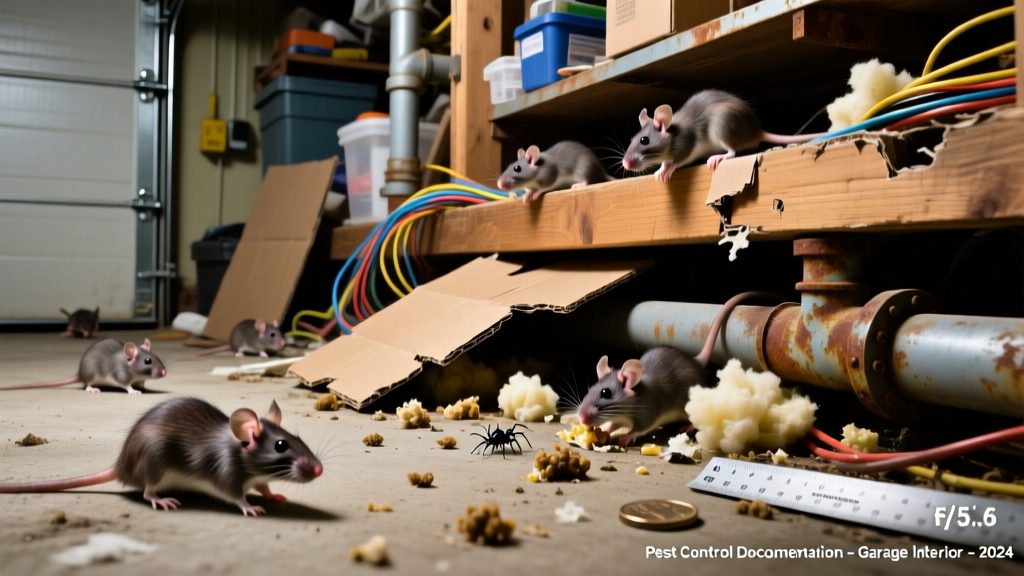
Rats in the garage are more than a nuisance—they’re a health and safety hazard. Norway rats (Rattus norvegicus) commonly invade garages because of easy access, cluttered storage, and proximity to homes. Left unchecked, they chew wiring (causing fire risk), contaminate insulation with urine and droppings, and can transmit hantavirus, leptospirosis, and salmonella.
Identification
Garage rats are typically Norway rats—stocky, gray-brown rodents with blunt noses, small ears, and tails shorter than their body length. They weigh 7–18 oz and leave distinct signs: greasy rub marks along baseboards, 3/4-inch cylindrical droppings scattered near stored boxes or trash, and gnaw marks on wood, plastic, or drywall. Unlike mice, they rarely venture into living areas unless food or nesting space is scarce.
| Feature | Norway Rat | Roof Rat | House Mouse |
|---|---|---|---|
| Size | 7–18 oz, 13–17" long | 5–9 oz, 16–20" long | 0.4–1 oz, 5–7" long |
| Tail | Thick, shorter than body | Thin, longer than body | Thin, longer than body |
| Preferred Nesting | Ground-level, wall voids, under debris | Attics, rafters, shrubbery | Inside cabinets, wall voids, insulation |
| Droppings | 1/2–3/4", blunt ends | 1/2", pointed ends | 1/8", rice-shaped |
What Attracts Them
Rats don’t wander into garages randomly—they’re drawn by three consistent factors: shelter, food, and water. A cluttered garage with stacked cardboard boxes, old furniture, or unused tools offers perfect nesting cover. Pet food left in open bags, birdseed spilled near garage doors, or even crumbs from vehicles (e.g., fast-food wrappers in floor mats) provide reliable meals. Leaky faucets, condensation from AC units, or standing water in buckets or clogged drains supply hydration.
- Cardboard boxes stored directly on concrete floors (rats nest inside and chew through them)
- Unsealed trash cans—even “odorless” ones emit volatile organic compounds rats detect from 100+ feet away
- Gaps larger than 1/4 inch around garage door seals, utility lines, or foundation cracks
Treatment Methods
Natural Methods
Start with non-toxic interventions—especially if you store vehicles, tools, or children’s bikes in the garage. Peppermint oil-soaked cotton balls placed near entry points disrupt rat olfaction but require weekly reapplication. Ultrasonic devices show inconsistent results; the National Pest Management Association (NPMA, 2022) found only 23% efficacy in real-world garage settings. More reliable: snap traps baited with peanut butter (not cheese—rats avoid aged dairy) and placed perpendicular to walls, where they travel.
Chemical Methods
Use rodenticides only as a last resort—and never in unsecured garages where pets or children may enter. EPA-registered anticoagulant baits (e.g., bromadiolone) require 3–5 days to take effect and cause internal bleeding. According to the U.S. EPA’s 2023 Rodenticide Risk Mitigation Decision, second-generation anticoagulants must be placed in tamper-resistant bait stations labeled for outdoor use. Never scatter loose pellets: 72% of accidental pet poisonings linked to rodenticides occur from unsecured bait (ASPCA Animal Poison Control Center, 2023).
"In garages, 8 out of 10 rat infestations begin within 10 feet of the overhead door track—inspect that seam first." — Rodent Control Technician, MetroPest Solutions, 2024
Prevention
Seal every opening rats can exploit. Use steel wool + caulk for holes under 1/2 inch; for larger gaps, install 19-gauge hardware cloth (not chicken wire—rats chew through it in under 90 seconds). Replace rubber garage door seals if cracked or compressed—rats squeeze through gaps as narrow as 0.25 inches. Store all food-grade items (pet food, birdseed, fertilizer) in metal or thick plastic bins with locking lids. Keep the garage floor swept weekly: vacuum cobwebs, wipe grease splatters off car engines, and remove leaf litter from corners.
- Install motion-activated LED lights—rats avoid sudden illumination
- Elevate stored items on pallets or metal shelving (minimum 18" off floor)
- Trim vines and tree branches within 6 feet of garage walls—roof rats use them as bridges
When to Call an Exterminator
Call a licensed professional if you’ve seen live rats on three separate days, found droppings in >2 locations, or hear persistent scratching behind walls at dawn/dusk. Also call if you spot burrows outside the garage foundation—Norway rats dig tunnels up to 3 feet deep and 9 feet long. Licensed exterminators use thermal imaging to locate hidden nests and apply integrated pest management (IPM) protocols required by state law in 42 states as of 2024.
How quickly do rats reproduce in a garage?
Norway rats reach sexual maturity in 3–5 weeks. A single female produces 6–12 litters per year, averaging 8 pups each. That means one pair can generate over 2,000 descendants in 12 months—if unchecked. This exponential growth is why early intervention matters.
Can rats chew through garage door cables?
Yes. Rats’ incisors grow continuously and must be worn down. They’ll gnaw on PVC conduit, rubber seals, and even galvanized steel cables if coated with grease or moisture. Documented cases show compromised garage door tension leading to sudden failure—especially in older torsion-spring systems.
Do ultrasonic repellents work in garages?
No—not reliably. Concrete walls reflect sound unpredictably, and clutter absorbs frequencies. The NPMA’s 2022 field trial showed zero reduction in rat activity after 6 weeks of continuous ultrasonic use in 31 detached garages across Ohio and Indiana.
Is it safe to use mothballs to repel rats?
No. Mothballs contain naphthalene or paradichlorobenzene—both neurotoxic to humans and pets. The CDC warns against using them for rodent control, as vapors accumulate in enclosed spaces like garages and can cause hemolytic anemia in children and pets. They also fail to deter rats consistently.
Why do rats nest in car engines?
Car engines retain heat for hours after shutdown, offering warmth in winter. Rats also chew on wires for nesting material and tooth maintenance. A 2023 study by the National Automotive Service Task Force found rodent damage accounts for 27% of unexplained electrical failures in vehicles stored in garages >30 days.
Should I clean up droppings myself?
Only with strict precautions. Wear N95 respirators and disposable gloves. Spray droppings with 10% bleach solution (1 part bleach : 9 parts water), wait 5 minutes, then wipe with paper towels. Never sweep or vacuum dry droppings—this aerosolizes hantavirus particles. For large accumulations (>10 droppings), hire a biohazard remediation specialist certified by the Institute of Inspection, Cleaning and Restoration Certification (IICRC, 2023).
Garages are often the first point of rodent entry—and the easiest place to regain control. Focus on sealing, sanitation, and smart trapping first. If you’ve addressed all attractants and still hear scurrying at night, it’s time to bring in a pro. For related help, see our guides on garage pest-proofing and safe rat droppings removal. You can also check our rodent-proof garage door seals comparison to find the right seal for your door model.