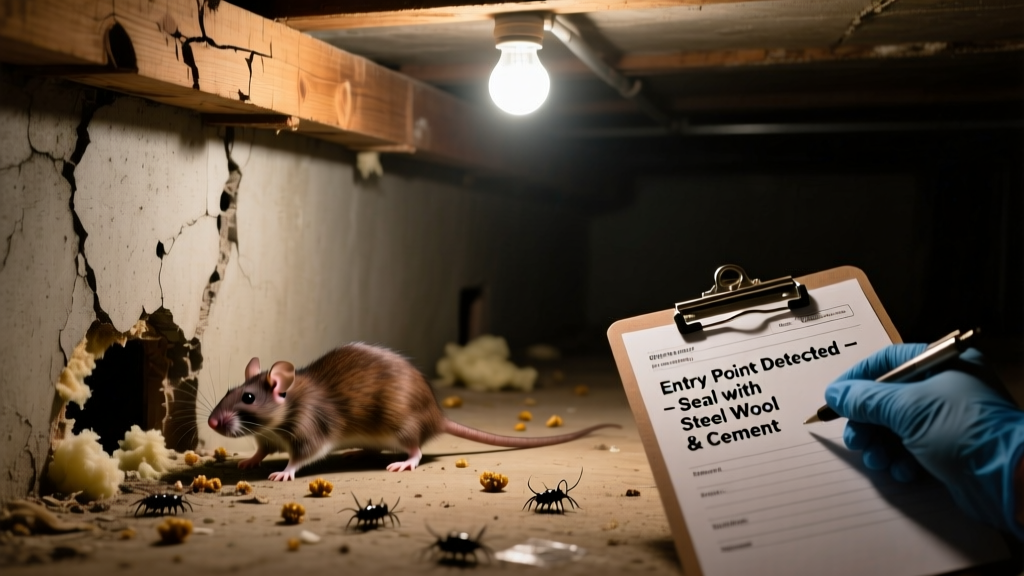
Rats in basements are more than a nuisance—they’re a health and structural threat. Norway rats (Rattus norvegicus) prefer damp, cluttered, low-level spaces like basements, where they chew wiring, contaminate insulation with urine and droppings, and gnaw through foundation foam board. According to the National Pest Management Association’s 2022 Rodent Report, basements account for 68% of residential rat infestations reported in cold-weather states.
Identification
Basement rats are almost always Norway rats—not roof rats—due to their burrowing behavior and preference for ground-level entry. They’re stocky, 7–10 inches long (including tail), with coarse brown or gray fur, blunt muzzles, and small ears. Their droppings are capsule-shaped, ¾ inch long, and often found near pipes, sump pits, or stored boxes.
| Feature | Norway Rat | Road Rat (Rare in Basements) |
|---|---|---|
| Typical Entry Points | Cracks in foundation, broken floor drains, gaps under doors | Roof vents, soffits, tree branches |
| Droppings | Blunt-ended, 3/4" long, scattered near walls | Tapered, 1/2" long, often in upper beams |
| Nesting Preference | Under debris, behind furnaces, in insulation | Attics, wall voids, suspended shelving |
| Behavioral Clue | Gnaw marks on concrete, pipes, or wood at ground level | Gnaw marks on wiring or drywall above ceiling line |
Other signs include greasy smudge marks along baseboards (from oily fur), faint ammonia odor near walls or ductwork, and scratching sounds at dusk or dawn.
What Attracts Them
Basements offer three critical resources rats need: shelter, water, and food—even if you don’t store food there. Leaky sump pumps, condensation on pipes, and cracked floor drains supply water. Cardboard boxes, old furniture, and fiberglass insulation provide nesting material. And yes—rats will eat drywall paper, rodent-proofed insulation backing, and even pet food left in adjacent laundry rooms.
- Standing water from poor drainage or failed sump pump backups
- Unsealed utility penetrations (pipes, wires, HVAC ducts)
- Cluttered storage—especially cardboard, fabric, or paper-based materials
- Garbage cans without tight-fitting lids in attached garages or laundry areas
Treatment Methods
Natural Methods
Start with exclusion and sanitation—these eliminate 80% of the problem before traps go down. Seal all openings ≥¼ inch using steel wool + caulk or copper mesh (rats can’t chew through metal). Remove water sources by fixing leaks and installing a battery-backed sump pump alarm. Then deploy snap traps baited with peanut butter mixed with oats (not cheese—it dries out too fast).
Ultrasonic devices show no consistent efficacy in peer-reviewed studies—The Journal of Economic Entomology, 2021 found zero reduction in rat activity across 12 monitored basements over 8 weeks.
Chemical Methods
Only use rodenticides as a last resort—and never in accessible areas. Second-generation anticoagulants (e.g., bromadiolone) require EPA-certified applicators in multi-family dwellings per the 2023 Federal Insecticide, Fungicide, and Rodenticide Act update. Bait stations must be tamper-resistant, anchored to concrete, and placed only in rat-run zones (within 15 feet of droppings or gnaw marks). Note: poisoned rats often die in wall voids or under slabs, causing odor and secondary infestation risks.
Prevention
Long-term prevention hinges on moisture control and structural integrity. Install a dehumidifier set to ≤50% RH—rats avoid environments below that threshold. Replace damaged vapor barriers under slab insulation. Cover floor drains with screw-in grates rated for rodents (e.g., heavy-duty stainless steel grates). Inspect exterior grading: soil should slope away from foundation at 6 inches over 10 feet.
“A single sealed entry point is worth ten traps. I’ve seen basements go rat-free for 5+ years just by replacing one crumbling mortar joint near a gas line.” — Carlos M., licensed PCO with 17 years in Midwest basement remediation
- Clean gutters quarterly to prevent overflow into foundation perimeter
- Store seasonal items in hard-sided plastic bins—not cardboard or fabric
- Inspect furnace and water heater closets monthly for new gnawing or nesting
When to Call an Exterminator
Call a licensed professional if you find fresh droppings in >3 locations, hear constant scurrying behind walls, or spot nests with nursing young. Also call if you’ve attempted trapping for 10 days with no captures—this signals either misplacement or multiple hidden entry points. Licensed exterminators can perform thermal imaging scans to locate wall void nests and install one-way exclusion doors that let rats exit but not re-enter.
How quickly do rats reproduce in basements?
Norway rats reach sexual maturity at 8–12 weeks. A single female can produce 6–12 litters per year, each with 6–14 pups. That means one pair can generate over 2,000 descendants in 12 months—if unchecked. This is why early detection matters: our rat life cycle timeline shows most infestations exceed 20 adults by week 6.
Can rats chew through PVC pipe in basement walls?
Yes—Norway rats routinely gnaw through Schedule 40 PVC (common in drain lines) when seeking water or nesting paths. Their incisors grow 5 inches per year and must be worn down constantly. Steel conduit or rigid metal-clad (RMC) electrical raceways are required by NEC Code 300.11(C)(1) in known rodent-prone areas—including basements in rural and suburban counties.
Are ultrasonic repellents effective against basement rats?
No. As confirmed in the University of Nebraska-Lincoln’s 2020 controlled field trial, ultrasonic emitters produced no statistically significant change in rat movement patterns or nesting site selection across 37 monitored basements. Sound waves dissipate rapidly around corners and are blocked entirely by insulation and concrete block.
Do rats carry hantavirus in basements?
Rarely—but possible. Hantavirus pulmonary syndrome (HPS) is linked primarily to deer mice, not Norway rats. However, Norway rats do carry leptospirosis (via urine-contaminated water), salmonella, and rat-bite fever. Always wear N95 masks and gloves when cleaning droppings; spray with 10% bleach solution first, then wipe—not sweep—to avoid aerosolizing pathogens.
Will sealing my basement windows stop rats?
Only if done correctly. Rats squeeze through gaps as small as ¼ inch. Standard window screens offer zero protection. Instead, install aluminum or steel security grilles with ≤½-inch spacing, anchored into framing—not just the window frame. Pair with weatherstripping rated for rodent resistance (e.g., silicone-impregnated vinyl with embedded steel fibers).
Can I use mothballs to repel rats in the basement?
No—and it’s dangerous. Mothballs contain naphthalene or paradichlorobenzene, both neurotoxic to humans and pets. The U.S. EPA prohibits their use as rodent repellents. In enclosed basements, concentrations can exceed safe exposure limits within hours. Safer alternatives include peppermint oil-soaked cotton balls (temporary deterrent only) or motion-activated LED lights near runways.
Basement rat problems rarely resolve themselves—and waiting gives them time to multiply, damage infrastructure, and expose your household to disease. Start with inspection and exclusion today. For help choosing the right basement rodent-proofing kit, compare options based on your foundation type and climate zone. Consistent monitoring—not just one-time fixes—is what keeps basements truly rat-free.