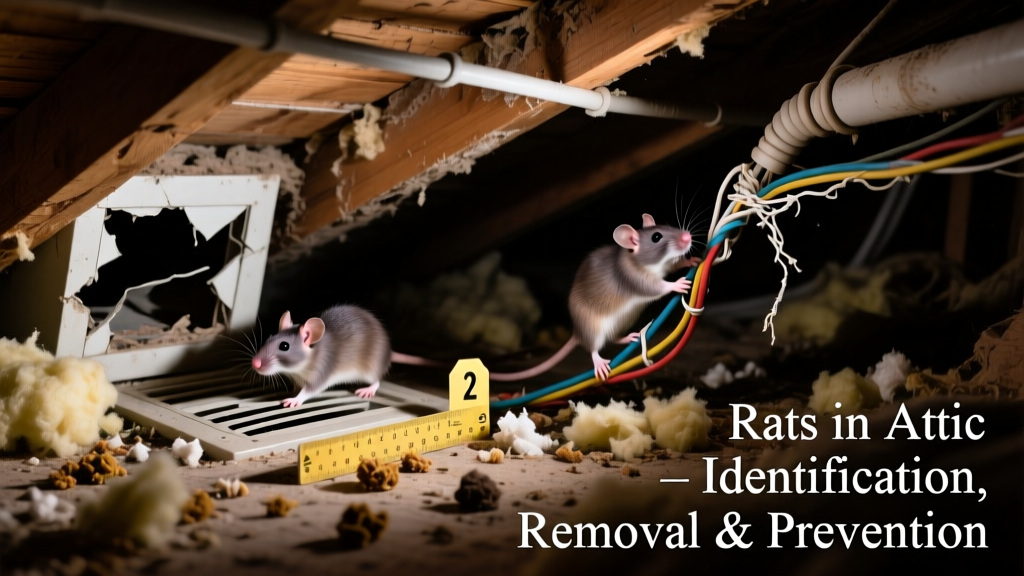
Rats in the attic aren’t just noisy neighbors—they’re structural threats, disease carriers, and fire hazards. Roof rats (Rattus rattus) and Norway rats (Rattus norvegicus) both invade attics, but roof rats dominate elevated spaces like rafters and insulation. Left unchecked, a single pair can produce up to 20 offspring per year—and chew through wiring, drywall, and vapor barriers.
Identification
Attic rats leave telltale signs long before you see them. Droppings are the most common clue: roof rat pellets are spindle-shaped, ½ inch long, and shiny black; Norway rat droppings are blunt-ended, slightly larger, and duller. You’ll also hear scratching at dusk or dawn, find greasy rub marks along beams, and spot gnawed insulation or nesting material like shredded paper or fabric.
| Feature | Roof Rat | Norway Rat |
|---|---|---|
| Preferred attic zone | Rafters, eaves, near vents | Insulation floor, soffits, near plumbing stacks |
| Droppings | 12–14 mm, pointed ends, glossy | 18–20 mm, blunt ends, matte |
| Climbing ability | Excellent—uses vines, wires, gutters | Poor—relies on ground-level access |
| Entry point size | As small as ½ inch | ¾ inch minimum |
What Attracts Them
Attics become rat magnets when three conditions align: shelter, warmth, and proximity to food/water. Poorly sealed soffit vents, cracked fascia boards, and uncapped chimneys provide easy access. Insulation offers nesting material and thermal cover. Nearby bird feeders, overflowing gutters, or leaky roof vents supply moisture—and if your kitchen or garage is accessible via attic ductwork or plumbing chases, that’s a direct buffet line.
- Unsealed roof vents or turbine fans
- Gaps around plumbing stacks or HVAC penetrations
- Overhanging tree branches within 3 feet of roofline
- Stored cardboard boxes or fabric-based insulation (attractive nesting material)
Treatment Methods
Natural Methods
Start with non-toxic deterrents—especially if pets, children, or wildlife are present. Peppermint oil-soaked cotton balls placed near entry zones disrupt rat olfaction, but require weekly reapplication. Ultrasonic devices show limited efficacy in large, cluttered attics (per University of California IPM’s 2022 evaluation). More reliable: snap traps baited with peanut butter or dried fruit, placed perpendicular to walls along travel paths. Set at least 10 traps for an active infestation—roof rats avoid new objects, so pre-bait for 3–4 days without setting springs.
Chemical Methods
Anticoagulant rodenticides (like bromadiolone) are restricted in attics under EPA’s 2020 Risk Mitigation Decision—only licensed applicators may use them indoors due to secondary poisoning risks to owls, hawks, and pets. If used, place tamper-resistant bait stations *only* where rats nest—not in open insulation. Never scatter loose bait: the U.S. EPA estimates 10,000+ pets are poisoned annually by improper rodenticide use.
"Trapping is the gold standard for attic rat removal—it confirms kills, avoids odor issues from hidden carcasses, and provides proof of activity patterns." — Dr. Robert Corrigan, Urban Rodentologist, Columbia University, 2021
Prevention
Sealing is non-negotiable. Use 19-gauge galvanized steel mesh (not hardware cloth—it’s chewable) over all openings larger than ¼ inch. Seal gaps around pipes and wires with copper wool + caulk (rats won’t chew copper). Install vent guards rated ASTM E2675-19. Trim trees to 4 feet from roofline. Replace damaged soffit panels—many aluminum soffits have hidden rust perforations rats exploit.
- Inspect attic perimeter at dusk with a flashlight—look for light leaks (entry points)
- Remove all nesting material before sealing (rats return to familiar sites)
- Install motion-activated LED lights in attic corners—roof rats avoid sudden illumination
- Store holiday decorations in hard-sided plastic bins, not cardboard or fabric totes
When to Call an Exterminator
Call a licensed professional if you find more than 5 fresh droppings per square foot, hear constant activity across multiple rooms, or discover nesting material with pups. Also call if you’ve attempted trapping for 10 days with zero captures—this suggests either misplacement or a larger colony entering elsewhere. According to the National Pest Management Association’s 2023 industry survey, 68% of attic rat jobs require structural repair *after* removal, which most DIYers overlook.
How fast do attic rats reproduce?
Roof rats reach sexual maturity at 3–4 months and breed year-round in heated attics. A single female produces 4–6 litters annually, averaging 8 pups per litter—so one breeding pair can generate ~100 descendants in 12 months.
Can rats chew through PVC pipe in the attic?
Yes. Rats routinely gnaw PVC, especially older or UV-exposed pipe. Their incisors grow 5 inches per year and must be worn down—so any soft polymer, rubber gasket, or foam sealant is vulnerable. Galvanized steel conduit is the only reliable barrier.
Will attic rats leave if there’s no food source?
Not reliably. Rats need only 1 oz of water daily—and condensation from AC lines, roof leaks, or humid air provides enough. They’ll survive weeks on insulation fiber alone. Eliminating food is necessary but insufficient without exclusion.
Do attic rats carry hantavirus?
Rarely—but they *do* carry leptospirosis, salmonella, and rat-bite fever. Hantavirus is primarily associated with deer mice (Peromyscus), not Rattus species. Still, always wear N95 masks and gloves when cleaning droppings—disturbing dried feces aerosolizes pathogens.
How much does professional attic rat removal cost?
Expect $300–$900 for inspection, trapping, and basic exclusion. Full remediation—including insulation replacement, sanitization, and structural repair—averages $1,800–$3,200. Compare quotes using our attic inspection checklist and review contractor licensing via your state’s pest control license lookup tool.
Can I use smoke bombs in the attic?
No. Smoke bombs are illegal for indoor use and pose extreme fire risk near insulation, wiring, or stored materials. They also fail to eliminate nests—rats simply retreat deeper into voids. The best rodent-proofing materials list details approved physical barriers only.
Attic rats demand speed, precision, and follow-through. Most failures stem from sealing too early—or skipping the sanitation step after removal. Replace contaminated insulation, disinfect surfaces with 10% bleach solution, and monitor for 30 days with trail cameras. If you hear scratching again, revisit your exclusion points—not your trap placement.