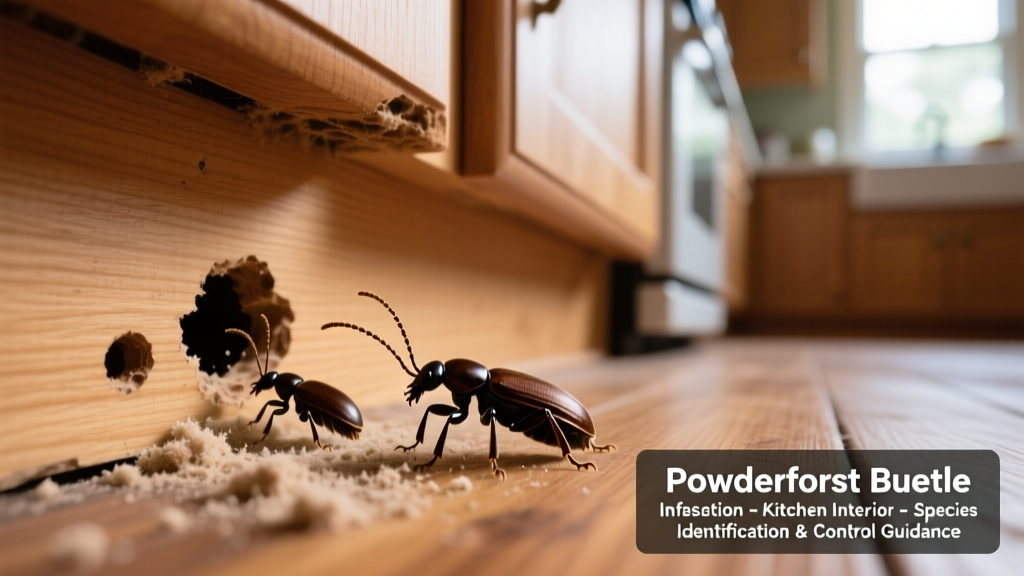
Powderpost beetles are tiny wood-boring insects—usually 1/8 to 3/16 inch long—that lay eggs in cracks or pores of hardwoods. In kitchens, they target cabinet frames, cutting boards, butcher blocks, and pantry shelving made from oak, ash, hickory, or bamboo. Left unchecked, their larvae tunnel through wood for up to 3 years, reducing structural integrity and contaminating food prep surfaces with frass (fine, flour-like dust).
Identification
Adult powderpost beetles are reddish-brown to black, slender, and often mistaken for ants or small cockroaches. They don’t fly well and rarely move in daylight. The real evidence is in the wood—not the bugs themselves.
- Pinhole-sized exit holes (1/32–1/16 inch) in hardwood surfaces
- Fine, talcum-powder-like frass that sifts out when tapped
- Small, cream-colored, C-shaped larvae (up to 1/4 inch) visible only if wood is split open
- No webbing, no odor—unlike carpet beetles or moths
Confusing them with other pests is common. Here’s how to tell the difference:
| Pest | Hole Size | Frass Texture | Common Targets |
|---|---|---|---|
| Powderpost Beetle | 1/32–1/16″ | Dry, silky, uniform powder | Hardwood cabinets, cutting boards, trim |
| Old House Borer | 1/8–3/16″ | Coarse, gritty, pellet-like | Softwood framing (rare in finished kitchens) |
| Carpenter Ant | 1/8″+, irregular | Shredded wood mixed with insect parts | Moist, decaying wood behind sinks or dishwashers |
| Termites | No exit holes (they eat inward) | Not produced—mud tubes instead | Subfloor, baseplates, wall studs |
What Attracts Them
Powderpost beetles don’t seek kitchens for food or moisture—they’re after dry, unfinished, or lightly sealed hardwoods with large pores. Their presence almost always means infested wood was brought in already: a reclaimed oak shelf, a vintage butcher block, or imported bamboo cabinetry.
- Wood with moisture content below 20% (ideal for development)
- Unsealed end grain—especially on shelf supports or drawer bottoms
- Low-light, low-traffic zones like under cabinets or inside pantry boxes
- Warmth from appliances (e.g., oven vents or dishwasher heat) accelerates larval development
They do not feed on drywall, plastic, or food—but frass can fall into open cereal boxes or spice jars, triggering health concerns.
Treatment Methods
Natural Options
For light infestations (fewer than 5 active holes in one cabinet), start non-chemical. Kiln-drying wood at 135°F for 6+ hours kills all life stages—but impractical for installed cabinetry. Instead:
- Remove affected items (cutting boards, wooden bowls) and freeze at 0°F for 72 hours
- Use a shop vac with crevice tool to extract frass from holes—then seal with shellac or polyurethane
- Apply food-grade diatomaceous earth (DE) in cracks and joints; reapply after cleaning
- Wipe surfaces with 5% acetic acid (white vinegar) to disrupt pheromone trails
Note: DE must remain dry to work—and never use near open food prep areas without thorough vacuuming first.
Chemical Treatments
For widespread activity—especially in glued-up panels or built-in cabinets—penetrating borate solutions (e.g., Bora-Care or Tim-Bor) are EPA-registered and labeled for interior hardwood use. Applied as a liquid spray or brush-on, they diffuse into wood up to 1 inch deep and remain active for decades.
According to the University of Florida IFAS Extension’s 2022 Pest Management Guide, borates reduce larval survival by over 95% when applied at full label strength to raw or sanded wood surfaces—but they won’t penetrate existing finishes like varnish or paint.
"If you see fresh frass in June or July, assume active larvae are still feeding. Surface sprays won’t reach them—only deep-penetrating borates or professional heat treatment will." — Dr. Faith Oi, UF/IFAS Entomology, 2022
Prevention
Preventing reinfestation means breaking the lifecycle before eggs hatch. Focus on wood selection, sealing, and monitoring—not just spraying.
- Inspect new hardwood items under bright light for pinholes before bringing them into the kitchen
- Seal all end grain on shelves, drawer fronts, and trim with at least two coats of polyurethane or epoxy resin
- Store wooden utensils and boards in low-humidity drawers (use silica gel packs if needed)
- Check pantry shelves quarterly—tap lightly and watch for fresh frass fallout
Also consider replacing high-risk items: bamboo and red oak are especially vulnerable. Maple, cherry, and poplar have tighter grain and resist infestation better. Learn more about wood types for kitchen cabinets before your next renovation.
When to Call an Exterminator
Call a licensed pest management professional if:
- You find >10 active exit holes across multiple cabinets or countertops
- Frass appears on floors or countertops daily—even after vacuuming
- You spot adults flying near windows or lights during daylight (indicates mature emergence)
- The infestation spans structural wood (e.g., floor joists beneath cabinets)
Heat treatment (raising cabinet wood to 120°F for 2+ hours) is highly effective but requires specialized equipment and containment. Most local firms charge $350–$850 for a targeted kitchen zone treatment—far less than whole-house fumigation. See our guide on when to call an exterminator for cost benchmarks and red flags.
Can powderpost beetles contaminate food?
No—they don’t eat food, but frass falling into open containers poses a physical contaminant risk. Discard any dry goods exposed to active frass fallout, and wash sealed jars with hot soapy water before reuse.
Do they bite or harm people?
No. Powderpost beetles lack mouthparts capable of biting skin or injecting venom. They’re strictly wood-dependent and avoid human contact.
Will painting or staining stop them?
Only if it fully seals pores and end grain. A single coat of latex paint does little—especially over porous woods like ash or walnut. Use oil-based primer + two topcoats, or better yet, a film-forming finish like conversion varnish.
How fast do they spread to other rooms?
Slowly. Adults live only 2–5 weeks and rarely travel far—most stay within 3 feet of emergence. But if you’ve got infested hardwood flooring or stair treads adjacent to the kitchen, inspect those areas too. Read our wood floor pest signs checklist.
Are DIY foggers effective?
No. Foggers disperse pyrethrins into air—not into wood where larvae live. They may kill adults on contact but leave 99% of the population unharmed. The National Pest Management Association (NPMA, 2023) explicitly advises against foggers for wood-boring beetles.
Can I sand out the damage?
Sanding removes surface frass and old finish—but not tunnels deeper than 1/8 inch. If holes are shallow and isolated, light sanding + borate soak + refinishing works. For deep damage in load-bearing shelf supports, replacement is safer.
If you’ve caught this early—within 6 months of first noticing frass—you likely avoided structural loss. Keep a small magnifying glass and flashlight in your kitchen junk drawer for quick checks. And remember: every hole tells a story. Listen to what the wood is saying before it’s too late.