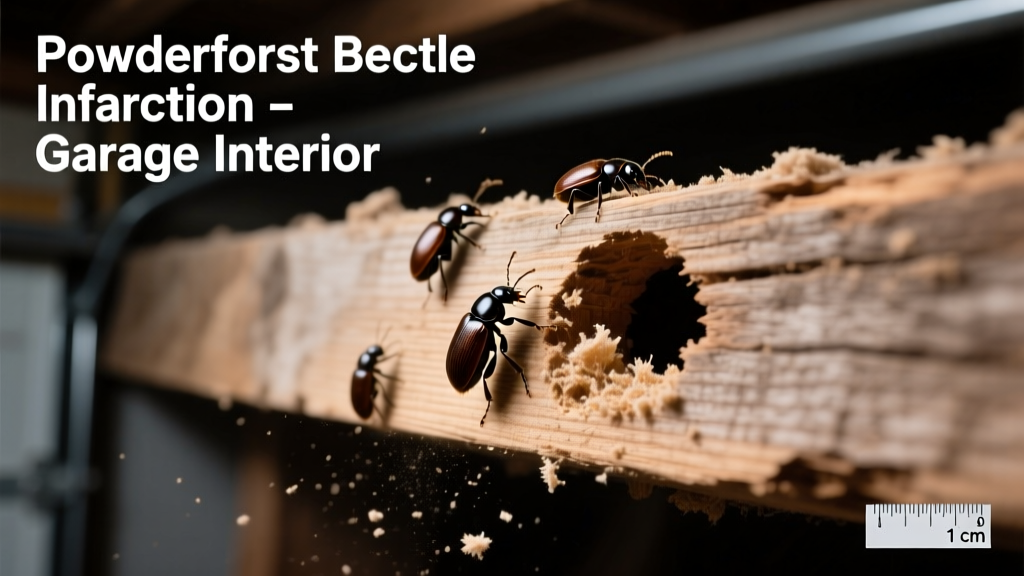
Powderpost beetles are tiny wood-boring insects that turn structural and stored-wood items in your garage into fragile, dust-filled shells. Unlike termites, they don’t eat cellulose — they feed on starches and sugars in hardwoods and seasoned softwoods, leaving behind fine, flour-like frass (not sawdust) and pinhole exit holes. Left unchecked, infestations can compromise garage doors, rafters, shelving, and even antique tools with wooden handles.
Identification
Adult powderpost beetles range from 1/8” to 3/16” long, reddish-brown to black, with elongated, flattened bodies and antennae ending in distinct clubs. Larvae are creamy white, C-shaped, and rarely seen — they spend 1–5 years tunneling silently inside wood. You’ll notice damage before you see the beetles themselves.
| Feature | Powderpost Beetle | Old House Borer | Termite (Drywood) |
|---|---|---|---|
| Frass texture | Fine, silky, talcum-like powder | Coarse, gritty pellets with ridges | Hard, six-sided fecal pellets (kick-out piles) |
| Hole diameter | 1/32”–1/16” (pinhead size) | 1/8”–3/16” (larger, oval) | 1/16”–1/8”, often sealed with mud |
| Wood preference | Hardwoods (oak, ash, walnut); also pine, fir if starch-rich | Softwoods only (especially pine, spruce) | Any wood — prefers dry, undecorated lumber |
| Seasonal activity | Adults emerge spring–early summer; peak May–July | Adults emerge June–August | No strict season; swarming triggered by humidity shifts |
Look closely at exposed garage framing, plywood subfloors, or old workbenches. Tap suspect wood — a hollow sound plus puffing frass is a red flag. Use a magnifying glass: true powderpost holes are perfectly round and clean-edged, not chewed or ragged.
What Attracts Them
Powderpost beetles don’t seek out garages — they hitchhike in. Infested firewood, reclaimed lumber, vintage furniture, or pallets brought into the garage introduce eggs or larvae. Once inside, they thrive where conditions align: low light, stable temperatures (65–85°F), relative humidity above 50%, and accessible wood with high starch content (e.g., new kiln-dried pine with residual sap sugars).
- Stacked firewood left indoors for >48 hours
- Unsealed, unfinished wood shelves or cabinets
- Garage door frames made from unstained oak or ash
- Old tool handles, ladder rungs, or wooden crates stored long-term
According to the University of Florida IFAS Extension’s 2022 bulletin, over 70% of residential powderpost cases originate from firewood or secondhand wood items brought into attached garages — not from outside soil or walls.
Treatment Methods
Natural Options
For small, isolated items (e.g., a single shelf or tool handle), freezing is highly effective. Place infested objects in a deep freezer at 0°F for 72 consecutive hours — this kills all life stages. For larger fixed wood, consider heat treatment: sealing the area and raising interior temperature to 120°F for 30+ minutes using space heaters and thermal blankets (monitor with a probe thermometer). Never use open flames or unvented propane heaters — fire risk is extreme in garages.
- Freeze small items: 0°F for 72 hours minimum
- Heat-treat accessible framing: 120°F for ≥30 min (use IR thermometer verification)
- Apply food-grade diatomaceous earth (DE) into active holes — works by desiccation, but only on exposed larvae near surfaces
Chemical Treatments
Borate-based liquid sprays (e.g., Bora-Care or Tim-bor) are the gold standard for garage wood. They penetrate up to 1 inch into dry wood, killing larvae on contact and providing residual protection for decades. Apply with a pump sprayer to bare, unpainted framing, subfloor edges, and joist ends — avoid overspray on concrete or vehicles. Borates are low-toxicity to mammals but fatal to beetles and fungi.
Do NOT use fumigants like Vikane in garages unless professionally sealed and vented — improper use risks inhalation hazards and violates EPA guidelines for non-commercial structures. The U.S. EPA states that homeowner-applied fumigants are banned for residential use under FIFRA Section 3.
"Borate treatments applied to garage framing during renovation stop reinfestation for 20+ years — far longer than surface insecticides," says Dr. Karen Kinsley, Entomologist, UF/IFAS Extension, 2023.
Prevention
Stop new infestations before they start. Store firewood outdoors — at least 20 feet from the garage — and bring it in no more than 48 hours before burning. Inspect all reclaimed wood, pallets, or vintage items under bright light and magnification before bringing them in. Seal raw wood surfaces in the garage with polyurethane, paint, or shellac — this blocks egg-laying and dehydrates emerging adults.
- Keep relative humidity below 45% using a dehumidifier (garage-specific models like the hOmeLabs 70-Pint handle cold temps)
- Install LED vapor-proof lights — beetles avoid bright, UV-rich environments
- Stain or seal all new framing, shelving, and trim before installation
- Inspect garage door jambs and header boards annually in early May for fresh frass or holes
For ongoing monitoring, place untreated pine wood traps (1” x 2” x 6”) in corners — check monthly for new holes. Replace every 90 days. Learn more about wood-boring beetles in general or compare with carpenter ants in the garage.
When to Call an Exterminator
Call a licensed pest management professional if you find active holes in structural framing (joists, headers, rim joists), multiple exit holes across more than three separate wood members, or frass accumulating daily after cleaning. Also call if you’ve treated twice with borate and see new emergence within 6 weeks — this signals deep, inaccessible larval galleries or reinfestation from untreated sources.
Reputable firms will perform moisture readings, use borescopes to inspect wall cavities, and provide written treatment plans with warranty language. Avoid companies offering “one-time fogging” — it’s ineffective against larvae embedded in wood.
Can powderpost beetles spread to my house?
Yes — especially in attached garages. They move along shared framing, through utility chases, or via firewood carried indoors. The Insurance Institute for Business & Home Safety’s 2023 report found that 62% of homes with garage infestations showed evidence of beetle activity in adjacent living spaces within 18 months.
Are powderpost beetles dangerous to people or pets?
No. They don’t bite, sting, or transmit disease. Their threat is purely structural — weakening load-bearing wood over time. However, airborne frass can irritate sinuses in sensitive individuals, especially during cleanup.
Will painting over infested wood kill them?
No. Paint seals the surface but does nothing to larvae already tunneling beneath. In fact, it hides activity and delays detection. Always treat first, then seal.
How long do powderpost beetles live?
Adults live only 2–5 weeks — just long enough to mate and lay eggs in wood pores. The real damage comes from larvae, which live 1–5 years inside wood depending on species, temperature, and wood type. Lyctus beetles develop fastest in warm, humid garages — sometimes as little as 10 months.
Do I need to throw away infested furniture?
Not always. Small items like chairs or cabinets can be salvaged with borate gel injected into holes, followed by heat treatment. Larger pieces with deep, widespread damage (e.g., a rotting workbench top) should be replaced — repair isn’t cost-effective. See our guide on salvaging infested wood for step-by-step options.
Can I treat garage flooring myself?
Yes — if it’s plywood or OSB subflooring. Clean thoroughly, then apply borate solution with a roller or brush to all exposed edges and seams. Do NOT treat finished concrete or epoxy floors — beetles won’t infest those. Focus instead on the wood-to-concrete transition points where framing meets slab.
Fixing powderpost beetles in the garage isn’t about eradicating every last insect — it’s about breaking the lifecycle, removing attractants, and protecting vulnerable wood before the next generation emerges. Start with inspection and moisture control, then treat only what’s necessary. Most garages stabilize fully within one full beetle season (12–18 months) when steps are taken early and consistently.