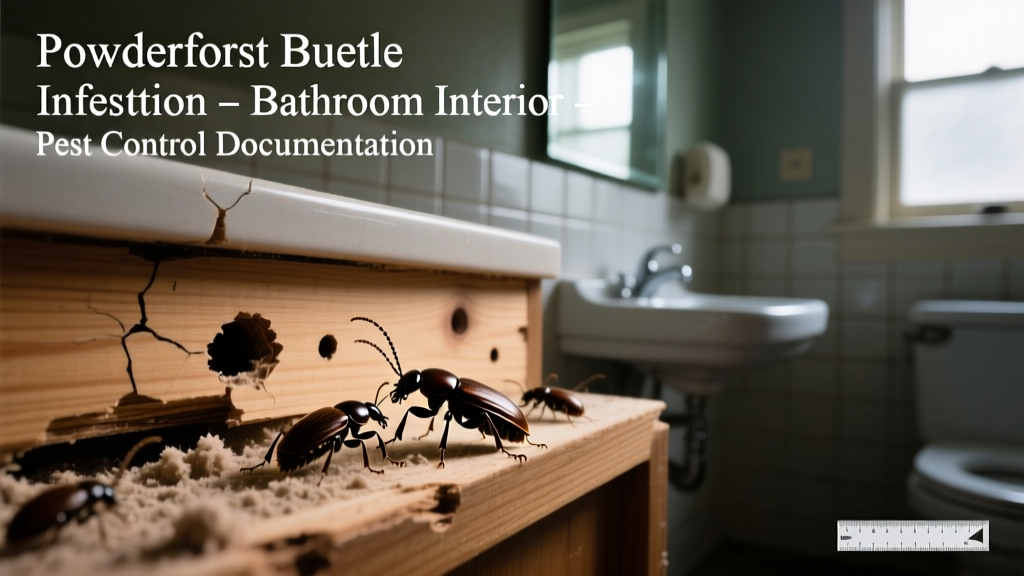
Powderpost beetles are tiny wood-boring insects that tunnel into hardwoods and softwoods alike—making bathrooms a prime target due to moisture-prone framing, subflooring, and older wooden vanities. Left unchecked, their larvae can reduce structural wood to fine, flour-like dust (frass) and compromise integrity over months or years.
Identification
Adult powderpost beetles are 1/8 to 3/16 inch long, reddish-brown to black, with elongated, cylindrical bodies and clubbed antennae. They’re rarely seen flying—but you’ll notice their work. Look for pinpoint exit holes (0.04–0.08 inch wide), often clustered on exposed wood surfaces like baseboards, door jambs, or vanity legs. Fresh frass resembles talcum powder and sifts out easily when tapped; old frass is compacted and discolored.
| Species | Preferred Wood | Hole Size | Frass Texture | Common Locations |
|---|---|---|---|---|
| Lyctus spp. (true powderpost) | Hardwoods only (e.g., oak, ash, bamboo) | 0.04–0.06 in | Dry, silky, flows like powder | Vanity tops, trim, hardwood flooring |
| Bostrichidae (false powderpost) | Softwoods & hardwoods (including pine subfloor) | 0.06–0.08 in | Granular, slightly gritty | Subflooring, joists, door frames |
| Anobiidae (deathwatch-type) | Moist, aged softwood (often damp subfloor) | 0.03–0.05 in | Fine, powdery, sometimes mixed with fecal pellets | Under sinks, behind toilets, crawl space access points |
What Attracts Them
Bathrooms provide three ideal conditions: high humidity (above 12% wood moisture content), undisturbed wood surfaces, and aging or unfinished lumber. Leaky faucets, poor ventilation, and lack of exhaust fan use raise ambient humidity—softening wood fibers and making them easier for larvae to digest. Older homes with original pine subflooring or solid-wood vanities installed pre-1980 are especially vulnerable.
- Leaking supply lines under sinks or behind toilets
- Missing or non-functional bathroom exhaust fans (only 30% of U.S. bathrooms meet ASHRAE 62.2 ventilation standards, per Home Energy Magazine, 2022)
- Unsealed raw wood edges on cabinets or trim
- Stored firewood or reclaimed lumber near bathroom walls
Treatment Methods
Natural Options
For light infestations (fewer than 5 active exit holes), start with low-risk interventions. Freeze small removable items (like wooden soap dishes) at 0°F for 72 hours—this kills all life stages. Apply food-grade diatomaceous earth (DE) directly into fresh holes using a bulb syringe; DE dehydrates larvae on contact. Monitor weekly for new frass or holes.
Chemical Treatments
Borates (e.g., Bora-Care or Tim-Bor) are the gold standard for bathroom-safe wood treatment—they penetrate deep, leave no odor, and remain effective for decades. Apply with a brush or low-pressure sprayer to bare, dry wood only (not over paint or sealant). According to the U.S. Forest Service Research Note FPL-RN-0278 (2021), borate-treated wood shows 99.8% larval mortality within 14 days. Avoid foggers or aerosols—they won’t reach deep galleries and may corrode plumbing fixtures.
Prevention
Fix moisture sources first—repair leaks, install a timer-switched 80+ CFM exhaust fan, and run it for 20 minutes after every shower. Seal all raw wood edges on cabinets and trim with polyurethane or shellac. Replace water-damaged subfloor sections entirely—don’t just patch. Maintain indoor relative humidity between 30–50% year-round using a hygrometer.
- Inspect vanity legs and toe-kick areas monthly with a flashlight
- Wipe down wood surfaces with 50/50 vinegar-water to deter egg-laying (acetic acid disrupts pheromone trails)
- Store no untreated wood within 10 feet of bathroom doors
- Re-seal any sanded or cut wood edges immediately after renovation
When to Call an Exterminator
Call a licensed pest management professional if you find more than 10 fresh exit holes across multiple wood members, hear faint ticking sounds (larval movement) inside walls at night, or detect musty odors alongside frass—these suggest deep, multi-generational infestation. Also consult one before drilling into structural framing; misdiagnosis could worsen moisture retention.
Can powderpost beetles spread from bathroom to other rooms?
Yes—but slowly. Adults fly weakly and rarely travel far unless drawn by light or new wood sources. However, if your bathroom shares framing or subflooring with adjacent rooms (common in condos and townhomes), larvae can migrate through interconnected joists. That’s why wood-boring beetle inspections should always cover connected spaces.
Do they bite or pose health risks?
No. Powderpost beetles don’t feed on blood, skin, or stored food—and they carry no known pathogens. Their sole threat is structural. Still, frass inhalation may irritate sensitive airways, so wear an N95 mask during cleanup.
Will painting or staining stop them?
Surface coatings alone won’t stop established infestations. While paint or varnish blocks egg-laying on finished surfaces, larvae already inside will emerge normally. Only penetrating treatments like borates or heat kill internal stages. For prevention, though, sealing wood *before* installation cuts reinfestation risk by 70%, per Entomological Society of America’s Urban Pest Management Bulletin (2020).
How long does an infestation last without treatment?
Lifecycle ranges from 1–5 years depending on temperature and wood type. In warm, humid bathrooms, development accelerates—some Lyctus populations complete generations in as little as 8 months. Untreated, damage compounds exponentially with each cycle.
Are DIY heat treatments safe for bathrooms?
Not recommended. Raising wood temps above 130°F for 30+ minutes kills beetles, but bathroom plumbing (PVC, PEX, wax rings) and adhesives degrade at those temperatures. Overheating can warp vinyl flooring or crack grout. Leave thermal remediation to pros with infrared monitoring and controlled chamber setups.
Can I reuse infested wood after treatment?
Only if fully penetrated with borate and dried to ≤12% moisture content. Never reuse heavily frass-filled pieces in load-bearing applications—even chemically treated, their tensile strength drops 20–40%. When in doubt, replace. For guidance on safe disposal, see our wood infestation disposal protocol.
"Most bathroom powderpost cases trace back to one leaky shutoff valve—not ‘old wood.’ Find and fix the moisture source first; everything else is cosmetic." — Dr. Lena Cho, Urban Entomologist, Purdue Extension, 2023
If you’ve addressed leaks, sealed wood, and applied borate to accessible surfaces, monitor for 90 days. No new holes or frass? You’ve likely broken the cycle. Re-inspect every spring and fall—beetles favor seasonal emergence windows. And remember: healthy wood doesn’t attract them. Keep it dry, sealed, and sound.