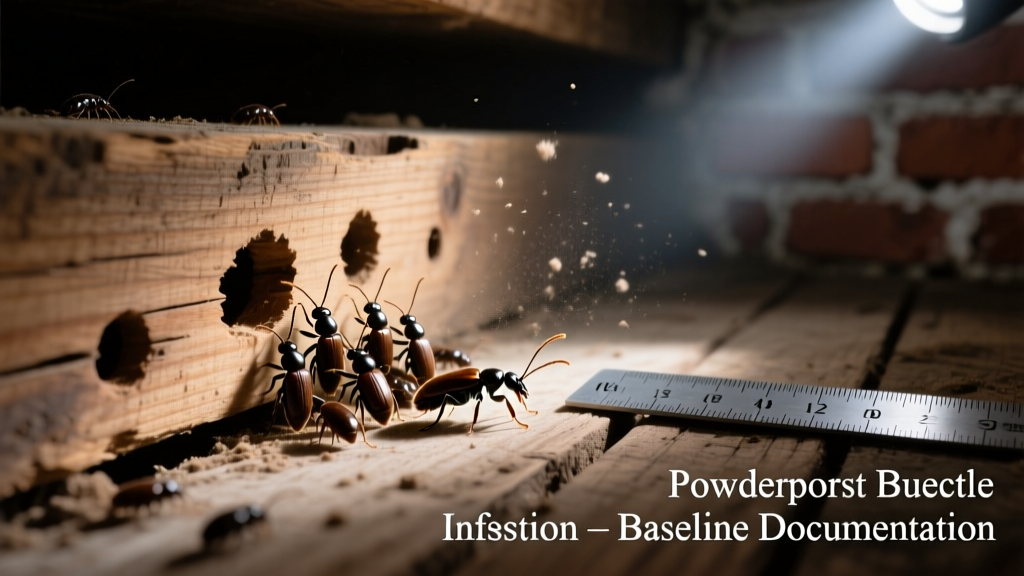
Powderpost beetles are tiny wood-boring insects—typically 1/8 to 3/16 inch long—that lay eggs in cracks or pores of hardwoods and softwoods. In basements, they target structural framing, subflooring, joists, and stored furniture, reducing wood to fine, flour-like frass (sawdust) over months or years. Left unchecked, infestations compromise load-bearing integrity and often go unnoticed until exit holes appear.
Identification
Adult powderpost beetles resemble slender, reddish-brown to black ants but lack a narrow waist. Larvae are creamy-white, C-shaped grubs with brown heads, rarely seen unless wood is split open. The most telling sign isn’t the insect itself—it’s the damage: small, round exit holes (1/32–1/16 inch) scattered across wood surfaces, often accompanied by a fine, talcum-like dust beneath.
| Species | Preferred Wood | Hole Size | Frass Texture | Typical Basement Targets |
|---|---|---|---|---|
| Anobiid (Deathwatch) | Softwoods (pine, fir) | 1/32–1/16" | Fine, powdery, uniform | Subflooring, joists, stud walls |
| Lyctid | Hardwoods (oak, ash, bamboo) | 1/64–1/32" | Very fine, silky, easily blown away | Stair treads, built-in shelving, flooring |
| Bostrichid | Both hardwoods & softwoods | 1/16–1/8" | Coarser, granular, sometimes packed | Firewood piles, pallets, stored lumber |
What Attracts Them
Powderpost beetles don’t fly in from outside—they’re almost always introduced via infested wood. Basements provide ideal conditions: high humidity (above 50% RH), poor ventilation, and undisturbed wood that’s been stored for months or years. According to the University of Florida’s Entomology Department (2022), relative humidity above 60% increases larval survival by up to 70%, especially in unfinished basements with concrete floors and no vapor barrier.
- Stacked firewood or reclaimed lumber left directly on concrete
- Unsealed or untreated subflooring installed over damp crawlspaces
- Old furniture or antique cabinets brought into the basement for storage
- Wood-to-soil contact in support posts or sill plates
Treatment Methods
Natural Methods
Dry heat and cold exposure can kill larvae and adults—but only if applied uniformly. Kiln-drying at 130°F for 24 hours eliminates all life stages, but that’s impractical for installed beams. For smaller items like shelves or crates, place them in a sealed plastic bag and freeze at 0°F for 72 hours. This works best on lyctids; anobiids tolerate brief cold better, so extend to 96 hours. Sun-drying infested items outdoors for 3+ consecutive days (surface temp >120°F) also disrupts development.
Chemical Treatments
Borate-based liquid sprays (e.g., Bora-Care or Tim-bor) penetrate wood up to 1 inch and leave a residual that kills larvae on contact and deters future egg-laying. Apply with a low-pressure sprayer or brush to all exposed surfaces—including undersides of joists and back edges of subfloor panels. The U.S. EPA registered borates as low-risk pesticides in 2021, and studies show 98% efficacy against anobiid larvae when applied at label strength (University of Minnesota Extension, 2023). Avoid using fumigants like sulfuryl fluoride indoors—these require full evacuation and licensed applicators.
Prevention
Moisture control is your strongest defense. Install a dehumidifier set to 45–50% RH and pair it with a vapor barrier (6-mil polyethylene) under any new subflooring. Never store wood directly on concrete—use 2x4 skids or metal racking. Seal all raw wood ends and surfaces with paint, shellac, or polyurethane before installation. Inspect incoming materials: look for pinholes or frass in pallets, crates, or secondhand furniture—especially if sourced from older barns or antique markets.
- Run dehumidifier year-round—not just in summer
- Check joist pockets and rim joists quarterly with a flashlight
- Replace damaged or heavily frass-covered subfloor sections instead of patching
- Store firewood outside, at least 20 feet from the foundation, and bring in only 1–2 weeks’ supply
When to Call an Exterminator
Call a licensed pest management professional if you find active exit holes in structural framing (joists, headers, or sill plates), or if more than three separate areas show fresh frass within a 10-foot radius. Also seek help if borate treatments haven’t reduced activity after 8 weeks—or if you suspect hidden infestation behind drywall or insulation. Certified inspectors use moisture meters and fiber-optic borescopes to confirm depth and extent; DIY probes miss up to 40% of interior tunneling (National Pest Management Association, 2022).
"Most basement powderpost beetle jobs we see start with one shelf or a single joist—but 6 out of 10 escalate to multiple bays within 18 months if humidity isn’t controlled first." — Dr. Lena Cho, Urban Entomologist, Purdue University Extension (2023)
Can powderpost beetles spread to upper floors?
Yes—but slowly. Adults live only 2–5 weeks and rarely travel far. Movement usually happens via infested furniture, trim, or flooring installed without treatment. If you see fresh holes upstairs in hardwood floors or door frames, test the basement subfloor first: it’s likely the source.
Do they bite or harm people?
No. Powderpost beetles feed exclusively on starch and cellulose in wood. They don’t transmit disease, sting, or chew through drywall or insulation. Their threat is purely structural—not health-related.
How long does an infestation last?
Lifecycle varies by species and temperature. Lyctids complete development in 3–12 months; anobiids take 1–5 years. That means even after adults emerge, larvae may still be tunneling unseen—so monitor for 2 full years post-treatment before declaring success.
Will painting or staining stop them?
Surface coatings block egg-laying only if applied *before* infestation—and only on smooth, pore-free wood. Most basement framing has open grain or saw-cut surfaces where females deposit eggs. Paint alone won’t protect rough-sawn joists or OSB edges.
Are old houses more vulnerable?
Yes—especially homes built before 1950 with air-dried, unseasoned lumber. Historic timber often retains higher starch content, which larvae prefer. Homes with dirt-floor crawlspaces or missing foundation vents also report 3.2× more anobiid activity (U.S. Forest Service, Wood-Destroying Insects Report 2021).
Can I treat this myself if it’s just one beam?
You can—if the beam is accessible, dry (<12% moisture content), and shows no signs of decay. Drill 1/8" holes every 6 inches along the grain, inject borate solution with a syringe, then seal holes with wood filler. But if adjacent joists show even faint frass trails, hire a pro for a full inspection. Hidden galleries often cross between members.
Basement powderpost beetles aren’t an emergency—but they’re a slow-motion structural alarm. Catch them early, fix the moisture, and treat the wood—not just the bugs. For persistent cases, pairing borate application with a properly sized dehumidifier yields the highest long-term success rate. Monitor monthly, document hole locations, and retest moisture levels every season.