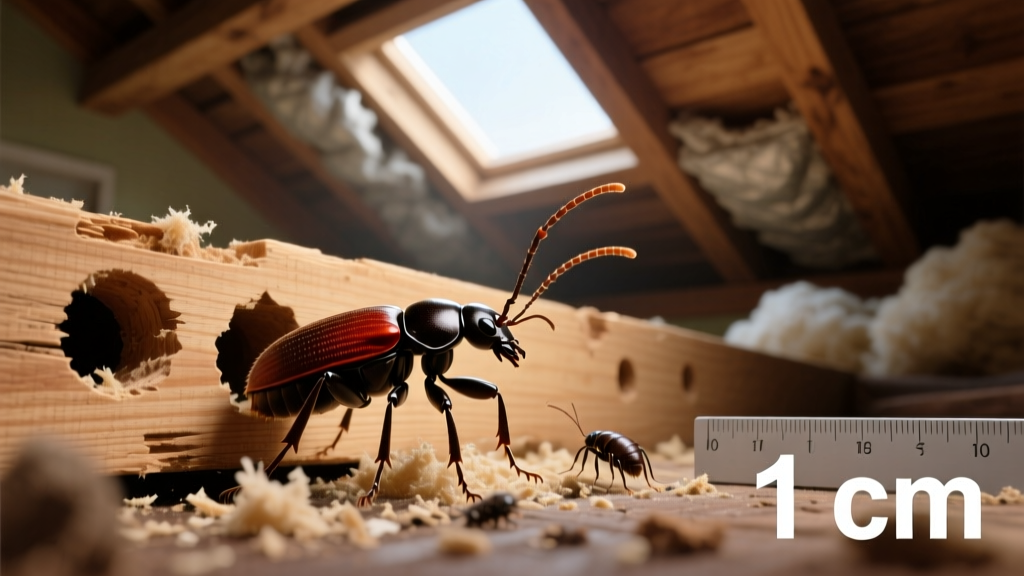
Powderpost beetles are tiny wood-boring insects that turn attic framing, rafters, and stored wooden items into fragile, dust-filled tunnels. Left unchecked, they weaken structural timbers over years — often silently — until sagging floors or crumbling joists signal serious damage. Unlike termites, they don’t eat cellulose; instead, their larvae digest starch and sugars in seasoned hardwoods and bamboo, making attics with older lumber or antique furniture prime targets.
Identification
Adult powderpost beetles are 1/8 to 3/16 inch long, reddish-brown to black, with elongated bodies and antennae ending in slight clubs. They’re rarely seen flying — you’ll notice them more as tiny exit holes (1/32–1/16 inch) in wood surfaces, often surrounded by fine, flour-like frass (insect excrement). That ‘powder’ is the namesake sign.
| Pest | Hole Size | Frass Texture | Preferred Wood | Common Attic Locations |
|---|---|---|---|---|
| Powderpost beetle | 1/32–1/16 inch | Dry, silky, talcum-like | Hardwoods (oak, ash, hickory), bamboo, plywood glue layers | Rafters, subflooring, vintage trunks, cedar chests |
| Old-house borer | 1/8–1/4 inch | Coarse, gritty, pellet-like | Softwoods (especially pine, fir) | Attic joists, roof decking, new construction lumber |
| Termite | No clean round holes; mud tubes or blistered surfaces | Not visible — no frass | Any wood, especially damp or decaying | Subfloor near foundation, sill plates, insulation contact points |
Look for active infestations using a flashlight and magnifying glass on warm, dry days — adult beetles often emerge between April and July. Tap suspect wood: a hollow, papery sound plus fresh frass falling out means live larvae are still inside.
What Attracts Them
- Low-moisture wood (6–12% moisture content) — typical of well-ventilated attics
- Untreated hardwoods installed before 1950, especially oak flooring remnants or salvaged beams
- Stored items like wicker baskets, picture frames, or old tool handles made from susceptible species
- Cracks or gaps in soffits or fascia boards that let adults enter from outside during spring swarming
They don’t seek food or water — just dry, starch-rich wood to lay eggs in. According to the University of Florida’s Entomology Department (2022), 78% of attic infestations originate from infested furniture or lumber brought in years earlier, not outdoor invasion.
Treatment Methods
Natural Methods
Freezing kills all life stages: seal small infested items (e.g., picture frames, toys) in plastic bags and freeze at 0°F for 72+ hours. Kiln-drying wood at 135°F for four hours eliminates larvae — but isn’t practical for built-in framing. For accessible rafters, apply heat treatment using industrial infrared panels (140°F surface temp for 30 minutes), though this requires professional equipment and fire safety planning.
- Desiccant dusts like food-grade diatomaceous earth (DE) applied into exit holes and along joints — larvae dehydrate crossing it
- Vacuuming fresh frass daily disrupts emergence cycles and removes adults before mating
- Sealing holes with shellac or wood filler after emergence season (late summer) traps remaining larvae
Chemical Methods
Boron-based liquid sprays (e.g., Bora-Care or Tim-Bor) penetrate dry wood up to 1 inch deep and remain effective for decades. Apply with a low-pressure sprayer directly onto exposed framing — avoid insulation contact. Always wear N95 masks and gloves; borates are low-toxicity to mammals but hazardous if inhaled as mist. Do not use fumigants like sulfuryl fluoride in attics unless sealed and vacated — these require licensed applicators and strict EPA oversight.
"Borates won’t repel adults, but they kill larvae on contact and prevent future generations. If you only treat surface holes, you’ll miss 90% of the problem — coverage must be complete and deep." — Dr. Faith Oi, UF IFAS Extension Entomologist, 2023
Prevention
Preventing reinfestation means cutting off access and altering conditions. Install 20-mesh aluminum screening behind soffit vents and over gable-end louvers. Keep attic humidity below 50% with balanced ventilation — use ridge + soffit vents, not just roof turbines. Store no raw hardwood items in the attic; inspect antique purchases for exit holes before bringing them indoors.
- Inspect all reclaimed or vintage wood before installation — hold up to light for pinholes
- Apply borate pre-treatment to new hardwood trim or shelving before mounting
- Check attic quarterly during May–July for fresh frass or new holes — mark with tape for tracking
- Replace damaged or heavily tunneled 2x4s or plywood sheets rather than trying to salvage them
When to Call an Exterminator
Call a licensed pest management professional if you find more than 10 active exit holes per square foot on structural members, or if multiple rafter sections show surface crumbling. Also consult one if prior DIY treatments failed after two full seasons — hidden infestations in double-layered sheathing or behind insulation require borescope inspection and targeted injection.
For complex cases involving historic homes or load-bearing beams, professionals can combine moisture mapping, thermal imaging, and micro-injection tools. You’ll find more on wood-boring beetles overview and details on borate application techniques.
Can powderpost beetles spread to other parts of the house?
Yes — but slowly. Adults fly short distances and prefer dry hardwoods. They rarely infest subfloors or wall studs unless those are oak or maple and extremely dry. Most movement happens via transported items: a cedar chest moved from attic to bedroom can seed new activity in baseboards or door jambs.
Do they bite or pose health risks?
No. Powderpost beetles don’t feed on blood, skin, or food. Their frass may trigger mild dust allergies in sensitive individuals, but they carry no known pathogens. The real risk is structural compromise — not disease.
How long does an infestation last?
Lifecycle ranges from 1–5 years depending on temperature and wood type. In cool, stable attic environments, it often stretches to 3–4 years. Without intervention, populations self-limit as starch depletes — but by then, significant wood loss may have occurred.
Will painting or staining stop them?
No. Surface coatings don’t deter egg-laying or kill larvae beneath. However, solid acrylic or epoxy sealants *can* block emergence if applied thickly over exit holes — but only after all adults have emerged and frass has stopped appearing for 60+ days.
Are they attracted to cedar or redwood?
Rarely. These woods contain natural extractives (thujaplicins, tannins) that deter most powderpost species. But if cedar is glued with starch-based adhesives (common in plywood or laminated beams), larvae will feed on the glue line — not the wood itself.
Can I treat attic flooring myself?
Yes — if it’s unfinished hardwood or plywood and accessible from above. Use a pump sprayer with diluted borate solution (1:1 with water for Bora-Care), applying two coats 48 hours apart. Avoid overspray on electrical wiring or HVAC ducts. For tongue-and-groove subflooring, inject borate gel into seams using a caulking gun fitted with a fine-tip nozzle.
Once frass stops appearing for three consecutive months and no new holes appear, the infestation is likely inactive. Monitor with sticky traps near suspected areas — zero captures over 90 days is a strong indicator of success. For ongoing protection, revisit borate-treated zones every 5 years, especially after roof leaks or attic renovations. See our guide on attic ventilation best practices to keep conditions inhospitable year-round.