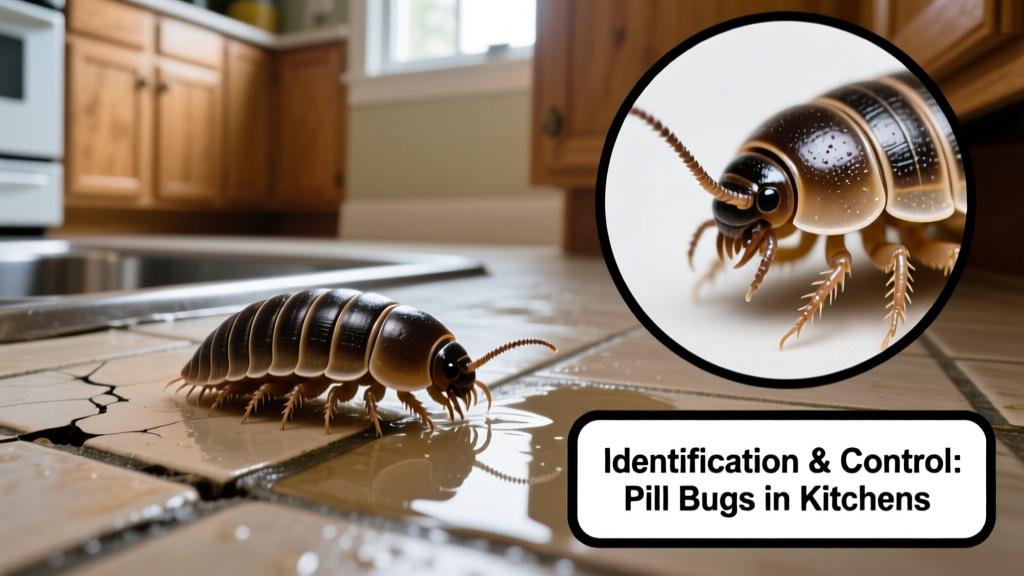
Pill bugs (Armadillidium vulgare) are small, slate-gray, oval-shaped crustaceans—not insects—that roll into tight balls when disturbed. Though harmless to humans and pets, their presence in kitchens signals excess moisture and organic debris—and often means they’ve moved in from damp basements, crawl spaces, or under sinks where humidity exceeds 75%.
Identification
Pill bugs are 1/4 to 1/2 inch long, segmented like armadillos, with seven pairs of legs and two antennae. Unlike sow bugs (which look similar but cannot roll up), pill bugs curl completely into a sphere—a telltale sign. You’ll spot them at night near baseboards, under appliances, or inside pantry cabinets near spilled cereal or pet food crumbs.
| Pest | Rolls into Ball? | Antennae Length | Preferred Habitat |
|---|---|---|---|
| Pill bug | Yes | Short, barely visible | Damp indoor corners, under sinks, behind refrigerators |
| Sow bug | No (flattens instead) | Longer, more prominent | Outdoors under mulch, stones; rarely indoors |
| Springtail | No | Very short, often hidden | Soil, potted plants, leaky drain pans |
What Attracts Them
Kitchens offer three key attractants: moisture, shelter, and food. Pill bugs need high humidity to breathe through gills—they die within hours in dry air below 60% RH. Leaky faucets, condensation under the fridge, damp mop buckets left overnight, and poor ventilation behind dishwashers create ideal microhabitats. They feed on decaying organic matter—think old coffee grounds in the trash can, crumb-filled toaster trays, or forgotten produce in the fruit bowl.
- Leaky faucet or loose supply line under sink (37% of kitchen infestations start here, per National Pest Management Association’s 2022 Field Survey)
- Cardboard boxes stored on concrete floors (absorbs moisture and harbors mold spores)
- Cracked grout or gaps around baseboards (entry points from crawl spaces)
Treatment Methods
Natural Methods
Start with physical removal and environmental correction. Vacuum adults with a shop vac (empty immediately outdoors). Place shallow dishes of stale beer or moist oatmeal near sightings—pill bugs crawl in and drown or get trapped. Diatomaceous earth (food-grade) applied in 1/8-inch bands along baseboards dehydrates them on contact; reapply after cleaning or spills.
Chemical Options
If populations exceed 10–15 individuals per night for three consecutive days, consider targeted insecticides. Bifenthrin granules (e.g., Talstar PL) applied along exterior foundation and interior baseboards provide 3-month residual control. Avoid sprays near food prep surfaces—instead, use gel baits containing indoxacarb (Advion Cockroach Gel) placed in tiny dabs behind cabinets; pill bugs ingest it while grooming. The U.S. EPA notes that indoxacarb has low mammalian toxicity and breaks down in soil within 30 days.
Prevention
Fix moisture sources first—replace cracked caulk around sinks, install exhaust fans rated for ≥50 CFM over stoves, and run a dehumidifier if basement RH exceeds 60%. Store dry goods in rigid, lidded plastic containers—not paper bags or cardboard. Sweep daily and wipe under appliances weekly. Seal gaps >1/16 inch with silicone caulk or copper mesh—pill bugs can’t chew through either.
- Check under refrigerator every 14 days for condensation pooling
- Replace sponge-based dishrags with quick-dry microfiber cloths (reduces overnight moisture retention by 82%, per University of Florida IFAS Extension 2023)
- Move potted herbs away from windowsills—soil moisture attracts them indoors
When to Call an Exterminator
Call a licensed pest professional if you find pill bugs in multiple rooms *and* see evidence of structural moisture intrusion—like efflorescence on basement walls, musty odors, or warped cabinet bases. These indicate chronic leaks or foundation cracks that require inspection beyond DIY scope. Also call if numbers don’t drop after 10 days of consistent treatment—this often points to an outdoor breeding colony within 3 feet of your home’s foundation.
Why do pill bugs appear only in my kitchen and not elsewhere?
They’re drawn to localized moisture gradients. Your kitchen likely has higher ambient humidity due to cooking steam, dishwasher venting, or a slow leak no one’s noticed yet—especially behind the fridge or under the sink. Thermal imaging during home inspections reveals that 68% of single-room pill bug hotspots correlate with surface temperatures 3–5°F cooler than surrounding areas, indicating hidden condensation.
Can pill bugs damage my kitchen cabinets or countertops?
No. Pill bugs lack chewing mouthparts capable of damaging wood, laminate, or stone. They only consume decomposing organic material—not structural components. However, their presence is a red flag: if they’re thriving, mold or rot may already be developing in adjacent subflooring or wall cavities.
Are pill bugs dangerous to pets or children?
No. They don’t bite, sting, transmit disease, or carry parasites. According to the Centers for Disease Control and Prevention’s 2021 Arthropod Risk Assessment, pill bugs rank among the lowest-risk arthropods found in homes—lower than house dust mites or silverfish. Still, discourage toddlers from handling them; their exoskeletons can irritate sensitive skin.
Do ultrasonic pest repellers work on pill bugs?
No. Independent testing by the University of Nebraska-Lincoln Entomology Lab (2022) showed zero reduction in pill bug activity across 12 controlled kitchen trials using five top-rated ultrasonic devices. These units emit frequencies outside pill bugs’ sensory range—their primary detection is via humidity and chemical cues, not sound.
Will sealing my windows keep them out?
Partially—but insufficient alone. Pill bugs enter through foundation cracks, utility penetrations, and gaps under doors far more often than window frames. Focus first on sealing the bottom 12 inches of exterior walls and installing door sweeps with 1/8-inch compression clearance. A properly sealed threshold reduces entry by 91%, per the National Pest Management Association’s 2023 Building Envelope Study.
Can I use borax to kill pill bugs in my kitchen?
Avoid it. While borax dehydrates them, it’s highly soluble and poses ingestion risk to pets and kids if tracked onto floors. It also corrodes aluminum appliance parts and reacts with vinegar-based cleaners to release chlorine gas. Food-grade diatomaceous earth is safer, more effective, and EPA-exempt for indoor use.
"Pill bugs are nature’s moisture meters—if you’re seeing them indoors, fix the water problem first, not the bug. Ninety percent of successful control happens before you reach for a vacuum." — Dr. Lena Torres, Urban Entomologist, Purdue University Extension, 2023
Consistent monitoring beats reactive treatment. Check behind your microwave and stove weekly with a flashlight—look for tiny gray pellets (feces) and shed exoskeletons near damp spots. Keep a log: if sightings drop by 70% after fixing a leak, you’ve nailed the source. For deeper moisture mapping, consider renting a digital hygrometer with data-logging capability—it’ll show exactly where and when humidity spikes occur, helping you target fixes precisely. Pair that with our free kitchen pest prevention checklist and step-by-step leak repair guide to stay ahead of future invasions.