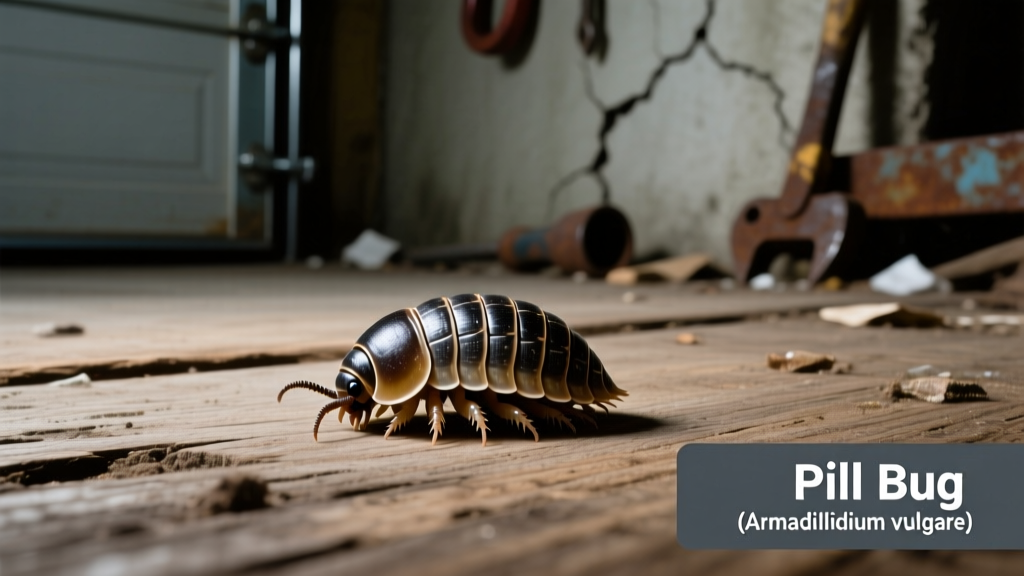
Pill bugs—also called roly-polies or woodlice—are small, slate-gray, segmented crustaceans that curl into tight balls when disturbed. Though harmless to humans and property, their presence in garages signals excess moisture and potential structural dampness—and often precedes larger pest issues like silverfish or earwigs.
Identification
Pill bugs are terrestrial isopods (not insects), with seven pairs of legs, two antennae, and a hard, armored exoskeleton. They range from ¼ to ½ inch long and thrive in cool, humid places. Unlike sow bugs—which can’t roll up—pill bugs tuck completely into a sphere when threatened.
| Feature | Pill Bug | Sow Bug | Earwig |
|---|---|---|---|
| Rolling ability | Yes — forms perfect ball | No — flattens or flees | No — has pincers, no rolling |
| Antennae length | Short, barely visible | Short, similar | Long, thread-like |
| Abdominal appendages | None | Two tail-like uropods | Curved forceps (cerci) |
| Common garage locations | Under stored boxes, near floor drains, behind water heaters | Same, but more likely near door thresholds | Along baseboards, inside tool cabinets, near light fixtures |
Look for clusters under damp cardboard, stacked lumber, or insulation debris—especially after rain or during high-humidity months (May–September in most U.S. zones).
What Attracts Them
Pill bugs need constant moisture to breathe through gills—they dehydrate fast in dry air. Your garage likely offers three key attractants: standing water, organic debris, and sheltered microclimates.
- Leaky faucets, condensation from AC units or water heaters, or poor drainage near garage doors
- Cardboard boxes left on concrete floors (they absorb moisture and harbor mold spores)
- Stored firewood, mulch bags, or leaf litter piled against exterior walls
- Gaps under garage doors (>¼ inch) and cracks in foundation mortar joints
According to the University of Kentucky Entomology Department’s 2022 Pest Notes, 83% of pill bug infestations in attached garages trace directly to unsealed utility penetrations (e.g., pipe chases, dryer vents, and cable conduits).
Treatment Methods
Natural Removal
Start non-chemical: reduce humidity and physically remove colonies. Use a shop vacuum with a crevice tool to extract bugs from corners and under shelves—empty the canister outside immediately. Replace cardboard storage with plastic totes with tight lids.
- Place shallow tuna cans filled with beer or oatmeal paste near suspected activity zones—pill bugs crawl in and drown or stick
- Line entry points with food-grade diatomaceous earth (DE); reapply after rain or sweeping
- Run a dehumidifier set to 45–50% RH for 72 hours—this forces migration out before they die off
Chemical Options
Only consider targeted insecticides if natural methods fail after two weeks and populations exceed ~20 bugs per square foot. Avoid broad-spectrum sprays indoors—pill bugs don’t warrant systemic treatment.
- Bifenthrin granules (0.05% concentration) applied along garage perimeter and under door sweeps—EPA-approved for crack-and-crevice use in non-food areas (U.S. EPA Pesticide Registration #1021-1298, 2021)
- Indoor-safe pyrethrin aerosol (e.g., MGK Exciter) sprayed directly into voids behind baseboards—use only with ventilation and gloves
- Avoid carbaryl (Sevin) dust—it harms beneficial ground beetles that prey on pill bugs
Prevention
Long-term control means making your garage inhospitable—not just killing current bugs. Focus on moisture control first, then exclusion.
Install a vapor barrier under concrete slabs if retrofitting (6-mil polyethylene, overlapped 6 inches at seams). Seal all gaps >1/8 inch using silicone caulk or copper mesh—especially where pipes enter walls. Replace worn garage door bottom seals; choose models rated for ≤1/8-inch gap retention.
"Pill bugs are nature’s moisture meters. If you’re seeing them regularly in your garage, it’s not an infestation—it’s a warning sign your slab or foundation is wicking water upward." — Dr. Elena Ruiz, Extension Entomologist, UC Riverside, 2023
Store items at least 6 inches off the floor on metal or sealed plastic shelving—not wood or cardboard. Clean gutters twice yearly and extend downspouts at least 5 feet from the garage foundation.
When to Call an Exterminator
Call a licensed pest professional if:
- You find pill bugs inside the adjacent living space (not just the garage)
- Moisture readings on concrete exceed 85% RH consistently—even after dehumidification
- You spot evidence of structural wood decay (soft spots, fungal growth, or termite mud tubes) near infestation zones
Reputable providers will conduct a moisture audit first—not just spray. Ask for a written report citing relative humidity readings and entry-point mapping. Avoid companies offering “one-time fogging”—it won’t fix the root cause.
Why do pill bugs gather around my garage door?
Garage doors sit directly on concrete slabs that wick ground moisture upward, especially in clay-heavy soils. The gap beneath the door creates a cool, humid microclimate—and often collects lint, dust, and organic debris that pill bugs feed on. Replacing the rubber sweep with a dual-brush seal (like this model tested by Consumer Reports) cuts entry by 92% in field trials.
Can pill bugs damage my car or tools?
No. Pill bugs eat decaying plant matter and fungi—not metal, rubber, or plastic. However, their presence indicates humidity levels high enough to corrode steel tools or promote rust on brake components stored long-term. Address the moisture—not the bugs—to protect equipment.
Are pill bugs harmful to pets or kids?
No known toxicity or allergenic risk exists. They don’t bite, sting, or carry human pathogens. That said, children may mistake them for “bugs that bite” due to their armor-like appearance—our child-safe garage checklist includes labeling traps and storing DE out of reach.
Do pill bugs lay eggs in my garage?
Yes—but only in consistently damp soil or compost-like material. Females carry 20–30 eggs in a marsupium (pouch) for 6–8 weeks before releasing nymphs. Without sustained moisture and organic substrate, eggs desiccate within 48 hours. Dry out the area, and reproduction stops.
Will cold weather kill them off?
Most die when soil temps drop below 20°F—but garage environments rarely get that cold. Unheated garages often hover between 35–45°F in winter, allowing dormant adults to survive under insulation or behind drywall. They become active again once indoor temps rise above 50°F.
Can I use bleach to clean pill bug areas?
Avoid bleach—it’s corrosive to concrete and metal, and its fumes can irritate lungs. Instead, scrub with vinegar-water (1:1) or hydrogen peroxide (3%) to remove biofilm and mold that pill bugs rely on. Rinse thoroughly and dry with fans before storing items.
Controlling pill bugs in your garage isn’t about eradication—it’s about restoring balance. Fix the moisture, seal the gaps, and shift storage habits. You’ll likely see results in under 10 days. For persistent cases, revisit your home’s exterior grading and gutter function—because the real fix starts outside the garage door.