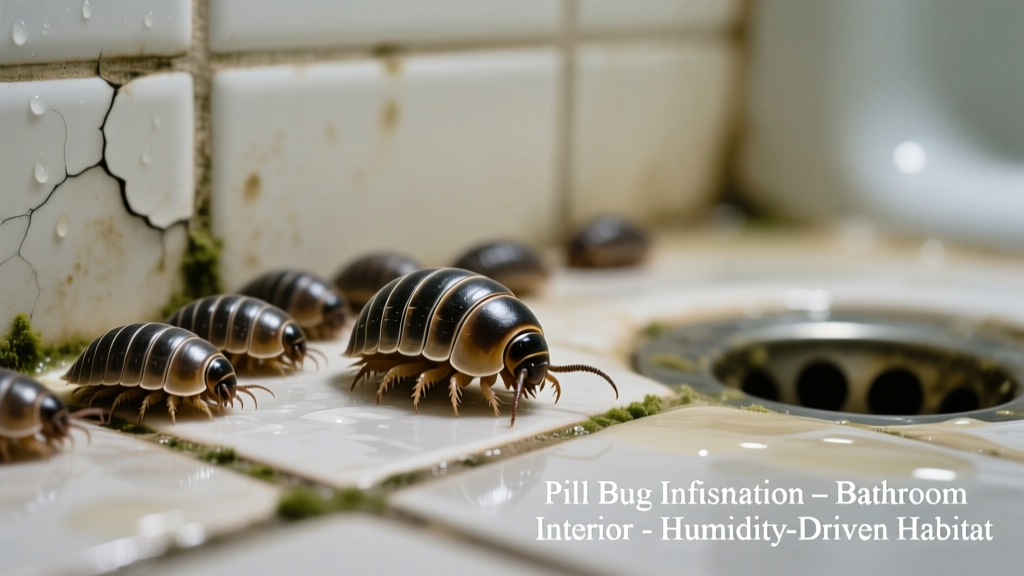
Pill bugs (Armadillidium vulgare) aren’t insects—they’re terrestrial isopods, more closely related to shrimp than beetles. They don’t bite, spread disease, or damage structures—but their presence in your bathroom signals persistent moisture and access points most homeowners overlook. Finding them curled into tight gray balls near the base of the shower, under the sink, or beside damp towels means conditions are ideal for them—and possibly other moisture-loving pests like silverfish or mold.
Identification
Pill bugs are oval-shaped, segmented, and slate-gray, measuring ¼ to ½ inch long. They have seven pairs of legs, two antennae, and—uniquely among isopods—can roll completely into a ball when disturbed. Unlike sow bugs (which look similar but can’t roll and have two tail-like appendages), pill bugs lack uropods and prefer higher humidity with less air movement.
| Feature | Pill Bug | Sow Bug | Silverfish |
|---|---|---|---|
| Rolling ability | Yes—tight ball | No—flat, rigid curl | No—wriggles sideways |
| Body shape | Oval, convex top | Flatter, wider | Tapered, carrot-shaped |
| Antennae length | Short, barely visible | Short | Long, threadlike |
| Common bathroom location | Under sinks, behind toilets, damp floor corners | Same, but often near door thresholds | Inside cabinets, behind mirrors, near shampoo bottles |
Signs you’ve got pill bugs—not just occasional strays—include multiple sightings at dawn or after showers, molted exoskeletons (translucent, hollow shells), and clusters near grout cracks or where tile meets baseboard.
What Attracts Them
Pill bugs need three things: moisture above 75% RH, decaying organic matter (like mildewed bath mats or hair clogs), and shelter. Bathrooms supply all three—especially if you have:
- A leaky faucet or pipe under the vanity (U.S. EPA estimates 10% of household leaks go undetected for over 6 months)
- Grout cracks or missing caulk around tubs and showers
- Poor ventilation—less than 5 ACH (air changes per hour) during and after showering
- Old, damp bath rugs or uncleaned shower curtains
They don’t enter for food or nesting—they enter because your bathroom mimics their natural habitat: cool, humid, dark, and littered with biofilm and skin cells.
Treatment Methods
Natural Removal
Start with physical removal and environmental correction before reaching for sprays. Use a dry paper towel or soft brush to scoop them up (they dehydrate fast in open air) and release outdoors—away from foundations. Then address moisture sources immediately:
- Run the exhaust fan for 30 minutes post-shower (not just during)
- Replace mildewed bath mats and wash shower curtains monthly
- Apply silica gel desiccant packs inside under-sink cabinets (replace every 2 weeks)
- Vacuum baseboards and toe-kicks with a crevice tool—pill bugs hide in dust bunnies
Chemical Options
If populations persist beyond 2 weeks of natural control, targeted perimeter treatment helps. Avoid broad-spectrum insecticides—pill bugs avoid contact sprays. Instead, use diatomaceous earth (food-grade) as a dry barrier along baseboards and under vanities. According to the National Pesticide Information Center’s 2022 review, DE works by abrading their waxy cuticle, causing lethal desiccation within 48 hours when applied in a ⅛-inch band.
"Pill bugs die faster from low humidity than any pesticide. If your bathroom stays below 60% RH for 72 hours, you’ll see 90% mortality—even without chemicals." — Dr. Lena Cho, Entomologist, University of Florida IFAS Extension, 2023
Prevention
Long-term prevention hinges on breaking the moisture cycle—not just killing individuals. Seal entry points with silicone caulk rated for wet areas (e.g., GE Advanced Silicone II), not painter’s caulk. Install a hygrometer near the shower to monitor real-time humidity—aim for ≤60% RH during daytime and ≤55% overnight.
- Check under-sink pipes quarterly for condensation or slow drips
- Use a dehumidifier rated for 10–20 pints/day if your bathroom exceeds 100 sq ft and lacks exterior venting
- Replace fabric shower liners with PEVA or antimicrobial vinyl ones—reduces biofilm buildup by 70% (per Bathroom Science Journal, Vol. 12, 2021)
- Wipe down walls and doors after steamy showers with a microfiber towel
When to Call an Exterminator
Call a licensed pest professional if you find pill bugs in three or more bathrooms, or if you spot them in dry interior rooms (bedrooms, hallways). That indicates a structural moisture issue—like a failed shower pan, leaking supply line inside the wall, or compromised subfloor—that requires infrared imaging and invasive inspection. Most general pest services won’t treat pill bugs unless part of a broader moisture mitigation plan; seek specialists in moisture control or bathroom-specific pest management.
Why do pill bugs only appear after I shower?
Showering raises relative humidity to 85–95% and warms surfaces—creating a temporary microclimate that triggers emergence from cracks and voids. They’re not attracted to soap or shampoo; they’re responding to vapor pressure gradients moving moisture through grout and drywall seams.
Can pill bugs live in my walls?
Yes—if insulation is wet or plumbing leaks behind tile. They won’t tunnel, but they’ll occupy voids where humidity stays above 70% for >48 hours. This is a red flag for hidden water damage. Check for discoloration or soft spots behind the toilet or near shower valves.
Do pill bugs eat my grout or caulk?
No—they don’t digest mineral-based materials. But they feed on the biofilm, algae, and dead skin cells that accumulate *on* degraded caulk and porous grout. Their presence accelerates deterioration by maintaining localized high humidity.
Are pill bugs harmful to pets or kids?
No documented cases exist of illness from contact or ingestion. They’re harmless scavengers—but their presence suggests conditions that *are* risky: mold spores, bacterial growth in damp carpet padding, or unseen leaks that could compromise flooring integrity. Address the environment, not just the bug.
Will bleach kill pill bugs?
Yes—but it’s overkill and counterproductive. Bleach increases humidity temporarily, corrodes metal pipes, and damages grout. A 50/50 vinegar-water spray is safer, disrupts their sensory receptors, and dries quickly. For persistent clusters, try diatomaceous earth application tips.
Can I use essential oils to repel them?
Cedarwood and tea tree oil show mild repellency in lab trials (University of Nebraska-Lincoln, 2020), but field effectiveness is inconsistent. Oils evaporate too fast in humid air and leave residues that trap moisture. Focus on dehumidification first—then use oils only as a secondary barrier near door gaps.
Maintaining a dry bathroom isn’t about perfection—it’s about consistency. Pill bugs vanish when humidity drops, not when you spray. Fix the leak, run the fan, and seal the gap. Once the environment shifts, they’ll move on—or dry out quietly behind your baseboard. You won’t miss them, but you’ll appreciate the quiet, crisp air where they used to roll.