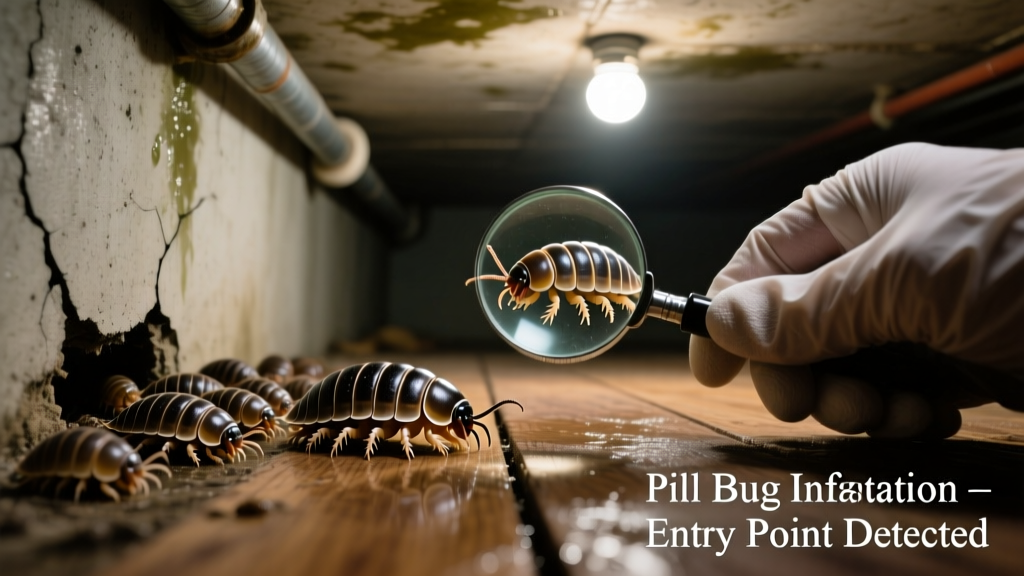
Pill bugs (Armadillidium vulgare) aren’t insects — they’re terrestrial isopods, crustaceans more closely related to shrimp than ants. Though harmless to people and property, their presence in basements signals excess moisture and potential entry points, and large clusters can alarm homeowners. They don’t bite or spread disease, but their numbers often indicate underlying moisture issues that could encourage mold or other pests.
Identification
Pill bugs are oval-shaped, slate-gray, segmented, and about 1/4 inch long. They have seven pairs of legs, two antennae, and a distinctive ability to roll into tight balls when disturbed — a behavior no sow bug (a close relative) can replicate. Unlike centipedes or silverfish, they lack wings and move slowly.
| Feature | Pill Bug | Sow Bug | Silverfish |
|---|---|---|---|
| Rolls into ball? | Yes | No — flattens instead | No |
| Body color | Gray-blue, sometimes iridescent | Gray-brown, duller | Metallic silver, shiny |
| Antennae length | Short, barely visible | Short | Long, threadlike, nearly body-length |
| Preferred habitat | Damp soil, under stones, basement corners | Similar, but tolerates slightly drier spots | Warm, humid areas near stored paper, glue, or starch |
Signs of infestation include spotting them along foundation walls, near floor drains, behind stored boxes, or clustered under cardboard or insulation debris — especially after heavy rain or during humid summer months.
What Attracts Them
Pill bugs require high humidity (70–90% RH) and access to decaying organic matter to survive. Basements become magnets when:
- Relative humidity exceeds 60% for extended periods
- There’s standing water, leaky pipes, or poor drainage around the foundation
- Cardboard boxes, old newspapers, or wood mulch are stored directly on concrete floors
- Cracks >1/16 inch exist in foundation walls, floor joints, or around utility entries
- Exterior grading slopes toward the house, pooling water near basement walls
According to the U.S. EPA’s 2022 Indoor Air Quality Guide, basements account for over 68% of documented pill bug infestations in residential structures — almost always tied to measurable moisture sources.
Treatment Methods
Natural Methods
Start with non-toxic, low-risk interventions:
- Use diatomaceous earth (food-grade) in a thin line along baseboards and cracks — dehydrates exoskeletons on contact
- Place shallow bowls of stale beer or diluted molasses near problem zones; pill bugs crawl in and drown
- Vacuum clusters with a shop vac (immediately empty outdoors — they can survive standard vacuums)
- Set rolled-up damp newspaper traps overnight; discard outside at dawn
Chemical Options
Only consider labeled insecticides if natural methods fail and populations persist beyond 2 weeks. Use products containing bifenthrin or lambda-cyhalothrin — applied as perimeter sprays *outside* foundation walls, not indoors. Never spray inside unless labeled for indoor crack-and-crevice use.
"Pill bugs rarely warrant chemical control indoors. If you’re seeing more than 10 per day in your basement, fix the moisture first — the pesticide is just a bandage." — Dr. Elena Ruiz, Entomologist, Purdue Extension IPM Program, 2023
Prevention
Long-term success hinges on altering the environment. Focus on moisture reduction and exclusion:
- Install and maintain a working sump pump with battery backup
- Run a dehumidifier set to 50–55% RH year-round (not just summer)
- Seal foundation cracks with hydraulic cement or polyurethane caulk
- Elevate stored items on plastic pallets — never cardboard or untreated wood
- Redirect downspouts at least 5 feet from the foundation and ensure soil slopes away at 1 inch per foot
Pair these steps with routine checks of window wells, French drains, and HVAC condensate lines — all common hidden moisture sources. For deep-seated moisture issues, consider installing a basement dehumidifier sized for your square footage and vapor barrier needs.
When to Call an Exterminator
Hire a licensed pest management professional if:
- You’ve reduced humidity below 55% and sealed all visible entry points, yet pill bugs reappear weekly for 3+ weeks
- You find live isopods inside wall voids (heard rustling or seen emerging from outlets)
- Moisture readings on basement walls exceed 20% (requires professional moisture meter verification)
- You suspect structural water intrusion — e.g., efflorescence, musty odor, or wet drywall patches
A qualified pro will conduct a moisture audit, inspect exterior grading and drainage, and apply targeted exterior barrier treatments — not blanket interior sprays.
Why do pill bugs only appear in my basement and not upstairs?
They can’t climb smooth vertical surfaces well and avoid light and air movement. Basements provide stable cool temperatures, higher humidity, and sheltered microclimates — conditions rarely found on upper floors. Their limited mobility means they rarely migrate upward once established below grade.
Can pill bugs damage my home?
No. They feed exclusively on decaying leaf litter, fungi, and rotting wood — not sound lumber, drywall, or wiring. However, their presence confirms decay-prone conditions that *could* support wood-destroying fungi or termites. Addressing the moisture protects against those real threats.
Do pill bugs lay eggs in my basement?
Yes — but only in consistently damp soil or compost-like material. Females carry eggs in a marsupium (pouch) for 3–4 weeks before releasing 20–30 young. Without sustained moisture and organic debris, eggs desiccate quickly on concrete or sealed floors.
Will sealing my basement windows keep them out?
Partially. Pill bugs enter through gaps under doors, utility penetrations, and foundation cracks — not window frames. Focus on threshold seals, vent covers with ≤1/16-inch mesh, and mortar repairs. A tight window helps less than fixing a 1/8-inch gap where plumbing enters the slab.
Are pill bugs attracted to LED lights?
No — they’re negatively phototactic (avoid light). Any clustering near LED fixtures is coincidental: it’s likely the fixture’s housing traps moisture or provides shelter, not the light itself. Switching bulb types won’t reduce numbers.
Can I use boric acid like I do for cockroaches?
Not effectively. Boric acid works best on insects that groom — pill bugs don’t. It also requires ingestion, and they avoid treated surfaces. Diatomaceous earth is safer and more reliably effective for isopods.
Managing pill bugs in your basement isn’t about eradicating a dangerous pest — it’s about diagnosing and correcting the dampness that lets them thrive. Once humidity drops and entry points close, populations collapse naturally within days. For persistent cases, pair environmental fixes with targeted exclusion — and remember that moisture control is always the first and most critical step. You’ll likely see results faster than with any spray or trap alone.