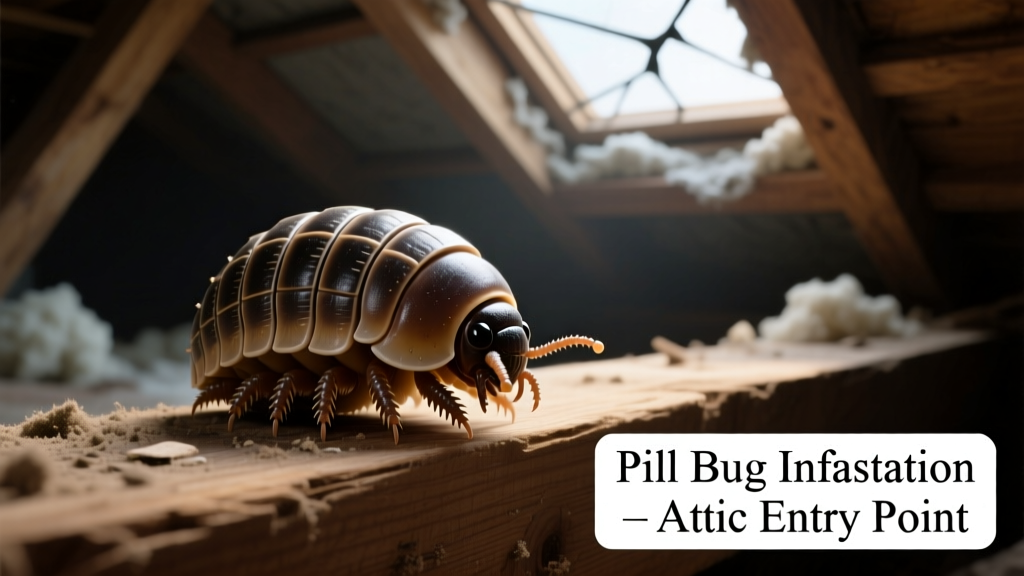
Pill bugs (Armadillidium vulgare) are terrestrial isopods—not insects—that occasionally invade attics when moisture and organic debris accumulate. Though harmless to humans and structures, their presence signals underlying moisture issues that can lead to wood decay, mold, and insulation damage—especially in older homes with poor attic ventilation or roof leaks.
Identification
Pill bugs are slate-gray, oval-shaped, and about ¼ inch long, with seven pairs of legs and two prominent antennae. When disturbed, they curl into tight, armadillo-like balls—a key trait distinguishing them from sow bugs, which flatten instead. You’ll spot them near insulation batts, under plywood subflooring, or clustered around damp rafter ties after rain.
| Pest | Size & Color | Key Behavior | Attic Risk Level |
|---|---|---|---|
| Pill bug | ¼" gray, segmented | Curls into ball; avoids light | Low structural risk, high moisture indicator |
| Sow bug | ¼" gray, flattened | Doesn’t roll; scurries sideways | Same moisture concern, less common in dry attics |
| Carpet beetle larvae | ⅛" brown/black, hairy | Feeds on wool, dust, dead insects | High—damages insulation, stored fabrics |
| Termite swarmers | ⅜" tan, wings, straight antennae | Found near light sources; shed wings | Critical—requires immediate inspection |
What Attracts Them
Pill bugs need constant humidity (75%+ RH) and decaying organic matter to survive. In attics, this means:
- Leaky roof valleys or damaged flashing allowing condensation buildup
- Wet cellulose or fiberglass insulation retaining moisture from poor ventilation
- Stored cardboard boxes, old paper, or wood shavings serving as food and shelter
- Blocked soffit vents or missing ridge vents trapping humid air
They rarely enter from outside directly—they migrate upward from crawlspaces or basements where conditions are already damp, then settle where attic microclimates mimic their native habitat.
Treatment Methods
Natural Remedies
Start with non-toxic options, especially if you’re storing valuables or have pets accessing the attic. Diatomaceous earth (food-grade) works well along joist edges and insulation seams—its microscopic shards dehydrate pill bugs on contact. Apply a 1/8-inch band where they congregate, reapplying after any humidity spike. Also try silica gel packets tucked into cardboard storage bins—they lower localized humidity enough to deter colonization.
Chemical Options
If populations exceed 20–30 individuals per square foot (common after prolonged leaks), consider targeted treatments. Bifenthrin-based dusts (e.g., Tempo Dust) applied with a hand duster into wall voids and behind insulation retain efficacy for 6–12 months. Avoid liquid sprays—they increase attic humidity and may damage vapor barriers. Never use pyrethroids near HVAC ductwork without consulting an HVAC technician first.
Prevention
Long-term control hinges on drying the attic environment. Install a smart humidity sensor (like the Govee H5179) to log readings over 72 hours—if levels consistently hit 65%+, action is needed. Prioritize these steps:
- Seal all roof penetrations (vents, pipes, chimneys) with butyl tape and roofing cement
- Add continuous soffit + ridge venting to achieve ≥1:150 net free area ratio (per EPA’s 2022 Home Ventilation Guidelines)
- Replace water-damaged insulation—wet cellulose holds 3× more moisture than fiberglass and harbors mold spores
- Store items in sealed plastic totes—not cardboard—and elevate off flooring with pallets
According to the Insurance Institute for Business & Home Safety's 2023 report, attics with balanced ventilation reduce pest-attracting humidity spikes by 68% compared to static-vented spaces.
When to Call an Exterminator
Call a licensed pest pro if you find pill bugs alongside live termites, carpenter ants, or evidence of rodent nesting (droppings, gnaw marks). Also seek help if you’ve corrected moisture issues twice and pill bugs return within 3 weeks—this often indicates an undetected leak path or cross-infestation from adjacent units in condos or townhomes. Look for providers certified by the National Pest Management Association (NPMA) who offer attic-specific moisture audits, not just spray-and-go services.
Do pill bugs eat wood or insulation?
No. Pill bugs feed exclusively on decaying plant matter and fungi. They won’t consume drywall, wood framing, or fiberglass insulation—but their presence confirms moisture levels high enough to support wood-rotting fungi like Serpula lacrymans. Fix the dampness, and the pill bugs leave; ignore it, and structural decay follows.
Can they survive winter in an attic?
Yes—if attic temps stay above 40°F and humidity remains elevated. Unlike outdoors, where freezing kills most populations, heated attics (especially above living spaces) provide year-round refuge. That’s why sightings often peak in January–February in northern climates—when indoor heating drives warm, moist air upward.
Are pill bugs dangerous to pets or children?
No known toxicity or allergenic risk exists. They don’t bite, sting, or transmit disease. However, cats sometimes ingest them while exploring—causing mild GI upset due to chitin exoskeletons. Keep pet access limited during active infestations, and vacuum rather than squish to avoid scattering fragments.
Why do I only see them at night?
Pill bugs are negatively phototactic and highly sensitive to desiccation. Attic lighting (even LED work lights) raises ambient temperature and lowers relative humidity rapidly. They retreat into insulation folds or beneath plywood decking during daylight—making flashlight inspections at dusk the most effective detection method.
Will sealing attic vents keep them out?
No—sealing vents worsens the problem. It traps moisture, encourages mold, and creates ideal pill bug habitat. Instead, install fine-mesh vent covers (1/8" aluminum screening) to block entry while preserving airflow. The U.S. Department of Energy’s 2021 Building America report confirms screened soffit vents reduce insect entry by 92% without compromising ventilation rates.
Controlling pill bugs in your attic isn’t about eradicating a pest—it’s about diagnosing and repairing a moisture symptom. Once you fix the root cause, the bugs disappear on their own. For related moisture issues, see our guides on attic condensation solutions and roof leak detection. If you’re also seeing small black beetles near stored grain or flour, check our drugstore beetle identification guide.