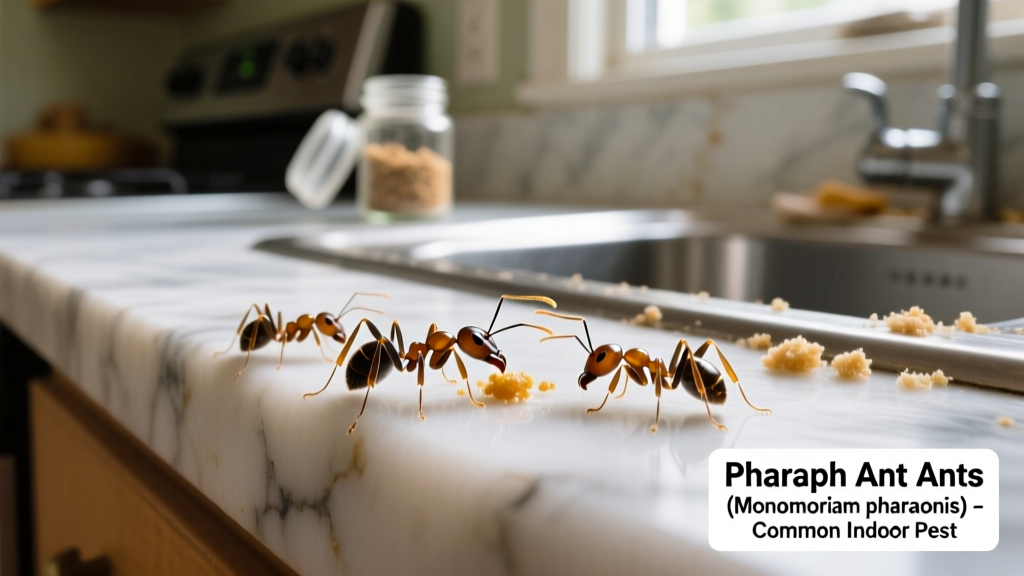
Pharaoh ants (Monomorium pharaonis) are tiny, light-yellow to reddish-brown ants that thrive in warm, humid indoor environments—especially kitchens. Unlike outdoor ants, they rarely forage outside and instead build satellite colonies inside walls, cabinets, and appliances. Their small size (1.5–2 mm), multiple queens per colony, and tendency to "bud" (split when disturbed) make them notoriously difficult to eliminate with standard sprays or baits.
Identification
Spotting pharaoh ants requires close inspection—not just because of their size, but because they’re easily confused with other small ants like thief ants or ghost ants. Look for these key traits:
- Workers are 1.5–2 mm long, with a pale yellow to light brown body and darker abdomen
- Two-segmented petiole (waist) visible under magnification
- No stinger—but they can contaminate food and medical supplies
- Trails are faint and erratic—not bold, straight lines like pavement ants
| Feature | Pharaoh Ant | Thief Ant | Ghost Ant |
|---|---|---|---|
| Size | 1.5–2 mm | 1.5–2.2 mm | 1.3–1.5 mm |
| Color | Pale yellow head & thorax; dark brown abdomen | Yellowish-brown overall; darker abdomen | Dark head & thorax; translucent white abdomen |
| Antennae segments | 12 (with 3-segmented club) | 10 (with 2-segmented club) | 12 (with 3-segmented club) |
| Preferred nesting site | Inside walls, behind baseboards, near heat sources | In wall voids, under floors, near grease/oil residues | In moist areas: sinks, dishwashers, potted plants |
What Attracts Them
Pharaoh ants aren’t drawn to sugar alone—they seek protein, grease, and moisture year-round. Kitchens offer all three: spilled oils, crumbs in toaster slots, damp sponges, and condensation behind refrigerators. They also exploit tiny gaps around plumbing and electrical conduits to move between units in multi-family buildings.
- Temperatures between 75–85°F (24–29°C)—common in heated kitchens
- High humidity (>60%) near dishwashers, coffee makers, or leaky faucets
- Access to protein-rich foods: meats, dairy, pet food, even dead insects
- Cluttered cabinets or stacked boxes that provide nesting cover
Treatment Methods
Natural Approaches
Non-chemical methods work best as stopgaps—not cures—for pharaoh ants. Boric acid dust (0.5–1% concentration) applied with a bulb duster into wall voids *can* suppress foraging workers, but it won’t reach deep colonies. Diatomaceous earth is ineffective indoors due to humidity and lacks residual action. Vinegar-water sprays disrupt trails temporarily but don’t kill queens or brood.
According to the University of Florida’s Entomology & Nematology Department (2022), “Pharaoh ant colonies contain hundreds of queens and bud rapidly when stressed—making repellent sprays counterproductive and often worsening infestations.”
Chemical Treatments
Effective chemical control relies on slow-acting, non-repellent baits—never sprays. Use gel baits containing hydramethylnon (e.g., Amdro Ant Block Gel) or sulfluramid (e.g., Combat Pharaoh Ant Killing Gel). Place bait stations directly on ant trails, not near competing food sources. Replace every 7–10 days until activity stops—typically 3–6 weeks.
“Baiting must be continuous and patient. One study found that 87% of pharaoh ant infestations treated with inconsistent baiting regimens rebounded within 14 days.” — National Pest Management Association, Ant Control Best Practices Report, 2021
Prevention
Long-term prevention focuses on eliminating access points and resources—not just killing visible ants. Seal cracks >1/16” with silicone caulk, especially where pipes enter walls. Store dry goods in rigid, lidded containers—not cardboard or thin plastic. Wipe down countertops after each use, and clean behind appliances monthly.
- Install door sweeps on exterior kitchen doors
- Fix leaky faucets and run exhaust fans during cooking
- Vacuum pantry shelves weekly—then dispose of the bag outside
- Keep trash cans sealed and take out daily, especially if storing meat scraps
When to Call an Exterminator
Call a licensed pest management professional if you see ants in more than two rooms, notice trails moving into walls or ceilings, or have had repeated bait failures over four weeks. Pharaoh ants spread rapidly between units—so if you live in an apartment or condo, notify building management immediately. Licensed pros use micro-injection tools to deliver bait into wall voids and monitor colony collapse with precision tracking.
Why do pharaoh ants avoid my ant traps?
Most commercial ant traps contain fast-acting toxins like pyrethrins or fipronil—these kill foragers instantly, triggering colony budding. Pharaoh ants need slow-acting baits that allow workers to return to the nest and share the toxin with queens and larvae. Try switching to a labeled pharaoh-specific gel bait like Advion Ant Gel.
Can pharaoh ants carry disease?
Yes. They’ve been linked to hospital-acquired infections—including Staphylococcus aureus and Salmonella—by crawling across contaminated surfaces and into sterile equipment. In homes, they pose higher risk to infants, elderly residents, and immunocompromised individuals. Learn more about kitchen pest health risks.
Do pharaoh ants bite or sting?
No. They lack a functional stinger and don’t bite humans. However, their presence signals unsanitary conditions—and their contamination of food prep surfaces is the real hazard.
Why did the ants multiply after I sprayed them?
Spraying triggers stress-induced budding: surviving queens split off with workers and brood to form new colonies elsewhere—often deeper in walls or under flooring. That’s why you’ll see more ants for 3–5 days post-spray. Stop spraying and switch to targeted baiting immediately.
Are pharaoh ants seasonal?
No. Unlike carpenter or pavement ants, pharaoh ants thrive year-round indoors. Their colonies grow fastest in winter when central heating creates ideal 80°F zones inside walls and above ceilings. You’re most likely to notice them November–March—not summer.
How long does it take to get rid of pharaoh ants?
With consistent, correct baiting, expect 3–6 weeks for full colony collapse. Monitor activity daily: if trails vanish for 72+ hours, reapply bait only in new hotspots. If activity persists beyond five weeks, suspect hidden nests behind insulation or in HVAC ducts—call a pro. See our step-by-step ant baiting checklist and download a printable kitchen pest inspection sheet.
Pharaoh ants don’t announce themselves with mounds or noise—they whisper through faint trails and tiny bodies. But once you know what to look for and how they behave, you shift from reacting to controlling. Patience, precision, and persistence are your strongest tools—not power sprays or panic moves.