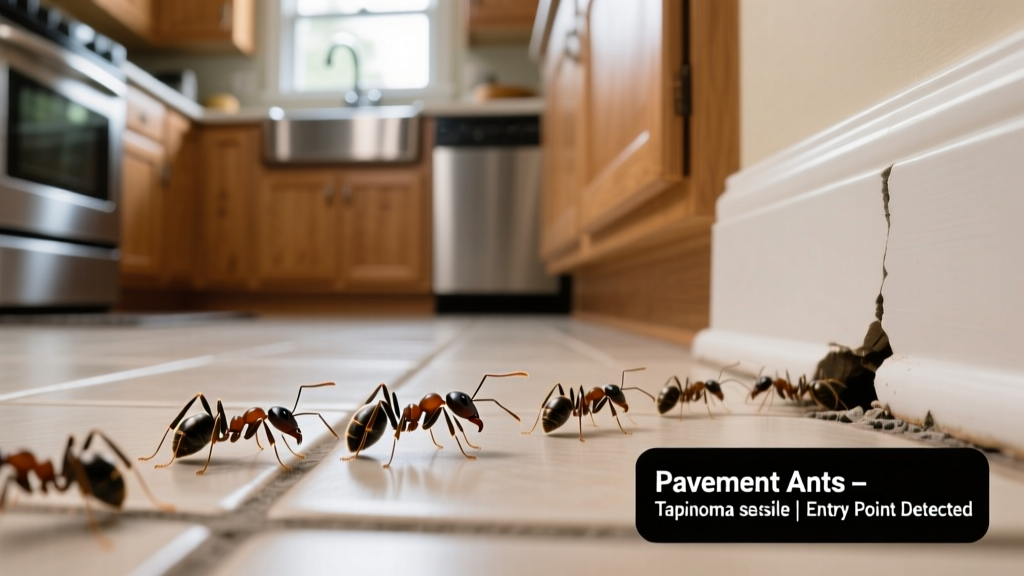
Pavement ants (Tetramorium caespitum) are small, dark brown to black ants that build nests under sidewalks, driveways, and concrete slabs — then trail indoors searching for food and moisture. In kitchens, they’re especially persistent because they exploit crumbs, grease films, and tiny gaps near baseboards or plumbing, often going unnoticed until dozens appear along countertops or inside cabinets.
Identification
These ants measure 2.5–3 mm long with a two-segmented petiole (waist), a pair of small spines on the thorax, and grooved head and thorax surfaces. Workers are uniform in size — unlike carpenter ants — and move in distinct, narrow trails rather than scattered foraging.
Key signs include:
- Fine piles of soil or sand near cracks in flooring, baseboards, or behind appliances
- Ants marching in single file toward sugar, syrup, or grease residues
- Nests visible as small mounds beneath cracked tile grout or behind refrigerator kickplates
| Feature | Pavement Ant | Odorous House Ant | Pharaoh Ant |
|---|---|---|---|
| Size | 2.5–3 mm | 2.4–3.3 mm | 1.5–2 mm |
| Color | Dark brown to black | Brown to black (darker abdomen) | Light yellow to reddish-brown |
| Trail behavior | Steady, narrow, persistent trails | Irregular, branching trails; emits coconut-like odor when crushed | Highly erratic; avoids light; nests deep in wall voids |
| Preferred nesting | Under concrete, bricks, slab foundations | Moist wood, insulation, wall voids | Warm, hidden spaces: electrical outlets, appliance motors |
What Attracts Them
Pavement ants don’t seek shelter — they seek food and water. Kitchens offer all three: spilled sweeteners, greasy stovetop residue, pet food bowls left out overnight, and condensation under leaky faucets or refrigerators. They’re also drawn to warmth radiating from dishwashers, ovens, and warming drawers.
According to the National Pest Management Association’s 2022 Ant Behavior Survey, 68% of pavement ant infestations in homes originated within 3 feet of a kitchen sink or dishwasher — not from exterior entry points alone.
- Crumb accumulation in toaster slots and behind stove ranges
- Uncleaned drip pans under burners
- Open cereal boxes or unsealed flour containers
- Loose or cracked grout between floor tiles (provides access from slab-level nests)
Treatment Methods
Natural Methods
Start with non-toxic options if you have pets, kids, or prefer low-impact solutions. Diatomaceous earth (food-grade) applied as a thin line along baseboards and under cabinets dehydrates ants on contact — but only works when dry and undisturbed. A 50/50 vinegar-water spray disrupts pheromone trails and deters re-entry when wiped on countertops and floors weekly.
Boric acid mixed with powdered sugar (1:3 ratio) makes an effective bait — worker ants carry it back to the nest, slowly eliminating queens and larvae. Place in bottle caps or shallow dishes away from foot traffic. Warning: Keep out of reach of children and pets; boric acid is toxic if ingested in quantity.
Chemical Methods
For established infestations, targeted insecticide gels deliver faster results. Advion Ant Gel (indoxacarb) and Optigard Ant Bait Gel (thiamethoxam) are EPA-registered and non-repellent — meaning ants don’t avoid them and readily share bait with nestmates. Apply pea-sized dabs every 3–4 feet along known trails, especially near cabinet hinges and where flooring meets walls.
Avoid broadcast sprays. The U.S. EPA notes that perimeter sprays often force colonies deeper into wall voids or under slabs, worsening long-term control (EPA Pesticide Fact Sheet, 2023).
Prevention
Seal entry points first — pavement ants exploit gaps as narrow as 1/16 inch. Use silicone caulk on cracks in flooring, around pipe penetrations, and behind appliances. Install door sweeps on exterior kitchen doors, and replace worn weatherstripping on pantry or utility room doors.
Store food in rigid, lidded containers — not cardboard boxes or thin plastic bags. Wipe down stovetops after each use, vacuum behind the fridge monthly, and clean inside microwaves and toasters weekly. Fix leaking faucets promptly; pavement ants detect moisture at levels below human perception.
- Empty trash daily — especially if containing fruit peels or sticky wrappers
- Wash dishes immediately or run the dishwasher the same day
- Inspect and seal gaps where utility lines enter the kitchen wall (e.g., gas lines, electrical conduits)
When to Call an Exterminator
Call a licensed pest professional if you see more than 20 ants per hour during daytime activity, notice soil piles appearing in new locations weekly, or find ants emerging from electrical outlets or behind wall-mounted cabinets. These indicate satellite nests or colony expansion beneath the slab — beyond DIY reach.
Reputable providers will conduct a full inspection, map entry routes, and apply non-repellent dusts like DeltaDust into wall voids and slab cracks — treatments unavailable to consumers.
"Pavement ants rarely respond to one-time treatments. Effective control requires disrupting both foraging behavior and nest reproduction — which means combining baiting, sealing, and sanitation over 3–4 weeks." — Dr. Elena Ruiz, Entomologist, Purdue University Extension, 2021
Can pavement ants damage my home?
No. Unlike carpenter ants or termites, pavement ants don’t chew wood or compromise structural integrity. Their presence signals moisture or food issues — not physical damage.
Do pavement ants carry disease?
They’re not primary disease vectors, but can mechanically transmit bacteria like Salmonella and E. coli after crawling across garbage, drains, or pet waste. The CDC lists them among nuisance pests with low but measurable pathogen carriage risk (CDC Environmental Health Bulletin, 2020).
Why do I see more ants after using bait?
This is normal. Bait attracts foragers, increasing visible activity for 3–7 days before decline. If numbers surge beyond 2 weeks, the bait may be stale, improperly placed, or incompatible with current colony food preferences — switch formulations or consult a pro.
Will cleaning alone get rid of them?
Cleaning reduces attraction but won’t eliminate the colony. Pavement ants nest outdoors or under slabs — so unless you seal entry points and deploy bait, they’ll return within days. Think of sanitation as step one, not the solution.
Are ultrasonic repellents effective?
No. Independent testing by the University of Nebraska-Lincoln found zero statistically significant reduction in pavement ant activity from ultrasonic devices (Entomology Field Report #NE2022-04). Save your money and focus on proven methods.
Can I use ant chalk or aerosol sprays I bought online?
Avoid ant chalk — it contains banned neurotoxins like DDT derivatives and is illegal for sale in the U.S. (U.S. CPSC Alert, 2021). Aerosol “ant killers” only kill visible workers and repel others, scattering colonies and making follow-up control harder. Stick to labeled gels or dusts applied precisely.
For ongoing kitchen pest management, pair this guide with our Kitchen Ant Prevention Checklist and How to Find Ant Nests in Walls. Consistent monitoring — especially along warm, greasy surfaces — keeps pavement ants from becoming a recurring issue. Remember: persistence beats panic. Most infestations resolve fully within 21 days when baiting, sealing, and cleaning work together.