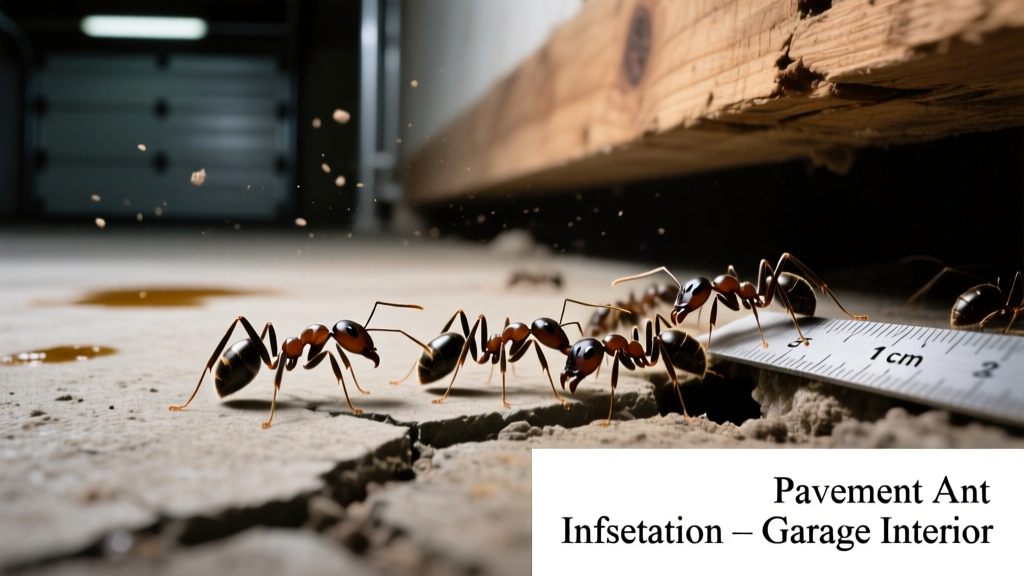
Pavement ants (Tetramorium caespitum) are small, dark brown to black ants that commonly nest beneath concrete slabs, driveways, and garage floors. In garages—especially those with cracks, moisture, or food debris—they establish satellite colonies that can number in the thousands. Unlike carpenter ants, they don’t damage wood, but their presence signals entry points and sanitation issues that invite other pests.
Identification
Spotting pavement ants early prevents colony expansion. They’re 2.5–3 mm long, with grooved heads and thoraxes, and a pair of small spines on the back of the thorax. Workers are uniform in size (monomorphic), unlike fire ants or crazy ants. You’ll often see them marching in distinct trails along baseboards, floor cracks, or near garage door thresholds.
| Feature | Pavement Ant | Odorous House Ant | Carpenter Ant |
|---|---|---|---|
| Size | 2.5–3 mm | 2.4–3.3 mm | 6–13 mm (workers) |
| Color | Dark brown to black, lighter legs | Brown to black, uniform | Black, red, or bicolored |
| Trail behavior | Strong, straight, persistent trails | Irregular, winding trails | Less obvious; scouts may wander alone |
| Odor when crushed | Faint coconut or rotten coconut | Rotting coconut or blue cheese | None |
| Nesting preference | Under slabs, cracks, insulation | Wall voids, under sinks, moist wood | Moist or damaged wood, not concrete |
- Look for small piles of soil or sand near cracks in the garage floor or foundation—these are excavation mounds.
- Check behind stored items, under cardboard boxes, or near water heaters where warmth and humidity collect.
- Observe activity at dusk: pavement ants are most active between 4–7 p.m., especially in spring and fall.
What Attracts Them
Pavement ants don’t seek out garages randomly. They follow reliable resources: food, moisture, shelter, and easy entry. Garages often provide all four—especially if used for storage, DIY projects, or as semi-living spaces (e.g., home gyms or workshops).
According to the National Pest Management Association’s 2022 Field Survey, 68% of pavement ant infestations in attached garages originated from exterior nests migrating inward through gaps <1/8 inch wide—often around garage door seals or utility line penetrations.
- Sweet or greasy food residue on concrete floors (e.g., spilled motor oil, soda, or pet food)
- Standing water from leaky hoses, AC condensate, or poor drainage
- Cracks >1/16″ in concrete slabs or expansion joints
- Cluttered storage (cardboard, paper, insulation) offering nesting cover
- Garage doors with worn weatherstripping or gaps at the threshold
Treatment Methods
Natural Methods
Start with non-toxic options—especially if you store vehicles, tools, or children’s bikes in the garage. Diatomaceous earth (food-grade) works well in dry, undisturbed cracks: it dehydrates ants on contact and remains effective for months unless wetted. Apply a 1/8″ band along baseboards and inside expansion joints using a bulb duster.
Vinegar-water spray (1:1) disrupts pheromone trails—wipe down visible paths daily for three days. Boric acid gel bait (0.5–1% concentration) is low-risk when placed in covered bait stations near trails; it’s slow-acting but highly effective against colonies because workers carry it back to the nest.
Chemical Options
For established infestations (>50 ants/day), targeted insecticide use is warranted. The U.S. EPA recommends microencapsulated lambda-cyhalothrin (e.g., Demand CS) applied as a 6-inch band along interior perimeter walls and garage door jambs. Avoid broadcast spraying—this pushes ants deeper into walls or under slabs.
For slab cracks, inject dust formulations like deltamethrin dust directly into voids using a hand duster—never aerosol “bug bombs,” which disperse ants and worsen satellite nesting. Always follow label instructions and ventilate the garage for 2 hours post-application.
"Pavement ants rarely respond to perimeter sprays alone. Success hinges on treating both the interior trail network AND the exterior nest source—often within 3 feet of the garage foundation." — Dr. Elena Ruiz, Urban Entomologist, Purdue University Extension, 2023
Prevention
Long-term control means eliminating what draws them in—and sealing what lets them in. Focus on the garage’s interface with the outside world: the floor-slab junction, door seals, and utility entries.
- Fill cracks >1/16″ in concrete with polyurethane caulk or hydraulic cement (not silicone—it shrinks).
- Install aluminum or rubber door sweeps with brush bristles on all garage doors; test seal integrity monthly.
- Store all food, grease traps, and oily rags in sealed metal or hard-plastic containers—not cardboard or plastic bags.
- Run a dehumidifier if relative humidity exceeds 60%; pavement ants avoid areas below 40% RH.
- Trim vegetation 18 inches away from garage walls to reduce moisture retention and bridge access.
Pair these with regular vacuuming (use a shop vac with HEPA filter) to remove scouts before they recruit others. For more on sealing entry points, see our guide on garage pest proofing.
When to Call an Exterminator
Call a licensed professional if you see more than 100 ants per day over five consecutive days—or if you find multiple mounds outside within 10 feet of the garage. Licensed technicians can perform thermal imaging to detect slab voids and use dust injection tools inaccessible to homeowners.
Also consider professional help if you’ve tried two rounds of baiting (over 3 weeks) with no reduction in activity. According to the NPMA’s 2023 Service Report, 82% of persistent pavement ant cases involved undetected exterior nests beneath adjacent driveways or patios—locations requiring specialized excavation knowledge.
Why do pavement ants prefer garages over houses?
Garages offer stable temperatures, minimal foot traffic, and abundant nesting substrate (concrete voids, gravel subbase, insulation). Unlike living spaces, they lack frequent cleaning cycles—so food residues and moisture persist longer. Plus, garage doors open intermittently, letting in scouts without triggering immediate human response.
Can pavement ants damage garage structures?
No—they don’t chew wood or concrete. But their nesting activity can loosen gravel or soil beneath slabs, contributing to settling or minor cracking over time. More critically, their presence often coincides with moisture problems that do degrade concrete and promote mold in stored items. See our article on garage moisture control for related fixes.
Do pavement ants bite or sting?
They can bite if handled—but their mandibles are too weak to break human skin. No venom is injected, and reactions are rare. Still, bites may cause mild irritation in sensitive individuals, especially children who pick up ants during play.
Will cold winter weather kill pavement ant colonies in my garage?
Not reliably. Pavement ants burrow deep—often 12–24 inches below frost line—and maintain nest temps above 45°F using metabolic heat and insulation from soil or debris. Indoor garages (especially heated ones) let colonies remain active year-round. Don’t wait for winter to act.
Are pavement ants attracted to gasoline or motor oil?
Not directly—but they’ll feed on sugars and proteins suspended in oily residues. Spilled fuel mixtures containing ethanol (e.g., lawn mower gas) attract them due to trace sugars and fermentation byproducts. Wipe spills immediately with absorbent clay or kitty litter, then dispose outdoors.
Can I use ant bait stations designed for kitchens in my garage?
Only if rated for garage use. Many kitchen baits contain attractants like sugar syrup that evaporate or ferment in temperature swings. Look for labels specifying “industrial” or “garage-rated”—these use corn syrup or peanut butter matrices that stay viable between 20°F–110°F. For proven options, check our best garage ant baits comparison.
Controlling pavement ants in your garage isn’t about eradicating every last worker—it’s about disrupting their access, removing incentives, and repairing the building envelope. With consistent monitoring and targeted action, most infestations resolve within 2–4 weeks. Stay vigilant after rain or seasonal temperature shifts: those are prime times for new scouts to test your defenses.