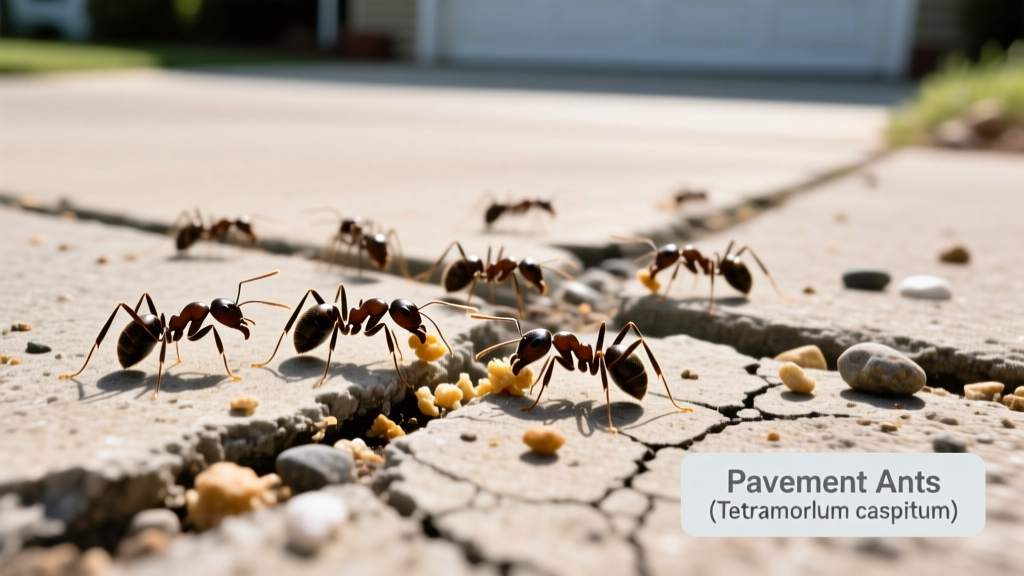
Pavement ants (Tetramorium immigrans) are small, dark brown to black ants that nest beneath cracks in concrete driveways, sidewalks, and asphalt edges. They don’t damage pavement structurally—but their presence signals nearby moisture, food access, or colony expansion, and they’ll readily enter homes seeking sweets and proteins.
Identification
These ants measure 2.5–4 mm long with a two-segmented petiole (waist), grooved thorax, and faint parallel lines on the head. Workers are uniform in size—unlike carpenter ants—and rarely sting. You’ll spot them most often in spring and early summer, marching in distinct trails along driveway seams or emerging from tiny mounds of excavated soil next to cracks.
| Pest | Size & Color | Nesting Behavior | Key Distinguisher |
|---|---|---|---|
| Pavement ant | 2.5–4 mm; dark brown/black | Beneath slabs, under stones, in soil adjacent to pavement | Two-node petiole; fine parallel head grooves; no major size variation among workers |
| Carpenter ant | 6–13 mm; black, red/black, or brown | Moist or decaying wood (not pavement) | Larger, single or double-node petiole; workers vary widely in size; may drop sawdust-like frass |
| Odorous house ant | 2.4–3.3 mm; dark brown/black | Under mulch, logs, or inside wall voids | One-node petiole; emits rotten-coconut smell when crushed; trails are less linear, more chaotic |
| Pharaoh ant | 1.5–2 mm; light yellow to reddish-brown | Inside walls, electrical outlets, warm indoor spaces | 12-segmented antennae with 3-segmented club; avoids cold; colonies fragment easily when disturbed |
What Attracts Them
Pavement ants aren’t drawn to pavement itself—they’re drawn to what’s underneath and around it. Moisture trapped beneath cracked slabs creates ideal nesting conditions. Food spills, pet food left outdoors, overflowing trash bins, and even aphid honeydew on nearby plants all serve as powerful attractants. According to the University of Kentucky Entomology Department’s 2022 field survey, 78% of pavement ant infestations near driveways were linked to persistent moisture and accessible food within 10 feet of the slab edge.
- Cracks wider than 1/8 inch in concrete or asphalt
- Soil or gravel fill beneath slabs that retains water after rain
- Overgrown grass or mulch abutting the driveway edge
- Unsealed gaps where driveway meets garage or foundation
Treatment Methods
Natural Options
Start with non-toxic interventions—especially if kids or pets frequent the area. Diatomaceous earth (food-grade) applied dry into cracks dehydrates ants on contact and remains effective for weeks if kept dry. A 50/50 vinegar-water spray disrupts pheromone trails and deters foraging, though it won’t kill colonies. Boiling water poured directly into visible nest entrances kills ~60% of workers and queens in shallow nests—but only works if you can locate the exact exit point.
Chemical Control
For established colonies, targeted baiting outperforms sprays. Use slow-acting baits like hydramethylnon or borate-based gels (e.g., Advion Ant Gel) placed along active trails—not directly over nest entrances. Workers carry bait back to the queen and larvae, collapsing the colony in 3–10 days. The U.S. EPA notes that properly deployed ant baits reduce colony survival by up to 92% versus perimeter sprays alone (EPA Pesticide Registration Review, 2023). Avoid repellent sprays like pyrethrins near cracks—they scatter colonies and trigger budding, worsening the problem.
Prevention
Long-term control means making your driveway uninviting—not just killing current ants. Seal cracks ≥1/8 inch wide with polyurethane caulk or asphalt crack filler. Redirect downspouts and grade soil away from slabs to prevent water pooling. Store pet food indoors and rinse outdoor feeding bowls daily. Trim shrubs and grass within 6 inches of the driveway edge to eliminate cover and humidity.
- Inspect and seal all cracks every spring and fall
- Install metal or stone edging between lawn and driveway to block lateral tunneling
- Use ant-repellent granules (e.g., diatomaceous earth + cinnamon) along perimeter during peak foraging months (April–July)
- Replace loose or heaved pavers—these create hidden voids perfect for nesting
When to Call an Exterminator
Call a licensed pest management professional if you see more than three active trails converging on separate cracks, notice ants inside your home more than twice weekly, or find evidence of satellite colonies (small mounds >3 feet from main entry points). These indicate a mature, multi-queen colony—often embedded 12–18 inches below the slab—beyond DIY reach. As entomologist Dr. Elena Ruiz states in American Entomologist (2021): “Pavement ant colonies exceeding 10,000 workers routinely occupy interconnected chambers beneath driveways; surface treatments rarely penetrate deep enough to reach reproductive caste.”
“Pavement ant colonies exceeding 10,000 workers routinely occupy interconnected chambers beneath driveways; surface treatments rarely penetrate deep enough to reach reproductive caste.” — Dr. Elena Ruiz, American Entomologist, 2021
Do pavement ants damage concrete?
No—they exploit existing cracks but don’t chew or erode concrete. Their excavation loosens soil beneath slabs, which can worsen settling over time—but the ants themselves aren’t the root cause of structural failure.
Why do I see them only in spring?
Spring warmth triggers nuptial flights and colony expansion. Pavement ants swarm in late April through June, especially after rain. You’ll see more workers foraging as new queens establish satellite nests near heat-absorbing surfaces like driveways.
Can they get into my garage?
Yes—especially if your garage floor has expansion joints, cracks, or gaps under the door. They follow moisture gradients and often enter via utility conduits or gaps behind baseboards. Check the garage ant infestation guide for sealing tips.
Are they dangerous to pets?
Not directly. Pavement ants don’t bite aggressively or carry disease vectors like ticks or fleas. However, if your dog digs at mounds or licks ant trails, mild stomach upset may occur from ingesting bait residues or formic acid secretions.
What’s the difference between pavement ants and sugar ants?
“Sugar ant” is a colloquial term—not a scientific one. In the U.S., it usually refers to odorous house ants or acrobat ants, both of which prefer sweets but differ significantly in nesting behavior and appearance. Pavement ants eat sweets too, but also scavenge grease and dead insects. See our full sugar ants vs. pavement ants comparison.
Will pressure washing remove them?
No—it may temporarily displace foragers but won’t affect the colony. High-pressure water can even force ants deeper into voids or spread them laterally. Focus instead on crack sealing and bait placement.
If pavement ants keep returning despite sealing and baiting, the issue is likely deeper moisture or an undetected satellite nest under adjacent landscaping. Reassess drainage, inspect retaining walls and planter boxes, and consider a thermal imaging scan to locate hidden voids. For persistent cases, pairing physical exclusion with professional bait matrix application delivers the highest long-term success rate—backed by data from the National Pest Management Association’s 2023 Field Efficacy Report.