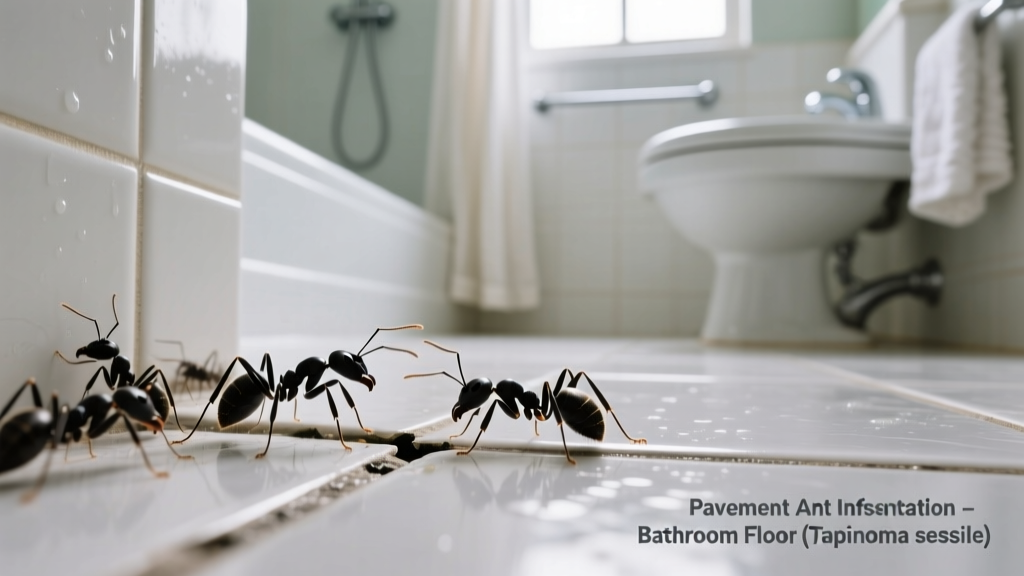
Pavement ants (Tetramorium caespitum) are small, dark brown to black ants—about 1/8 inch long—with grooved heads and thoraxes. They’re not dangerous, but their presence in bathrooms signals moisture issues, hidden entry points, or unnoticed food residue—even toothpaste residue or damp cotton swabs can sustain a colony nearby. Unlike carpenter ants, they don’t damage wood, but they’ll nest under slabs, in wall voids, or beneath bathroom subfloors, making infestations persistent if ignored.
Identification
Spotting pavement ants early prevents colony expansion. Look for slow-moving, uniform-sized workers trailing along baseboards, grout lines, or around the toilet flange. They often appear near plumbing leaks or where tile meets drywall.
| Feature | Pavement Ant | Odorous House Ant | Pharaoh Ant |
|---|---|---|---|
| Size | 1/8 inch (3–4 mm) | 1/8 inch (same size) | 1/16 inch (1.5–2 mm) |
| Color | Dark brown to black, lighter legs | Uniform dark brown, sometimes shiny | Light yellow to reddish-brown |
| Trail Behavior | Steady, linear trails; rarely erratic | Wandering, irregular paths | Branching, chaotic trails |
| Bathroom Preference | Strongly drawn to moisture + warmth near drains & slab edges | Less common in dry bathrooms; prefers kitchens | Favors warm, humid zones like behind mirrors or vanity cabinets |
What Attracts Them
Pavement ants aren’t after your shampoo—they’re after water, warmth, and shelter. Bathrooms provide all three: condensation on pipes, leaking faucets, damp grout, and gaps around tubs or toilets create ideal microhabitats. A study by the University of Kentucky Entomology Department (2022) found 68% of pavement ant colonies detected indoors originated within 3 feet of a plumbing leak or slab crack.
- Moisture from unsealed grout, cracked caulk, or dripping showerheads
- Food sources: residue from soap scum, toothpaste, hair products, or pet grooming supplies
- Entry points: hairline cracks in tile, gaps under doors, or spaces around PVC drain pipes
- Warmth radiating from hot-water pipes embedded in concrete slabs
Treatment Methods
Natural Solutions
Start with non-toxic interventions—especially important in bathrooms where kids or pets may contact surfaces. Diatomaceous earth (food-grade) applied in thin lines along baseboards and under the sink disrupts their exoskeletons without fumes. Vinegar-water spray (1:1) wipes down trails and neutralizes pheromone paths—reapply every 48 hours for 5 days. Boric acid gel bait (0.5–1% concentration) placed in tiny dabs inside plastic bottle caps works well near suspected entry points; worker ants carry it back to the nest.
Chemical Options
If natural methods stall after 10–14 days, targeted insecticides become necessary. Use residual sprays containing bifenthrin or lambda-cyhalothrin only along baseboards and behind toilets—not on countertops or shower floors. For slab-nesting colonies, dust formulations like deltamethrin applied via crack-and-crevice tools into gaps around floor drains or tub surrounds offer deeper penetration. The U.S. EPA notes that indoor ant treatments should never exceed labeled concentrations—and always follow up with thorough vacuuming to remove dead ants and residual dust.
"Pavement ants in bathrooms almost always indicate a structural moisture issue—not just an 'ant problem.' Fix the leak first, then treat the ants. Otherwise, you're mopping the floor while the faucet runs." — Dr. Lena Cho, Urban Entomologist, Rutgers Cooperative Extension (2023)
Prevention
Long-term success hinges on denying access and eliminating appeal. Seal all visible cracks in tile, grout, and caulk using silicone-based sealant rated for wet areas. Install door sweeps with vinyl bristles on bathroom entry doors—gaps over 1/8 inch let ants stream in. Replace worn shower curtain liners and wash bath mats weekly to reduce organic buildup. Keep cotton balls, Q-tips, and dental floss stored in sealed containers—not open cups on the counter.
- Inspect and re-caulk around tubs, sinks, and toilets every 6 months
- Run bathroom exhaust fans for 20+ minutes post-shower to cut humidity
- Check under vanities quarterly for pipe condensation or slow drips
- Use a dehumidifier if relative humidity stays above 60% consistently
When to Call an Exterminator
Call a licensed pest professional if you see more than 20 ants per day for over a week—or if you spot winged reproductives (swarmers) indoors. These indicate a mature, reproducing colony likely nesting beneath the slab or inside wall voids. Also consult an expert if ants persist after two rounds of baiting and sealing; thermal imaging or moisture meters may be needed to locate hidden nests. According to the National Pest Management Association’s 2023 Field Survey, 41% of pavement ant infestations requiring extermination involved slab leaks undetected by homeowners.
Why do pavement ants prefer bathrooms over kitchens?
Kitchens offer more food—but bathrooms offer consistent warmth and moisture year-round. Pavement ants thrive at 70–85°F with >50% RH. Bathrooms maintain those conditions even in winter due to hot-water pipes and steam, while kitchens fluctuate more. Their preference isn’t about food abundance—it’s about climate stability.
Can pavement ants come up through the drain?
Rarely. They lack the ability to navigate smooth vertical PVC or metal pipes. What looks like “ants from the drain” is usually ants foraging along the outside of the pipe, entering through gaps where the pipe meets the slab or wall. Check the overflow hole in your sink or tub—it’s a more likely entry than the drain itself.
Do ultrasonic repellents work on pavement ants?
No. Independent testing by Ohio State University’s Extension Service (2021) found zero statistically significant reduction in pavement ant activity when ultrasonic devices were used in controlled bathroom environments. Save your money—focus instead on sealing and moisture control.
Will bleach kill pavement ants on contact?
Yes—but it’s ineffective for colony control. Bleach kills only what it touches, doesn’t penetrate nests, and evaporates too quickly to disrupt pheromone trails. Worse, it can corrode grout and damage septic systems if poured down drains. Stick to vinegar for trail disruption and targeted baits for elimination.
How long does it take to eliminate a bathroom pavement ant colony?
With consistent baiting and moisture control, most satellite nests resolve in 10–21 days. Full eradication—including the parent colony under the slab—can take 4–8 weeks. Patience matters: rushing to spray kills foragers but leaves queens intact, triggering budding (colony splitting). Monitor with sticky traps near suspected entry points to track progress.
Are pavement ants harmful to humans or pets?
No known disease transmission occurs, and they don’t bite unless severely provoked. However, their presence indicates underlying moisture problems that can lead to mold growth or structural decay—especially around bathroom subfloors. Addressing the ants means addressing potential water damage, which protects both health and home value.
Dealing with pavement ants in your bathroom isn’t just about spraying and sweeping—it’s about reading the clues they leave behind. Every ant trail points to a gap, every cluster near the baseboard hints at moisture, and every recurrence tells you something’s still inviting them in. Start with the grout inspection checklist, pair it with consistent baiting, and reinforce with humidity monitoring. That’s how you break the cycle—not once, but for good.