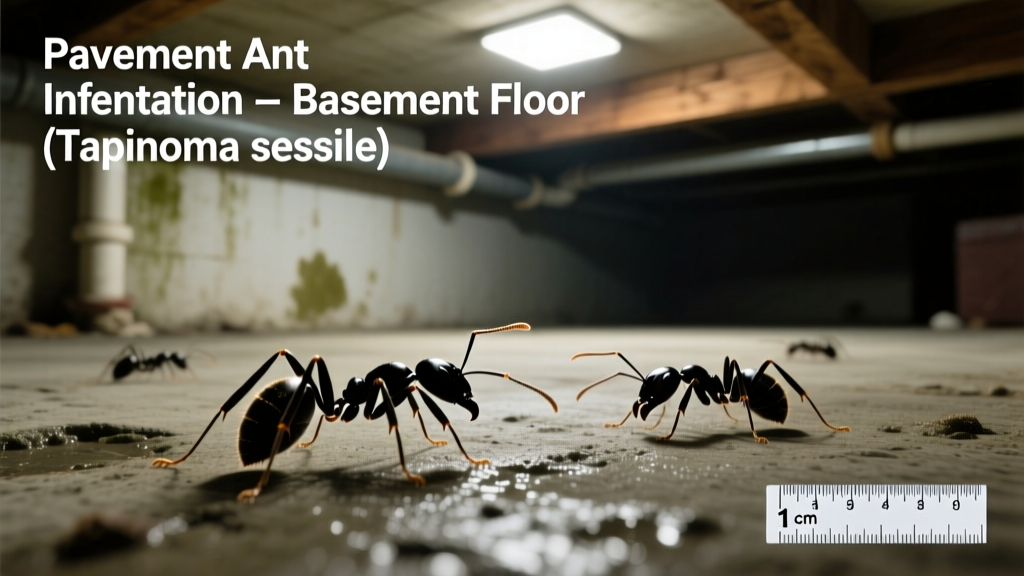
Pavement ants (Tetramorium caespitum) are small, dark brown to black ants commonly found nesting under concrete slabs, driveways, and—increasingly—inside basements. Unlike carpenter ants, they don’t damage wood, but their presence signals moisture issues, structural gaps, or nearby food sources—and colonies can exceed 10,000 workers.
Identification
Spotting pavement ants early prevents colony expansion. They’re 2.5–4 mm long with grooved head and thorax, a pair of spines on the back of the thorax, and a 12-segmented antenna ending in a distinct 3-segmented club. Workers are uniform in size (unlike odorous house ants), and you’ll often see them marching in straight lines along floor cracks, near sump pumps, or behind baseboards.
| Feature | Pavement Ant | Odorous House Ant | Carpenter Ant |
|---|---|---|---|
| Size | 2.5–4 mm | 2.4–3.3 mm | 6–13 mm (workers) |
| Color | Dark brown to black | Brown to black, uniform | Black, red/black, or brown |
| Thorax spines | Yes — two prominent | No | No (smooth, evenly rounded) |
| Smell when crushed | Faint coconut or rancid butter | Strong rotten-coconut odor | None or mild moldy scent |
| Preferred nesting site | Under slabs, foam board, insulation | Wall voids, damp cardboard, under sinks | Moist or decaying wood, foam board |
Key signs in basements include:
- Fine piles of excavated soil near expansion joints or where foundation meets slab
- Ants foraging near dehumidifiers, water heaters, or laundry areas
- Small, consistent trails leading into cracks in concrete floors or cinderblock walls
- Nesting inside EPS or XPS foam board insulation (they tunnel without eating it)
What Attracts Them
Pavement ants aren’t drawn to basements by accident—they follow reliable resources. Their top three attractants are moisture, warmth, and accessible food. Basements provide all three: condensation on pipes and cold walls creates humidity; furnaces, water heaters, and electrical panels emit low-grade heat; and crumbs, pet food spills, or even residue from cleaning products offer nutrition.
According to the National Pest Management Association’s 2022 Residential Pest Trends Report, pavement ant calls spike 37% in homes with unsealed basement rim joists or missing vapor barriers—confirming that structural gaps matter more than cleanliness alone.
- Cracks wider than 1/16″ in concrete floors or cinderblock mortar joints
- Unsealed utility penetrations (e.g., around plumbing stacks or HVAC ducts)
- Stored cardboard boxes directly on concrete (harbors moisture and provides cover)
- Leaky sump pump discharge lines or condensate drains
Treatment Methods
Natural Methods
Start with non-toxic options if the infestation is light (fewer than 50 ants/day) and no nests are visible. Diatomaceous earth (food-grade) works well when lightly dusted into cracks and behind baseboards—it dehydrates ants on contact and remains effective as long as it stays dry. Boric acid mixed at 1% concentration with powdered sugar (99% sugar, 1% boric acid) acts as a slow-kill bait—ants carry it back to the nest, poisoning the queen and larvae over 3–7 days.
Essential oil sprays (e.g., peppermint + clove + water) disrupt pheromone trails but won’t eliminate colonies. Use only as a temporary deterrent while sealing entry points.
Chemical Methods
For moderate to heavy activity (multiple trails, >100 ants/day), targeted insecticide application is necessary. The U.S. EPA recommends using gel baits containing fipronil (0.01%) or hydramethylnon (2%)—these are less toxic to humans and pets than broadcast sprays and deliver lethal doses directly to the colony.
Avoid perimeter sprays indoors unless applied by a licensed technician. Over-the-counter pyrethroid sprays (e.g., bifenthrin) may kill foraging workers but repel others, causing satellite colonies to form elsewhere in the basement.
"Pavement ants rarely nest *inside* finished basements—they almost always enter from exterior nests under the slab. If you’re seeing consistent activity near the perimeter wall, inspect the exterior grade and seal the slab-wall joint first." — Dr. Elena Ruiz, Urban Entomologist, Cornell Cooperative Extension, 2023
Prevention
Long-term control hinges on making your basement physically unwelcoming—not just temporarily ant-free. Pavement ants exploit tiny flaws, so precision matters.
- Seal all cracks >1/32″ in concrete floors and cinderblock walls with polyurethane caulk or hydraulic cement
- Install metal mesh or copper wool behind foam board insulation before drywalling
- Elevate stored items on plastic pallets—not cardboard or wood—and keep 6 inches clear of walls
- Run dehumidifiers to maintain 45–55% relative humidity year-round
- Redirect downspouts at least 5 feet from the foundation and ensure soil slopes away at 1 inch per foot
Replace damaged or compressed EPS insulation—ants tunnel through it like soft soil. Consider switching to mineral wool board in high-risk zones like rim joists and exterior walls.
When to Call an Exterminator
Hire a licensed pest professional if:
- You’ve seen more than 200 ants in a single day across multiple locations
- Soil piles reappear within 48 hours after cleaning
- You locate a nest behind drywall or inside foam board insulation
- Activity persists for more than 10 days after proper baiting and sealing
Look for technicians certified in ant-specific integrated pest management—not general “pest control” licenses. Ask for a written inspection report identifying likely entry vectors and a warranty covering retreatments for at least 90 days.
Why do pavement ants prefer basements over other parts of the house?
Basements offer stable temperatures (55–70°F year-round), higher humidity than upper levels, and direct access to exterior nests via the slab. Their natural nesting behavior targets the thermal mass and moisture retention of poured concrete foundations—making basements a logical extension of their outdoor habitat.
Can pavement ants damage my home’s structure?
No—they don’t chew wood or insulation. However, their excavation beneath slabs can undermine perimeter insulation and create pathways for moisture infiltration. In rare cases, large colonies have loosened mortar in older cinderblock foundations, accelerating deterioration.
Do pavement ants carry diseases?
They’re not known disease vectors like cockroaches or houseflies, but pavement ants can mechanically transmit Salmonella and Staphylococcus bacteria picked up from garbage, sewage, or rodent droppings. This risk increases in unfinished basements with poor sanitation or prior rodent activity.
Will vinegar kill pavement ants or just repel them?
Vinegar (5% acetic acid) disrupts pheromone trails and may kill individual ants on contact—but it evaporates quickly and has zero residual effect. It won’t reach the nest or affect queens or larvae. Use it only for spot-cleaning trails, never as a standalone treatment.
How long does it take to eliminate a pavement ant colony?
With proper bait placement and sealing, most indoor activity stops in 5–7 days. Full colony elimination—including satellite nests—takes 2–4 weeks. Monitor with sticky traps near entry points: fewer than 3 ants trapped over 72 hours indicates success.
Are pavement ants active in winter?
Yes—if basement temps stay above 50°F and moisture is present. Colonies remain active year-round in heated basements, especially near furnaces and water heaters. Activity often peaks January–February when outdoor foraging is impossible.
Consistent vigilance pays off: once sealed and dried, basements become far less attractive to pavement ants—and many other pests. Pair your ant control with a comprehensive moisture management plan and revisit your foundation crack sealing schedule every 18 months. Ants won’t return if the conditions they need disappear.