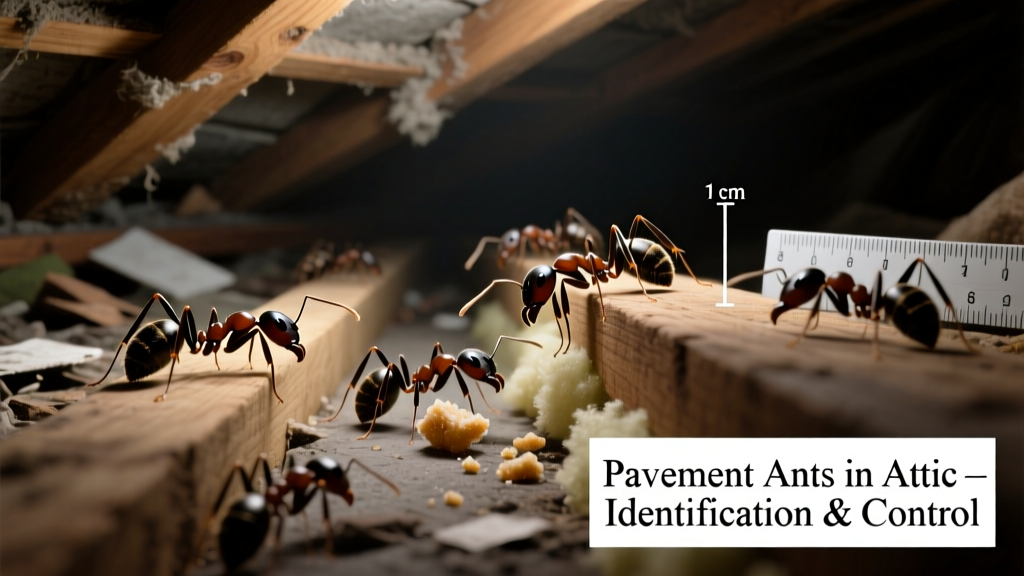
Pavement ants (Tetramorium caespitum) rarely nest in attics—but when they do, it signals a serious structural or moisture issue. Unlike carpenter ants, they don’t chew wood, but their presence in upper-level spaces means they’ve found warmth, shelter, and likely a food or water source you haven’t noticed. Left unchecked, colonies can grow to 10,000+ workers and spread into living areas.
Identification
Spotting pavement ants in the attic requires knowing what sets them apart from common attic invaders like carpenter ants or odorous house ants. They’re small (2.5–4 mm), dark brown to black, with parallel grooves on the head and thorax—and crucially, two-segmented petioles (waist segments) visible under magnification.
- Worker ants are uniform in size (no major/minor caste variation)
- Nests appear as small mounds of soil or insulation debris near rafters, soffits, or roofline gaps
- Foraging trails are faint but persistent—often along joists, ductwork, or electrical conduits
- No sawdust piles (unlike carpenter ants); instead, look for tiny granular debris mixed with dead insects or crumbs
| Feature | Pavement Ant | Carpenter Ant | Odorous House Ant |
|---|---|---|---|
| Size | 2.5–4 mm | 6–13 mm (major workers larger) | 2.4–3.3 mm |
| Color | Dark brown/black with lighter legs | Black, red/black, or solid red | Brown to black, uniform |
| Nest sign in attic | Soil-like debris near entry points | Sawdust (frass) + smooth galleries in wood | Greasy trails on beams; no debris |
| Smell when crushed | Faint musty odor | Coconut-like | Rancid butter or blue cheese |
What Attracts Them
Pavement ants prefer ground-level nests—so attic infestations almost always trace back to compromised building envelopes. They enter through cracks ≥1/16″ wide, often following utility lines, vents, or soffit gaps. Once inside, they seek three things: consistent warmth (attics hit 90°F+ in summer), moisture (leaky roofs, condensation on cold ducts), and accessible food (stored holiday decorations with candy, pet food boxes, or rodent carcasses).
According to the National Pest Management Association’s 2022 Structural Pest Report, 68% of pavement ant attic cases involved pre-existing roof leaks or improperly sealed attic hatches.
- Roof vent boots with cracked or missing sealant
- Unscreened gable or ridge vents
- Gap between chimney and framing (common in older homes)
- Insulation disturbed by squirrels or bats—creating warm, dry voids
Treatment Methods
Natural Methods
Start with non-toxic options—especially if you have pets, children, or stored heirlooms in the attic. Diatomaceous earth (food-grade) works best when puffed into wall voids behind outlets or along baseplates where ants travel. It dehydrates ants on contact but loses efficacy if damp. Boric acid bait stations (1% concentration mixed with sugar syrup) placed near trails lure workers back to the colony. Avoid spraying essential oils—peppermint or tea tree may repel but won’t eliminate nests, and vapors can damage vintage paper or fabric in storage boxes.
Chemical Methods
For established colonies, targeted insecticide dusts outperform sprays. DeltaDust (deltamethrin) lasts 6+ months in dry attic environments and is labeled for void applications. Apply only with a hand duster into cracks, behind fascia boards, and inside soffit cavities—never broadcast. The U.S. EPA estimates that improper broadcast spraying accounts for 42% of homeowner pesticide overuse in residential attics (EPA Pesticide Registration Review, 2023). Always wear an N95 mask and gloves; attic dust contains fiberglass, mold spores, and insect fragments.
"Pavement ants in attics are almost never primary nesters—they’re satellite colonies. Kill the main nest outside first, then treat the attic as a foraging corridor." — Dr. Lena Cho, Urban Entomologist, Cornell Cooperative Extension, 2021
Prevention
Sealing is non-negotiable. Use copper mesh (not steel wool—it corrodes) stuffed into gaps >1/8″, then sealed with silicone caulk rated for attic temperatures (e.g., GE Silicone II). Replace damaged soffit vents with aluminum models featuring 1/8″ mesh—standard fiberglass screening is too coarse. Store all cardboard boxes off the floor on plastic bins; pavement ants nest in corrugated cardboard left undisturbed for >3 weeks.
- Inspect attic perimeter quarterly—focus on roof-to-wall intersections
- Install vapor barrier over insulation if humidity exceeds 55% RH (use a hygrometer)
- Trim tree branches ≥6 ft from roofline to block bridge access
- Fix roof leaks within 48 hours—moisture attracts both ants and fungi that soften wood
When to Call an Exterminator
Call a licensed professional if you see more than 25 ants/hour in the attic during daylight, find multiple nest sites (≥3 distinct debris piles), or suspect the colony connects to exterior pavement nests via foundation cracks. Also consult one if your home has knob-and-tube wiring—disturbing insulation near live wires poses electrocution risk. Reputable firms will conduct thermal imaging to locate hidden nests and provide a written exclusion plan—not just a spray-and-go visit.
Do pavement ants damage attic insulation?
No—they don’t chew or burrow into fiberglass or cellulose. But their nesting debris (soil, dead insects, plant matter) can compress insulation, reducing R-value by up to 18% in localized spots (per Oak Ridge National Lab’s 2020 Building Envelope Study). Vacuum debris with a HEPA-filter shop vac before resealing.
Can pavement ants come through HVAC ducts into the attic?
Rarely—their preferred routes are structural gaps, not duct interiors. However, if duct seams are unsealed near attic registers or if flex ducts have punctures, ants may crawl along the exterior surface. Seal all duct joints with mastic (not tape) and inspect for ant trails along duct boots.
Why are pavement ants active in winter in my attic?
Attics act as thermal buffers. When outdoor temps drop below 40°F, pavement ants retreat to warmer zones—including heated attics where ambient temps stay above 55°F. Their metabolism slows, but foraging continues near heat sources like recessed lights or uninsulated chimneys.
Will attic ant bait affect bats or birds nesting nearby?
Properly placed bait stations pose minimal risk—bats avoid sweet baits, and birds rarely enter attics. Still, avoid gel baits near soffit openings used by swallows or chimney swifts. Opt for solid-form baits (e.g., Advion Ant Gel in tamper-resistant stations) mounted on joists—not loose granules.
How long does it take to eliminate an attic pavement ant colony?
With correct baiting, expect 10–21 days for full colony collapse. Dust treatments show immediate reduction but may miss queens in satellite nests. Monitor using sticky traps near suspected entry points—if catches drop >90% for 72 hours, the nest is likely neutralized. For verification, check our carpenter ants in attic guide to rule out misidentification—or compare signs with our general attic ant identification chart.
Are pavement ants attracted to attic wiring?
No—they ignore PVC-sheathed NM cable. But they’ll nest behind junction boxes where warmth, dust, and occasional food crumbs accumulate. Inspect boxes for frass-like debris and wipe interiors with a dry cloth before sealing gaps.
If you’ve addressed entry points and baited consistently but still spot ants after three weeks, revisit your moisture control strategy. Pavement ants follow humidity gradients like a compass—fixing a single leak often collapses the entire attic foraging network. For help assessing roof integrity, see our roof leak attic signs checklist.