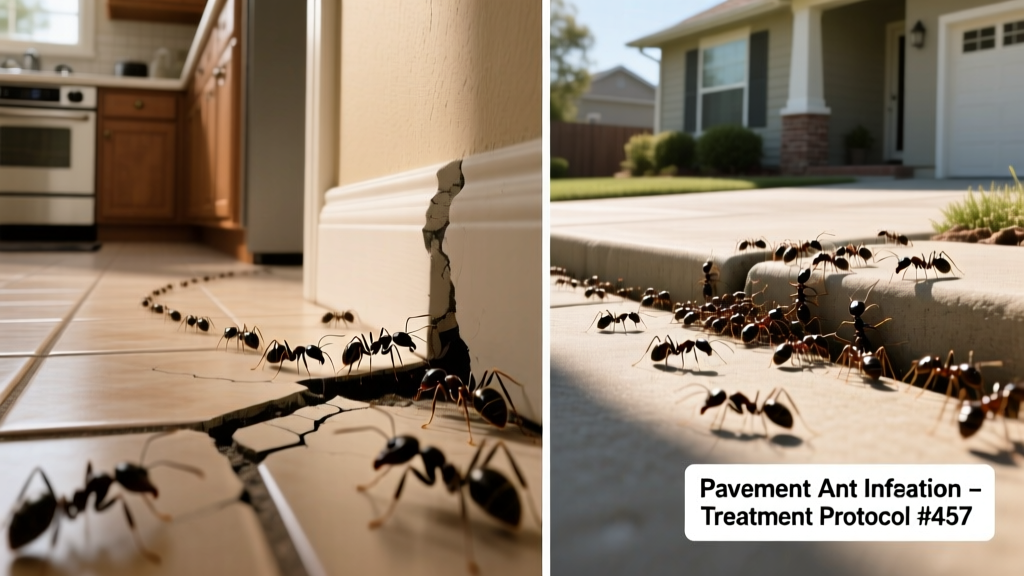
Pavement ants (Tetramorium caespitum) are small, dark brown to black ants that build nests under sidewalks, driveways, and concrete slabs—and often tunnel into basements, garages, and slab-on-grade foundations. They don’t bite or spread disease, but their presence signals structural gaps and can lead to persistent foraging in kitchens and pantries. According to the National Pest Management Association’s 2022 Field Survey, pavement ants rank among the top 5 most commonly reported ant species in northern and midwestern U.S. homes.
Identification
Spotting pavement ants early prevents colony expansion. They’re 2.5–4 mm long, with grooved thoraxes, 12-segmented antennae ending in a distinct 3-segmented club, and pale legs. Workers are uniform in size—unlike carpenter ants—and often trail in straight lines from cracks in concrete to food sources.
- Look for small mounds of soil (1–2 inches wide) near foundation cracks, patio edges, or beneath slabs
- Notice tiny piles of displaced sand or gravel near door thresholds
- Watch for slow-moving, deliberate trails—not erratic like odorous house ants
| Feature | Pavement Ant | Carpenter Ant | Odorous House Ant |
|---|---|---|---|
| Size | 2.5–4 mm | 6–13 mm | 2.4–3.3 mm |
| Color | Dark brown to black, lighter legs | Black, red/black, or solid red | Brown to black, uniform |
| Nesting site | Under pavement, stones, or slab foundations | Moist or decayed wood, wall voids | Wall voids, under insulation, near pipes |
| Smell when crushed | Faint coconut or rancid butter | None | Rotting coconut |
What Attracts Them
Pavement ants aren’t drawn to moisture like some pests—they’re after protein and sugar. Their foraging peaks March through October, especially after warm spring rains soften soil and open new entry paths. Common attractants include:
- Crumb accumulation under appliances and along baseboards
- Unsealed pet food bowls left overnight
- Gaps >1/16″ around utility lines, garage doors, and basement windows
- Outdoor grease buildup on grill areas or dumpster pads
The U.S. Department of Agriculture notes that pavement ant colonies can contain up to 10,000 workers—and multiple satellite nests may connect to one main colony under your driveway or walkway.
Treatment Methods
Natural Solutions
Start here if you have pets, kids, or prefer low-toxicity options. Diatomaceous earth (food-grade) works best when applied dry and undisturbed in wall voids, behind baseboards, and along foundation cracks. It dehydrates ants on contact—but only kills those that crawl through it. Boric acid mixed at 1% concentration with powdered sugar (e.g., 1 tsp boric acid per ¼ cup sugar) acts as a slow-kill bait: workers carry it back to the nest, poisoning the queen over 3–7 days. How to mix boric acid bait safely.
Chemical Options
For established infestations, non-repellent liquid insecticides like fipronil or imidacloprid (applied as perimeter sprays or crack-and-crevice injections) disrupt ant communication without triggering colony evacuation. Avoid pyrethroids alone—they repel ants, causing them to split nests and worsen the problem. Always follow label instructions; the EPA requires all registered products to list application rates and re-entry intervals. For indoor use, gel baits containing hydramethylnon or abamectin provide targeted control near foraging trails.
Prevention
Sealing entry points is 70% of long-term success. Use silicone caulk for gaps ≤¼″ and copper mesh + expanding foam for larger openings around pipes and conduits. Trim tree branches and shrubs at least 18″ from exterior walls to remove natural bridges. Keep mulch and firewood ≥20 feet from foundations—pavement ants avoid deep organic layers but will nest under shallow bark piles adjacent to slabs.
- Install door sweeps with ≤1/8″ gap on all exterior doors
- Vacuum kitchen floors daily during active season—not just weekly
- Store dry goods in rigid, latched containers (not cardboard or thin plastic)
- Inspect and repair cracks in concrete driveways and walkways annually
According to the University of Minnesota Extension’s 2023 Urban Entomology Bulletin, 92% of pavement ant re-infestations occur within 12 months when foundation cracks remain unsealed—even after full chemical treatment.
When to Call an Exterminator
Hire a licensed pest management professional if you see more than three distinct soil mounds within 20 feet of your home, notice ants emerging from multiple interior wall outlets or floor vents, or have tried two rounds of baiting with no reduction in activity after 14 days. Reputable firms use thermal imaging and moisture meters to locate hidden nests beneath slabs—a capability most DIYers lack. Ask for a written inspection report and warranty covering retreatments for at least 90 days.
Do pavement ants damage structures?
No. Unlike carpenter ants or termites, pavement ants don’t chew wood or compromise concrete. They excavate soil only—and their tunnels rarely exceed 18″ deep. However, their nesting can undermine thin pavers or loosen mortar joints over time.
Can pavement ants live inside walls?
Rarely—but they’ll exploit existing voids. Most interior sightings trace back to nests under the slab, with workers entering via utility penetrations or expansion joints. If you hear rustling inside walls, suspect another species like pharaoh ants or carpenter ants instead.
Why do I see more ants after using bait?
This is normal. Bait attracts foragers and stimulates increased trail activity for 2–4 days before decline begins. If numbers stay high beyond day 5, the bait may be stale, improperly placed, or mismatched to their current food preference (protein vs. sugar).
Are pavement ants seasonal?
Yes. Activity surges in spring and fall when soil temperatures hit 60–75°F. Colonies become dormant below 50°F and rarely forage above 85°F. Indoor sightings year-round usually mean the nest is under heated slab or near a furnace duct.
How fast do pavement ant colonies grow?
A single queen produces ~20 eggs/day early in colony development. It takes roughly 6–8 weeks for eggs to mature into workers. Mature colonies add ~1,000 new workers annually—and can survive 15+ years with multiple queens.
Can I use vinegar to repel pavement ants?
Vinegar disrupts scent trails temporarily but doesn’t kill ants or affect nests. It’s useful for cleaning surfaces *after* eliminating the colony—but won’t stop re-entry. For barrier use, consider diatomaceous earth or silica gel instead.
"Pavement ants are the ultimate opportunists—they don’t invade because they’re aggressive, but because we leave the front door cracked. Fix the crack, and the problem solves itself." — Dr. Elena Ruiz, Urban Entomologist, Purdue University Extension, 2021
If you’ve sealed every visible gap, cleaned thoroughly, and still see trails after two weeks of consistent baiting, revisit your exterior perimeter: check for buried landscape edging, loose brickwork, or old sewer line access points. Many pavement ant nests originate from forgotten utility trenches or abandoned septic drain fields. For more on sealing techniques, see our guide on how to seal cracks in concrete foundations. And if you’re dealing with both pavement ants and carpenter ants, confirm species first—treatment strategies differ sharply.