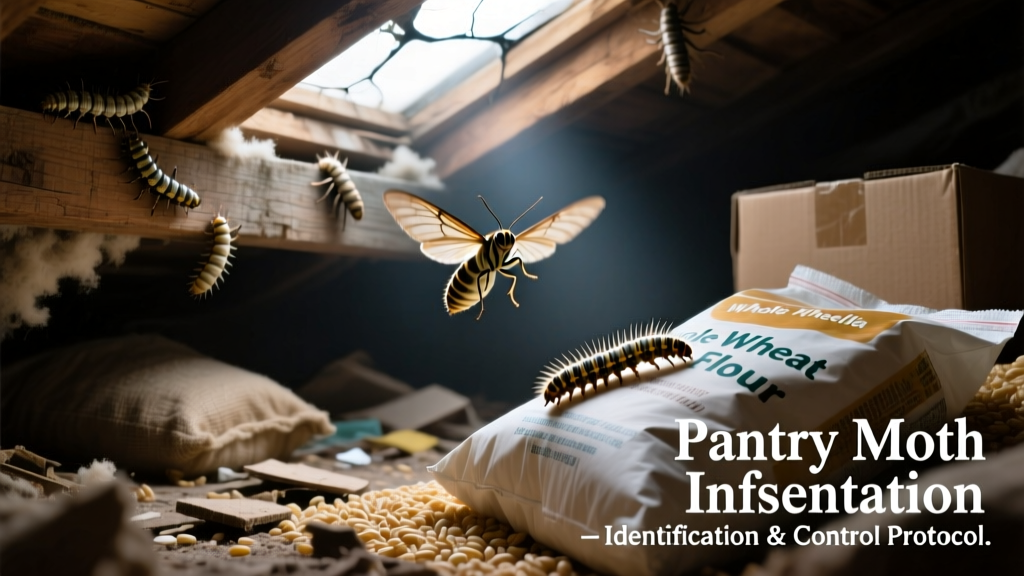
Pantry moths (primarily Indian meal moths, Plodia interpunctella) don’t belong in attics—but they show up there regularly when infested dry goods are stored overhead or when larvae migrate upward from kitchens below. Unlike clothes moths, they seek food, not fabric—and an attic full of forgotten oatmeal buckets, birdseed sacks, or holiday baking supplies becomes a breeding ground no one expects.
Identification
Adult pantry moths are small—about 3/8 inch long—with distinctive bi-colored wings: coppery-brown outer halves and pale gray near the head. You’ll spot them flying weakly at dusk near rafters or insulation gaps—not fluttering like clothes moths, but drifting like tired dust motes. Larvae are off-white caterpillars with brown heads, often found inside cardboard boxes or spinning silken webbing across joists.
| Pest | Wings | Larval Habitat | Primary Attraction |
|---|---|---|---|
| Pantry moth | Copper-gray bi-color, ½-inch wingspan | Inside grain, nuts, dried fruit, pet food | Dry stored food |
| Clothes moth | Uniform tan, narrow wings, ⅜-inch span | In wool insulation, old blankets, carpet padding | Keratin (wool, fur, feathers) |
| Webbing clothes moth | No metallic sheen; held roof-like at rest | Under attic floorboards, in soiled clothing bins | Animal-based fibers + dust |
What Attracts Them
Pantry moths don’t fly into attics looking for space—they follow food trails. Common attractants include:
- Unsealed bags of flour, rice, or cereal stored in cardboard boxes (larvae chew through cardboard easily)
- Birdseed or pet food left in plastic totes without gasketed lids
- Old holiday decorations containing dried fruit wreaths or nut-based crafts
- Insulation contaminated by rodent nests containing cached grains
According to the University of Kentucky Entomology Department’s 2022 pest survey, 68% of attic pantry moth cases traced back to improperly stored birdseed or bulk grains—often overlooked during spring cleaning.
Treatment Methods
Natural Methods
Start with non-toxic interventions that disrupt the life cycle:
- Freeze infested items at 0°F for 4 days (kills eggs and larvae)
- Vacuum all cracks along rafters and behind insulation using a HEPA-filter vacuum
- Place pheromone traps (like Trapper LTD) on attic beams—replace monthly
- Wipe joists and storage shelves with 5% vinegar solution to remove larval silk and egg residue
Chemical Methods
Only use residual insecticides if larvae persist after 10–14 days of natural treatment. Apply only to non-porous surfaces (e.g., metal shelving, concrete floors) and never directly on insulation or stored food containers:
- Pyrethrin-based aerosols (e.g., CB-80) for spot-treating active flight zones
- DeltaDust (deltamethrin) applied as a thin line along rafter ends—never in open air or near HVAC intakes
- Avoid foggers: they disperse pesticide unevenly and leave residue on insulation fibers where larvae hide
Prevention
Attic pantry moth recurrence drops sharply when storage habits change. Focus on containment and inspection:
- Store all dry goods in rigid, gasket-sealed containers—Mason jars or screw-top HDPE bins with O-ring lids
- Label and date every container; discard anything over 6 months old without opening
- Inspect new birdseed or pet food before bringing it upstairs—check for webbing or tiny holes in packaging
- Install a vapor barrier under attic flooring to block moisture that encourages mold—and the insects that feed on it
"I’ve pulled pantry moth larvae from attic insulation three times in one season—all traced to a single unsealed bag of cracked corn stored in a garage-turned-attic. Seal it, or skip it." — Carla M., certified structural pest inspector (NPMA, 2023)
When to Call an Exterminator
Call a licensed professional if:
- You find live larvae in insulation, ductwork, or wall voids (not just surface-level webbing)
- Moth activity continues for more than 3 weeks despite full treatment protocol
- You suspect rodent activity contributing to food contamination (e.g., chewed bags, droppings)
Look for firms certified in food-safe pest management, not general home exterminators—many standard treatments aren’t approved for spaces above kitchens.
Can pantry moths damage attic insulation?
No—they don’t eat fiberglass or cellulose. But their silk webbing traps dust and moisture, reducing R-value over time. More critically, their presence signals that food debris has infiltrated the space—a red flag for rodents or mold.
Do pantry moths lay eggs in ceiling tiles?
Rarely. They prefer food sources. However, if ceiling tiles are stained with spilled syrup, honey, or peanut butter (from dropped snacks during storage), yes—eggs can hatch there. Wipe down tile edges with diluted isopropyl alcohol during cleanup.
Will cold winter temperatures kill pantry moths in the attic?
Not reliably. Attics rarely stay below 20°F long enough to kill pupae. In fact, the U.S. Department of Agriculture notes that pantry moth pupae survive sustained exposure to 14°F for up to 72 hours—common in many northern attics.
Are pantry moths attracted to LED lights in the attic?
No. They’re drawn to warmth and food odors—not light spectra. But motion-sensor LEDs may startle adults into erratic flight, making them easier to spot during evening inspections.
Can I reuse attic-stored food after a moth infestation?
Only if it was sealed in impermeable containers (glass, thick plastic with locking lids) and shows zero webbing, frass, or live larvae. Discard anything in paper, cardboard, or thin plastic—even if it looks clean. Eggs are microscopic and embed in packaging fibers.
Do pantry moths come from the roof vents?
No. Adults rarely fly in from outside. They almost always hitchhike in via infested groceries or migrate upward from lower-floor pantries. Check the attic access hatch seal and kitchen ceiling penetrations (e.g., plumbing stacks) for gaps.
Dealing with pantry moths in the attic isn’t about fumigating—it’s about breaking the food chain. Most successful resolutions happen within 10 days of removing the source and sealing storage. If you’ve tackled a similar infestation, share what worked in the comments—or explore our guide on pantry moths in the kitchen for cross-contamination prevention tips.