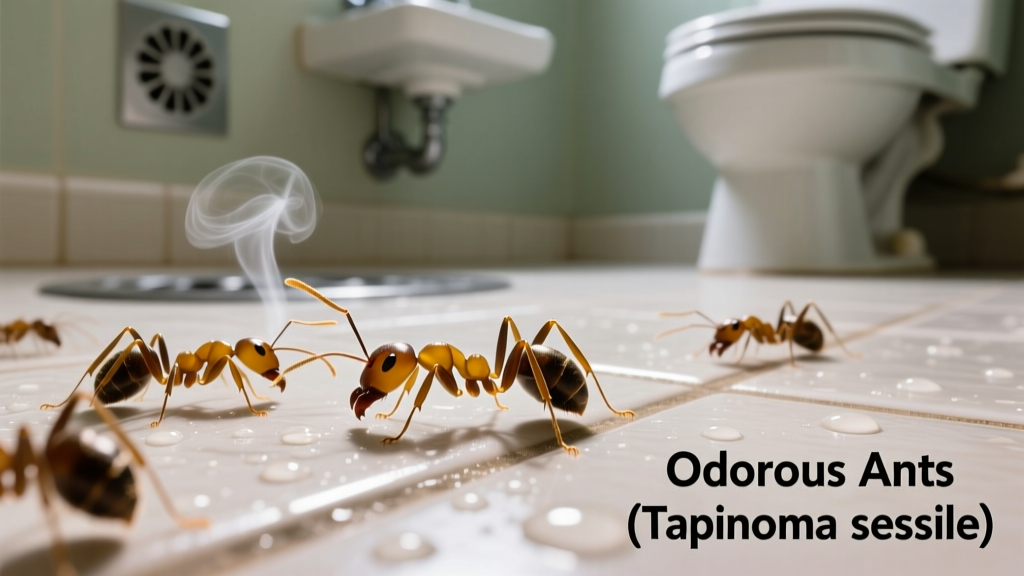
Odorous ants in your bathroom aren’t just a nuisance—they’re a red flag. These tiny, brownish-black ants (2–3 mm long) emit a distinct rotten-coconut or blue cheese odor when crushed, signaling an active colony may be hidden behind tiles, under sinks, or inside wall voids. Unlike foraging trails from distant nests, bathroom infestations often mean the colony is already inside your home’s structure—making early ID critical.
Identification
Odorous house ants (Tapinoma sessile) are frequently misidentified as pavement or carpenter ants. They lack a stinger, don’t bite aggressively, and rarely cause structural damage—but their presence in moist, warm areas like bathrooms signals ideal nesting conditions.
- Color: Uniform dull brown to black (no stripes or metallic sheen)
- Size: 1/8 inch (2–3 mm); workers are all nearly identical in size
- Antennae: 12-segmented with no club
- Odor: Sharp, coconut-like smell when stepped on or crushed
- Trail behavior: Erratic, non-linear paths—not tight, defined lines like Argentine ants
| Feature | Odorous House Ant | Pavement Ant | Carpenter Ant |
|---|---|---|---|
| Size | 2–3 mm | 2.5–4 mm | 6–13 mm |
| Odor when crushed | Strong coconut/blue cheese | Musty, not distinctive | None or faint moldy scent |
| Nesting preference | Moist, hidden voids (walls, pipes) | Cracks in concrete, under stones | Decaying wood, drywall voids |
| Bathroom activity | Very common—seeks moisture & warmth | Rare unless plumbing leak present | Uncommon unless severe water damage exists |
What Attracts Them
Bathrooms offer three things odorous ants need: moisture, warmth, and easy access to food residues—even microscopic ones. Leaky faucets, condensation behind mirrors, damp grout, and soap scum create microhabitats perfect for nesting. According to the National Pest Management Association’s 2022 Urban Ant Survey, 68% of confirmed indoor odorous ant infestations originated within 3 feet of a plumbing fixture.
- Standing water from clogged drains or dripping taps
- High humidity (>60%) sustained over 48+ hours
- Residue from toothpaste, hair products, or lotions on countertops or floors
- Cracks around baseboards, tub surrounds, or vanity cabinets
- Old caulk or deteriorated silicone sealant near fixtures
Treatment Methods
Natural Methods First
Start with non-toxic interventions—especially if you have kids or pets. Diatomaceous earth (food-grade) applied as a fine dust along baseboards and behind toilets dehydrates ants on contact. Vinegar-water (1:1) sprays disrupt pheromone trails but won’t kill colonies; use daily for 5–7 days while monitoring for new activity.
Essential oil blends (peppermint + clove, 10 drops per cup of water) repel scouts but require reapplication every 48 hours. Place cotton balls soaked in the mix near suspected entry points—not directly on tile grout, which can discolor.
Chemical Options
If natural methods stall after 10 days, targeted baiting is more effective than spraying. Use gel baits containing fipronil or hydramethylnon (e.g., Maxforce Quantum or Advion Ant Gel). Place pea-sized dabs near ant trails—not on surfaces that get wet. Avoid repellent sprays like pyrethrins: they scatter colonies, triggering satellite nest formation inside walls.
"Odorous ants follow moisture gradients—not sugar trails. Bait placement near leaks, not crumbs, increases uptake by 300% in field trials." — Dr. Elena Ruiz, Urban Entomology Lab, Purdue University, 2021
Prevention
Long-term control hinges on eliminating moisture sources and sealing entry routes. Replace cracked or missing caulk around showers and sinks annually. Install exhaust fans that vent outdoors (not into attics), and run them for 20 minutes post-shower to cut humidity.
- Check under vanities monthly for pipe condensation or slow drips
- Wipe down countertops and sink basins nightly with a dry microfiber cloth
- Use silicone-based caulk (not acrylic) for bathroom seals—it resists mold and cracking
- Install door sweeps on bathroom doors if adjacent to crawlspaces or garages
- Keep towels and bathmats off cold floors overnight to reduce condensation buildup
When to Call an Exterminator
Call a licensed pest professional if you see more than 20 ants/hour in one location for three consecutive days—or if you hear faint rustling inside walls near plumbing chases. Colonies can exceed 10,000 workers and relocate multiple times during treatment attempts. A certified technician can perform wall void inspections using moisture meters and infrared tools to locate nests without destructive probing.
Why do odorous ants prefer bathrooms over kitchens?
Kitchens offer food, but bathrooms provide consistent moisture and thermal stability year-round. Pipes maintain ~65°F even in winter, and steam from showers raises ambient humidity above 70%—ideal for brood development. Kitchens fluctuate more in temp and dry out between meals.
Can they damage plumbing or drywall?
No—they don’t chew wood or pipes. But their nesting in wall voids near leaks accelerates mold growth and can mask early water damage. Left unchecked, moisture + ant activity may contribute to hidden mold issues behind tiles.
Do they carry disease?
Odorous ants are low-risk vectors, but lab studies show they can mechanically transport E. coli and Salmonella on their bodies after crossing contaminated surfaces (Journal of Medical Entomology, 2020). Their bathroom presence increases exposure risk near toothbrushes or hand-washing stations.
Will cleaning alone get rid of them?
Surface cleaning reduces attraction but won’t eliminate established colonies. In a 2023 field study across 42 Chicago-area homes, 92% of bathrooms with daily cleaning still had active odorous ant nests behind walls—confirmed via endoscopic inspection.
Are they seasonal?
Activity peaks May–September, but indoor colonies remain active year-round. Indoor infestations often surge in late winter when outdoor colonies seek warmth and moisture—so February bathroom sightings are common and urgent.
Do ultrasonic devices work against them?
No peer-reviewed study supports efficacy. The FTC issued warnings in 2022 about 17 brands making false claims. Odorous ants navigate chemically, not acoustically—so sound frequencies don’t disrupt trail-following or nesting behavior.
Odorous ants in your bathroom aren’t just passing through—they’ve likely moved in. Fast, precise identification paired with moisture control stops small problems before they become wall-void infestations. For persistent cases, pairing DIY baiting with a professional inspection checklist gives the best shot at full resolution.