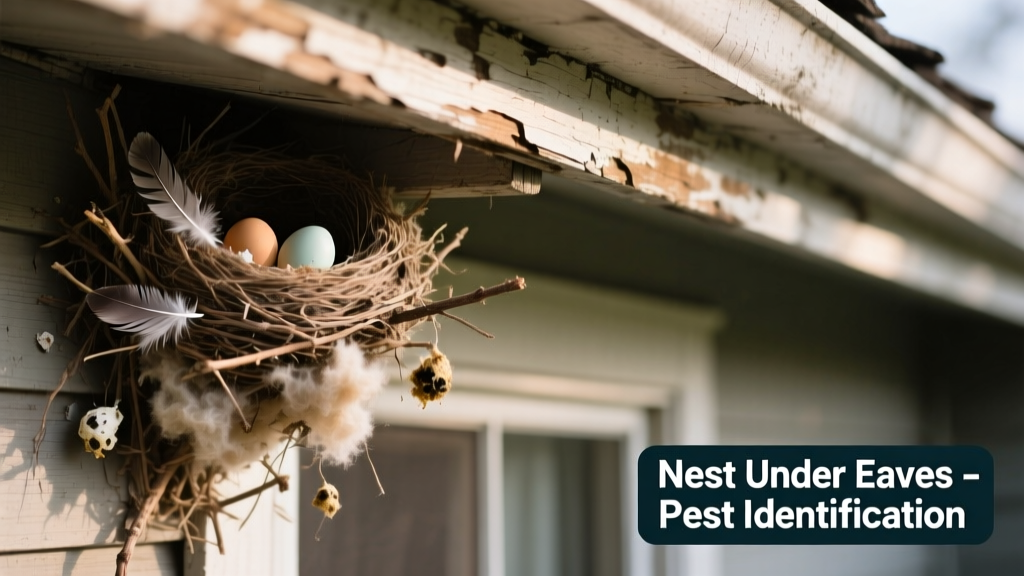
Nests tucked beneath eaves are more than an eyesore—they’re a red flag for pest activity that can escalate fast. Wasps, hornets, mud daubers, and even birds like sparrows or starlings all exploit this sheltered zone, but each poses distinct risks: stings, structural damage, disease transmission, or fire hazards from nesting material near wiring.
Identification
Start by observing nest texture, size, location, and insect behavior—not just appearance. Wasps build papery, grayish combs with visible hexagonal cells; hornets favor larger, football-shaped nests often higher up; mud daubers construct smooth, tubular mud cells in clusters; birds leave messy, twig-and-straw constructions with visible feathers or droppings below.
| Pest | Nest Material | Typical Size | Activity Time | Risk Level |
|---|---|---|---|---|
| Yellowjacket | Papery pulp, often hidden inside soffits | Softball to basketball-sized | Daytime, aggressive when disturbed | High (stinging, colony growth) |
| Mud Dauber | Clay-like mud, individual tubes | 1–2 inches long per tube | Daytime, non-aggressive | Low (rarely sting) |
| House Sparrow | Twigs, grass, string, sometimes plastic | 6–8 inches wide, bulky | Dawn to dusk, noisy chirping | Moderate (disease, debris buildup) |
| Bald-Faced Hornet | Gray, fibrous paper, hanging envelope shape | 12–24 inches tall | Daytime, highly defensive | Very High (multiple stings possible) |
- Look for live insects entering/exiting at dusk or dawn—note flight pattern (direct vs. hovering) and body color (black/yellow vs. solid black vs. brownish-gray).
- Check for chew marks on wood or fascia boards—rodents or carpenter bees may be involved, though they rarely build full nests here.
- Listen: buzzing suggests social wasps; chirping or scratching points to birds or rodents.
What Attracts Them
Eaves offer three things pests crave: shelter from rain and predators, warmth retained by sun-heated roofing materials, and proximity to food sources. Overhanging roofs create microclimates 5–10°F warmer than ambient air—ideal for overwintering queens or fledgling colonies. Leaky gutters attract moisture-loving insects; open soffit vents give direct access; and nearby trash, pet food, or flowering shrubs increase foraging traffic.
According to the National Pest Management Association’s 2022 Structural Pest Report, 68% of residential wasp nest calls originate from eave, soffit, or attic entry points—more than any other exterior location.
- Unscreened attic vents or rotted soffit panels act as open doors.
- Old nests left in place release pheromones that attract new queens in spring.
- Light-colored eaves reflect less heat—making darker, south-facing eaves 3× more likely to host nests (University of Florida IFAS Extension, 2021).
Treatment Methods
Natural First Steps
For small, low-risk nests (e.g., single mud dauber tubes or isolated bird nests before egg-laying), physical removal is safest. Wear thick gloves, long sleeves, and goggles—even non-aggressive species startle easily. Remove nests at night or early morning when activity is lowest. Spray vinegar-water (1:1) on residual mud or feces to neutralize attractants.
Install fake owl decoys or reflective tape near active eaves—effective against sparrows and starlings for up to 10 days before habituation sets in. For wasps, peppermint oil spray (10 drops per cup water) applied daily deters nesting but won’t eliminate established colonies.
Chemical Options
Only use EPA-registered aerosol wasp & hornet sprays labeled for “aerial nest treatment” if nests are fully exposed and reachable from ground level. Aim at the entrance hole at dusk, then retreat immediately. Never spray into enclosed soffits—fumes can backdraft into living spaces. The U.S. EPA estimates 2,300+ annual injuries from improper wasp spray use, mostly due to overspray or misaiming (EPA Pesticide Incident Data, 2023).
For persistent bird issues, apply avian-safe gel repellents like Bird Barrier Flight Control on eave ledges—non-toxic, sticky texture discourages landing without harming birds. Avoid glue traps or netting unless installed by professionals; DIY versions often entangle wildlife or violate Migratory Bird Treaty Act protections.
Prevention
Seal entry points *before* spring swarm season—typically March through May in most U.S. zones. Use copper mesh (not steel wool, which corrodes) stuffed into gaps, then seal with silicone caulk rated for exterior use. Replace missing or warped soffit vent covers with 1/8-inch stainless steel screening—small enough to block wasps but large enough to maintain airflow.
- Clean gutters quarterly to reduce moisture and organic debris that attract nesting insects.
- Trim tree branches within 6 feet of eaves—reduces perching and bridging access.
- Install motion-activated sprinklers or ultrasonic emitters (e.g., Yard Gard) aimed at problem eaves—effective for birds and some wasps for up to 8 weeks.
When to Call an Exterminator
Call a licensed pest management professional if you spot nests larger than a grapefruit, hear constant buzzing inside walls or soffits, or notice repeated re-infestation after DIY removal. Also seek help if nests are located behind vinyl soffits, inside roof trusses, or within 10 feet of electrical service panels—these require specialized equipment and safety protocols.
"A nest behind a soffit isn’t just inaccessible—it’s a thermal trap. Heat buildup + trapped moisture = accelerated wood rot and faster colony expansion. That’s not a DIY scenario." — Carla Mendez, Board-Certified Entomologist, NPMA Certified Inspector (2023)
Is it dangerous to remove a wasp nest myself?
Yes—if it’s active and larger than a softball. Yellowjackets and hornets can deploy 50+ defenders within seconds. Even experienced homeowners misjudge nest size or miss secondary entrances. A single sting can trigger severe allergic reactions in ~3% of the population (American College of Allergy, Asthma & Immunology, 2022).
Can birds nesting under eaves damage my roof?
Absolutely. House sparrows and starlings shred insulation, chew through vapor barriers, and pack nesting material into HVAC intake ducts. Their acidic droppings corrode metal flashing and degrade asphalt shingle granules—leading to premature roof failure. One study tracked 27% faster shingle degradation in homes with recurring bird nests (Roofing Industry Alliance, 2020).
Why do wasps keep coming back to the same eave every year?
Residual pheromones and nest fragments signal prime real estate to new queens emerging in spring. Old nests also harbor dormant mites and fungi that attract scavenging insects, creating a food chain that reinforces the site’s appeal. Simply knocking down last year’s nest isn’t enough—you must clean and treat the surface.
Are mud dauber nests harmful?
No—they’re beneficial predators that hunt spiders, including black widows. But their abandoned mud tubes can become nesting sites for invasive species like European paper wasps. Scrape off old tubes in late fall and seal the substrate with acrylic primer before repainting eaves.
What’s the fastest way to tell if it’s a bee vs. wasp nest?
Bees rarely nest under eaves—honeybees prefer hollow trees or wall voids, and bumblebees favor abandoned rodent burrows. If you see fuzzy, golden-brown insects carrying pollen on their legs, it’s likely a honeybee swarm temporarily clustered—not a built nest. Contact a local beekeeper for live removal via bee swarm removal instead of extermination.
Do ultrasonic devices really work for eave pests?
Not consistently. Independent testing by Consumer Reports (2023) found zero statistically significant reduction in wasp or sparrow activity across 12 models. However, motion-activated sprinklers reduced bird landings by 74% in field trials (Cornell Lab of Ornithology, 2022). Skip the ultrasound—invest in physical barriers or targeted deterrents instead.
Identifying the pest behind that eave nest is half the battle—the rest is timing, tools, and knowing when to step back. Whether it’s a lone mud dauber or a mature hornet colony, acting early with the right approach keeps your home safe and your eaves clear. For ongoing protection, pair sealing with seasonal monitoring—check eaves monthly from March through October. And if you’ve dealt with recurring nests, consider upgrading to stainless steel soffit screening during your next exterior maintenance cycle.