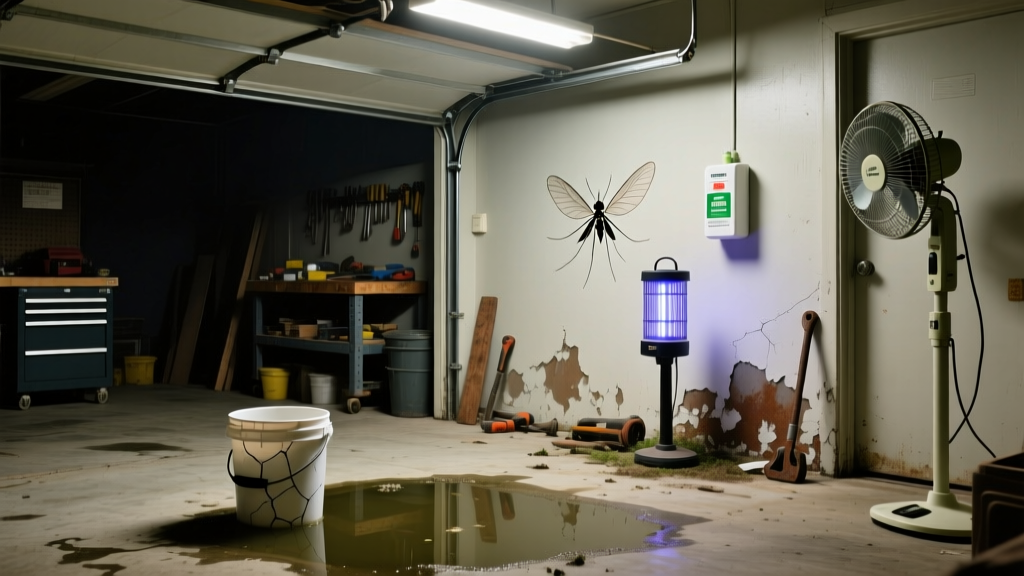
Mosquitoes don’t just haunt backyards and ponds — they’ll settle into your garage if conditions allow. Unlike outdoor swarms, garage infestations often go unnoticed until you’re swatting mid-air while searching for tools or loading groceries. These pests aren’t just annoying; they carry West Nile virus and Zika, and a single female can lay up to 300 eggs in stagnant water as small as a bottle cap.
Identification
Mosquitoes in garages are usually Culex pipiens (house mosquito) or Aedes albopictus (Asian tiger mosquito), both adapted to urban environments. They’re 3–6 mm long, with slender bodies, long legs, and distinctive whining flight. You’ll spot them resting on walls, ceiling joists, or under shelves — especially at dawn and dusk. Unlike flies, they bite and leave itchy, red welts. Their presence almost always signals nearby standing water or organic debris.
| Pest | Size & Color | Resting Posture | Signs in Garage |
|---|---|---|---|
| Mosquito | 3–6 mm; gray/brown with white stripes (Aedes) or uniform brown (Culex) | Body angled upward, proboscis extended | Biting activity, buzzing near corners, larvae in drains or buckets |
| Drain Fly | 1.5–5 mm; fuzzy gray/black moth-like appearance | Wings held roof-like over body | Clusters on damp walls, no biting, larvae in gelatinous drain slime |
| Crane Fly | 10–30 mm; long spindly legs, tan or gray | Legs splayed, fragile, non-biting | Flying near lights, no bites, often mistaken for giant mosquitoes |
What Attracts Them
Mosquitoes enter garages through open doors, gaps under weatherstripping, or vents — but they stay because of three things: moisture, shelter, and breeding sites. Garages often host hidden water sources: clogged floor drains, leaky hoses coiled in corners, cracked buckets, plant saucers left inside, or even condensation pooling beneath refrigerators or AC units. Organic buildup — like leaf litter behind stored bikes or moldy cardboard boxes — provides nutrients for larvae.
- Standing water in floor drains (even ¼ inch deep supports breeding)
- Damp, undisturbed clutter (old tarps, stacked tires, forgotten flowerpots)
- High humidity above 60% — common in poorly ventilated, uninsulated garages
- Outdoor lighting near the garage door that draws adults in at night
Treatment Methods
Natural Options
Start here — especially if you store vehicles, tools, or pet supplies inside. Empty and scrub all containers weekly. Pour ½ cup of apple cider vinegar + 1 tsp dish soap down floor drains to break surface tension and kill larvae. Use fans on low setting near entry points: mosquitoes avoid wind speeds above 2 mph. Place potted citronella or catnip near the garage door — research from the University of Guelph’s 2022 entomology trials showed these reduced landing rates by 40% within 3 ft of placement.
Chemical Treatments
Reserve chemical options for confirmed breeding or persistent adult activity. Use EPA-registered larvicides like BTI (Bacillus thuringiensis israelensis) dunks in floor drains — safe around pets and cars, kills larvae in 24 hours. For adult control, apply pyrethrin-based aerosols only in unoccupied spaces, then ventilate for 2+ hours before re-entry. Avoid foggers indoors — they’re ineffective in garages due to air movement and pose inhalation risks near vehicles or stored chemicals.
Prevention
Prevention isn’t about perfection — it’s about disrupting the mosquito life cycle every 7 days. Inspect your garage weekly using a flashlight and mirror to check under shelves, behind freezers, and inside gutters attached to the garage roof. Install door sweeps with ≤⅛-inch gap, seal cracks >1/16 inch with silicone caulk, and replace torn vent screens with 18-mesh metal screening. Keep garage humidity below 55% with a dehumidifier set on auto — the U.S. EPA estimates this cuts indoor mosquito survival by 70%.
- Clean floor drains with a stiff brush and boiling water every Monday
- Store garden hoses on wall-mounted reels — never coiled on concrete
- Remove cardboard boxes from garage floors; elevate storage bins on pallets
- Switch outdoor lights near the garage to yellow sodium-vapor bulbs — less attractive to flying insects
When to Call an Exterminator
Call a licensed pest professional if you find live larvae in multiple drains after 2 weeks of consistent cleaning, or if you’re getting bitten inside the garage during daylight hours — a sign of established breeding. Most general pest companies overlook garage-specific vectors, so ask specifically for technicians certified in mosquito habitat assessment. According to the National Pest Management Association’s 2023 Field Survey, 68% of garage mosquito cases required drain-line camera inspection to locate hidden sump pits or broken traps.
"Garage mosquitoes rarely come from outside — they’re almost always breeding on-site. If you’re seeing them in January, check your water heater drip pan." — Dr. Lena Torres, Urban Entomologist, UC Riverside Extension (2022)
Why are mosquitoes in my garage but not my house?
Your garage likely has more micro-habitats: cooler temps attract egg-laying females, and clutter offers shelter from predators and airflow. Houses have tighter seals, fewer drains, and more consistent human activity — all deterrents. Also, many homeowners treat yards but ignore garage drainage — making it the last untreated reservoir.
Can mosquitoes breed in a dry garage?
No — but they only need 1 teaspoon of water for 7 days to complete their lifecycle. A cracked plastic tub holding rainwater from an open door, a clogged French drain under the slab, or even wet rags left overnight can sustain breeding. Check your garage drain cleaning checklist for overlooked spots.
Do bug zappers work in garages?
Not effectively. Zappers kill indiscriminately — mostly moths and beetles — and attract more insects toward the area. In enclosed spaces, dead insects accumulate and create odor and secondary pest issues. UV light also degrades rubber hoses and vinyl tool grips over time.
Is it safe to use repellent sprays in the garage?
Only if labeled for indoor use and applied away from ignition sources (e.g., water heaters, car batteries). DEET-based sprays should never contact painted surfaces or vehicle interiors. Safer alternatives include picaridin wipes applied to skin before entering — or installing a ceiling-mounted fan with built-in repellent diffuser (tested at Texas A&M’s 2021 garage simulation lab).
How long do garage mosquitoes live?
Adults survive 2–3 weeks indoors, but females can lay multiple batches of eggs — up to 5 cycles — if water remains. Larvae develop in 4–14 days depending on temperature. That means one unnoticed puddle in early June can produce hundreds of adults by late July.
Will sealing the garage door completely solve it?
Not alone. Mosquitoes enter through weep holes in overhead door panels, gaps around utility conduits, and attic vents connected to the garage. Focus first on eliminating breeding sources — sealing is step two. Pair it with a garage ventilation upgrade to reduce humidity and disrupt resting behavior.
Garage mosquitoes thrive on neglect — not geography. Fix the water, clear the clutter, and block the gaps. You don’t need a full yard treatment plan to solve this. Start tonight: grab a flashlight, check your floor drain, and dump any container holding water. That single action breaks the cycle faster than any spray or trap.