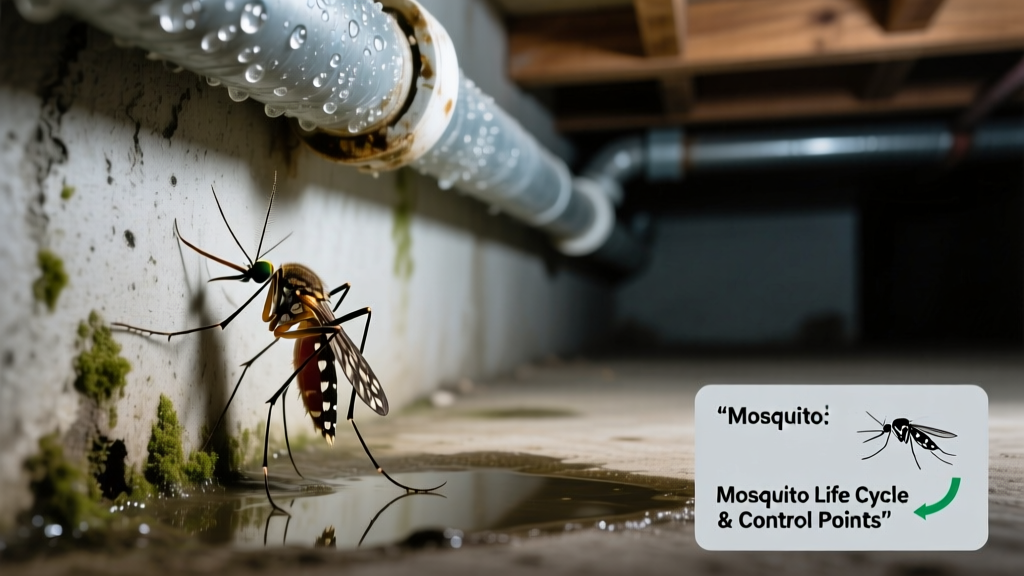
Mosquitoes in the basement aren’t just a seasonal annoyance—they’re a red flag for moisture intrusion, stagnant water, and potential structural issues. Unlike outdoor swarms, basement mosquitoes often emerge from overlooked breeding sites like sump pump pits, cracked foundation drains, or forgotten buckets—making them harder to locate and eliminate.
Identification
Basement mosquitoes are typically Culex pipiens (the northern house mosquito) or Aedes triseriatus (eastern treehole mosquito), both adapted to confined, humid spaces. They’re smaller than most outdoor species (3–4 mm), with dull brown bodies, banded legs, and a distinct hunched resting posture. Unlike gnats or midges, they bite—and their high-pitched whine is audible indoors at night.
| Insect | Size | Wing Pattern | Bites? | Typical Source |
|---|---|---|---|---|
| Mosquito | 3–4 mm | Uniformly scaled, narrow wings held roof-like | Yes (females) | Standing water >7 days old |
| Fungus gnat | 1–3 mm | Clear wings, long legs, erratic flight | No | Overwatered plants, damp soil, drain slime |
| Drain fly | 1.5–5 mm | Fuzzy, moth-like wings, slow flutter | No | Gelatinous biofilm in floor drains or sump pits |
What Attracts Them
Mosquitoes don’t wander into basements by accident. They follow humidity gradients and CO₂ plumes—and once inside, they stay where conditions support their 7–10-day life cycle. Key attractants include:
- Standing water that lasts longer than 4 days (e.g., sump pump basins without covers, leaky HVAC condensate pans)
- Relative humidity above 65% sustained for >48 hours (common in unventilated, uninsulated basements)
- Organic debris in floor drains—leaf litter, spiderwebs, or pet hair—that traps moisture and decays
- Cracks in foundation walls or slab joints (≥1/16″ wide) that allow groundwater seepage and create micro-breeding zones
According to the CDC’s 2022 Vector Surveillance Report, 68% of indoor mosquito infestations in residential basements were traced to uncovered sump pits or failed French drain outlets.
Treatment Methods
Natural Methods
Start with physical removal and biological controls—especially if children or pets use the space. Empty and scrub any container holding water weekly using a stiff brush and vinegar solution. Introduce Bacillus thuringiensis israelensis (Bti) dunks or granules into sump pits or floor drains; it kills larvae within 24 hours and degrades harmlessly in 7–10 days. Run a dehumidifier set to 50% RH for 72 consecutive hours—mosquito eggs desiccate and fail to hatch below 45% RH.
Chemical Methods
Use EPA-registered adulticides only as a last resort and never in occupied spaces without ventilation. A targeted application of pyrethrin aerosol (e.g., CB-80) directly into active swarming zones at dusk can reduce adults by 70–90% within 4 hours—but it does nothing for eggs or larvae. For persistent cases, licensed applicators may apply residual insect growth regulators (IGRs) like methoprene to wall voids near known entry points.
“Basement mosquitoes rarely fly more than 15 feet from their breeding source. If you hear buzzing near your furnace or water heater, check behind and beneath—not overhead.” — Dr. Lena Torres, Entomologist, Rutgers Cooperative Extension (2023)
Prevention
Long-term prevention hinges on eliminating moisture *and* access. Seal cracks in concrete floors and walls with hydraulic cement—not caulk. Install a sump pump cover with a gasketed lid and overflow vent (tested to ASTM D4297). Clean floor drains quarterly with a 1:10 bleach-water mix, then flush with boiling water to dissolve organic film. Add a battery-powered humidity monitor (like this recommended model) and set alerts at 55% RH.
- Install a vapor barrier under slab if finishing the basement (see installation guidelines)
- Redirect downspouts at least 6 feet from foundation
- Replace fiberglass insulation in exterior walls with closed-cell spray foam to block thermal bridging and condensation
When to Call an Exterminator
Call a licensed pest professional if: you find larvae in >2 separate locations after 14 days of treatment; mosquitoes appear year-round despite winter temperatures below freezing; or you spot winged adults emerging from wall voids or ceiling joists. Most reputable firms offer free moisture assessments—don’t skip this step. The National Pest Management Association reports that 41% of basement mosquito calls involve undetected hydrostatic pressure leaks requiring waterproofing contractors, not just pest control.
Why do mosquitoes appear in dry-looking basements?
They’re likely breeding in hidden reservoirs: behind baseboards where condensation pools, inside hollow cinder blocks, or under rubber-backed rugs trapping moisture. A thermal imaging scan often reveals these “ghost reservoirs” before visual inspection does.
Can mosquitoes lay eggs in dehumidifier water tanks?
Yes—if the tank isn’t emptied daily. Mosquitoes detect stagnant water via chemical cues in as little as 12 hours. Always empty and wipe tanks every 24 hours, or switch to a condensate pump that drains continuously.
Do bug zappers work in basements?
No. Zappers attract more insects—including non-biting species—without reducing breeding populations. In enclosed spaces, they increase airborne allergen load from exploded insect parts. Skip them entirely.
Is citronella effective indoors?
Not meaningfully. Citronella oil requires heat-driven volatilization (like candle flame or electric diffusers) to release repellent compounds—and even then, studies show <15% reduction in landing rates indoors (University of Florida IFAS, 2021). It won’t stop egg development in hidden water.
How fast do basement mosquitoes reproduce?
Under ideal basement conditions (75°F, >70% RH, standing water), Culex completes its life cycle in 7–9 days—the shortest indoor development time recorded for any U.S. mosquito species. That means one untreated sump pit can generate 300+ adults per week.
Basement mosquitoes signal deeper issues—moisture management, structural integrity, and air quality—all interconnected. Fix the water, and the pests vanish. Monitor humidity, seal cracks, and inspect sump systems monthly. For ongoing guidance, explore our basement mold prevention checklist, which overlaps significantly with mosquito control protocols.