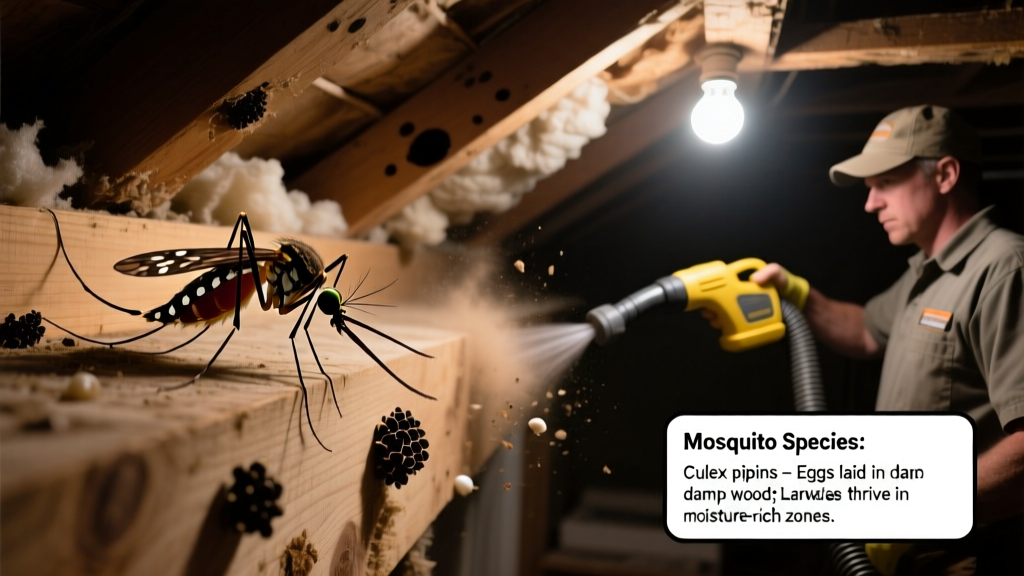
Mosquitoes don’t belong in your attic—but they show up anyway. Unlike outdoor swarms, attic infestations signal hidden moisture, stagnant water, or structural gaps that let them in and thrive. Left unchecked, they breed silently, increasing bite risk and potentially spreading disease-carrying species like Aedes albopictus, which can survive cooler indoor microclimates (CDC, 2022).
Identification
Mosquitoes in attics are often mistaken for midges or drain flies—especially when seen resting on rafters or insulation. Adult attic mosquitoes are typically 3–6 mm long, with slender bodies, long legs, and a distinctive proboscis. They’re most active at dawn and dusk but may buzz near light fixtures or vents during daytime if disturbed.
Key signs include:
- Faint buzzing near soffits, ridge vents, or gable openings
- Small, dark specks clinging to underside of roof sheathing or insulation batts
- Clusters of tiny white eggs (1–2 mm) in damp wood seams or pooled condensation
- Bite marks on neck or scalp after attic access—even without visible adults
| Pest | Size | Wing Pattern | Typical Habitat | Behavior Near Humans |
|---|---|---|---|---|
| Mosquito (Culex pipiens) | 4–5 mm | Uniformly scaled, no spots | Damp wood, leaky gutters feeding attic, HVAC condensate pans | Actively seeks blood meals; bites indoors |
| Drain Fly (Psychoda spp.) | 1.5–2 mm | Fuzzy, moth-like wings | Slime in roof vent pipes or clogged downspouts | Does not bite; hovers near drains |
| Midges (Chironomidae) | 2–4 mm | Clear, narrow wings; no proboscis | Stagnant water in roof valleys or flat-roof ponds | No biting; weak fliers, gather near windows |
What Attracts Them
Attics aren’t natural mosquito habitat—but three conditions override that: standing water, warmth, and entry points. Mosquitoes need only 1 inch of water for 7 days to complete their life cycle. In attics, this comes from:
- Roof leaks pooling on plywood decking or insulation
- Clogged or disconnected HVAC condensate lines dripping into ceiling joists
- Improperly sealed bathroom or kitchen exhaust ducts venting warm, humid air into attic space
- Blocked soffit vents trapping dew and rain splash
Temperatures above 50°F year-round—common in insulated attics—allow Culex to remain active through winter (University of Florida IFAS Extension, 2021). Add organic debris (bird nests, rodent droppings), and you’ve got nutrient-rich breeding substrate.
Treatment Methods
Natural Methods
Start with physical removal and environmental disruption. Vacuum adult mosquitoes with a shop vac fitted with a fine-mesh filter—never use a household vacuum (they’ll escape through filters). Then eliminate all moisture sources: dry wet insulation with industrial fans, replace soaked batts, and scrub moldy wood with 3% hydrogen peroxide.
For active breeding sites, apply Bti (Bacillus thuringiensis israelensis) granules directly to standing water in roof valleys or drip pans. Bti kills larvae in 24 hours and is EPA-registered safe for indoor attic use (U.S. EPA Pesticide Registration, 2023). Avoid garlic sprays or essential oils—they repel but don’t kill and degrade fast in warm, dusty attic air.
Chemical Methods
If larvae persist after 72 hours or adults swarm near vents, targeted residual sprays work best. Use pyrethroid-based aerosols (like D-Force HPX) applied as a crack-and-crevice treatment along rafter ends, behind insulation, and around vent boots—not broadcast sprays. Never fog an attic: aerosolized particles settle unevenly and pose inhalation risk without proper PPE.
According to the National Pest Management Association’s 2023 Field Protocol, attic mosquito treatments require at least two applications spaced 5–7 days apart to break the egg-to-adult cycle—since eggs laid just before first treatment hatch later.
"Most attic mosquito calls we get stem from one overlooked drip line or a single missing soffit screen. Fix the water, and 90% of the problem vanishes before you reach for a spray can." — Sarah Lin, Certified Structural Pest Inspector, NPMA Member since 2015
Prevention
Preventing reinfestation means making the attic inhospitable—not just treating symptoms. Install aluminum soffit vent screens with ≤1/8-inch mesh (standard fiberglass allows mosquito entry). Seal all roof penetrations—including plumbing stacks and chimney chases—with silicone caulk rated for attic temperature swings (-20°F to 140°F).
Routine maintenance includes:
- Inspecting attic after every heavy rain for new water stains
- Cleaning roof gutters twice yearly—and checking downspout extensions for soil contact
- Verifying HVAC condensate pumps run cleanly and drain outside, not into attic subfloor
- Using dehumidifiers set to ≤50% RH if attic humidity exceeds 60% for >48 hours
For homes with cathedral ceilings or unvented attics, consider installing a continuous ridge vent with integrated insect screening—this reduces thermal draw while blocking entry. See our attic ventilation checklist for full specs.
When to Call an Exterminator
Call a licensed pest pro if:
- You find live larvae in >3 separate locations (e.g., roof valley, HVAC pan, and soffit cavity)
- Adults emerge from wall voids or ceiling fixtures—not just attic access points
- Moisture readings exceed 18% in structural wood (indicating possible rot + chronic breeding)
- You’ve treated twice with Bti and pyrethroids but see new eggs within 5 days
Look for technicians certified in Structural Mosquito Management (SMMP credential, offered by the Entomological Society of America since 2020). They’ll conduct moisture mapping and use thermal imaging to locate hidden reservoirs you can’t see.
Why do mosquitoes appear in my attic during winter?
Some species—including Culex pipiens—enter diapause (a hibernation-like state) in sheltered, above-freezing spaces. Your heated attic provides ideal overwintering habitat. Adults cluster in insulation or behind knee walls, becoming active again during warm spells. They don’t breed in winter unless heat sources (like recessed lights or ductwork) raise local temps above 55°F.
Can attic mosquitoes transmit West Nile virus?
Yes—but risk is low in most residential attics. Culex mosquitoes must feed on infected birds first, then humans. Indoor transmission requires both infected bird roosts (e.g., starlings in soffits) and sustained human exposure. Still, any blood-feeding mosquito in living space warrants removal. For regional risk data, check your state’s West Nile virus risk map.
Will sealing my attic completely keep mosquitoes out?
No—and it’s unsafe to do so. Total sealing traps moisture, encourages mold, and violates building codes requiring minimum attic ventilation (IRC R806.1). Focus instead on targeted exclusion: seal holes ≥1/8 inch, install fine-mesh vent covers, and manage humidity. Ventilation stays intact; entry points close.
Do bats or birds in my attic attract mosquitoes?
Indirectly, yes. Bird nests and bat guano retain moisture and provide organic nutrients for mosquito larvae. A 2022 Cornell study found attics with active pigeon roosts had 4.3× more Culex larvae than comparable homes without nests. Remove nests *only* during non-breeding season (late summer/fall) and install exclusion devices—see our bird exclusion guide for humane methods.
How long does it take to eliminate an attic mosquito infestation?
With consistent moisture control and two Bti treatments, most infestations resolve in 10–14 days. If eggs were laid in hard-to-dry areas (e.g., between roof deck and underlayment), full resolution may take 3 weeks. Monitor with sticky traps placed near suspected entry points—replace weekly until no captures occur for two consecutive weeks.
Are attic mosquito bites different from outdoor ones?
Not biologically—but behaviorally, yes. Indoors, mosquitoes feed repeatedly on the same person (often the homeowner accessing the space), leading to clustered bites on scalp, neck, or shoulders. These bites may swell more due to delayed immune response in warm, dry attic air. Wash bites with cool water and apply 1% hydrocortisone cream—avoid scratching to prevent infection.
Mosquitoes in your attic aren’t a fluke—they’re a symptom of moisture and access. Fix the conditions, not just the bugs, and you’ll stop cycles before they start. Regular attic inspections every spring and fall catch issues early, saving time, health, and repair costs down the line.