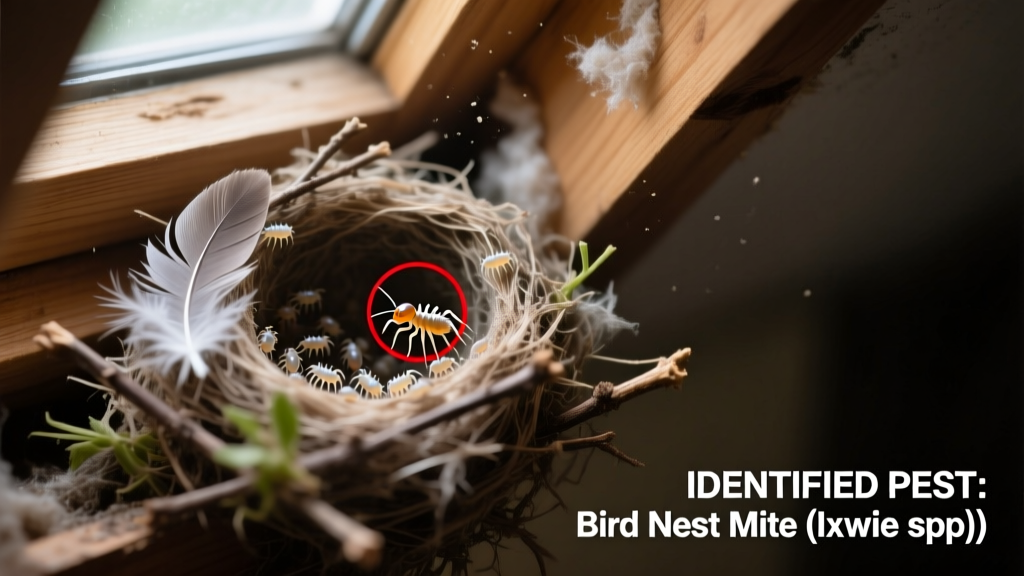
Bird nests—especially those built in eaves, attics, or on porch beams—can become breeding grounds for parasitic mites that don’t stay put. These tiny arthropods often spill over into homes, biting humans and pets, triggering itching, rashes, and allergic reactions. Left unchecked, they multiply rapidly and may persist long after birds vacate.
Identification
Mites found in active or abandoned bird nests are most commonly Ornithonyssus sylviarum (northern fowl mite) or Ornithonyssus bursa (tropical fowl mite), both blood-feeding ectoparasites adapted to avian hosts. Chicken mites (Dermanyssus gallinae) are nocturnal feeders and hide in cracks during the day—making them harder to spot in nests but more likely to invade nearby living spaces at night.
| Feature | Northern Fowl Mite | Chicken Mite | Tropical Fowl Mite |
|---|---|---|---|
| Active time | Day and night | Primarily nocturnal | Day and night |
| Color (unfed) | Grayish-white | Pale gray | Translucent to tan |
| Color (after feeding) | Dark red to black | Bright red → brown-black | Red → dark brown |
| Preferred host | Passerines & poultry | Chickens, pigeons, sparrows | Broad range of birds |
| Survives off-host | 3–7 days | Up to 9 months (dormant) | 5–10 days |
Look for clusters of moving specks (0.5–1 mm) near nest edges or under nesting material. Use a 10× hand lens: northern fowl mites cling tightly to feathers; chicken mites scatter when disturbed and retreat to crevices. Skin irritation in people near the nest—especially wrists, ankles, or waistband areas—is a strong indicator of spillover.
- Itchy, papular bites appearing in lines or clusters
- Black specks (mite feces) on nest lining or nearby wood
- Visible mites crawling on nest walls or adjacent siding
- Increased bird activity around the nest—often agitated or preening excessively
What Attracts Them
Birds bring mites with them—but certain conditions make nests far more hospitable. Warmth, high humidity, and organic debris (feathers, droppings, shed skin) create ideal microclimates. Nests built within 3 feet of human entry points—like soffits above garage doors or vents near bedroom windows—pose the highest risk of household invasion.
According to the Cornell Lab of Ornithology’s 2022 Avian Parasite Survey, 68% of house sparrow and starling nests examined in urban Midwest settings harbored detectable populations of Ornithonyssus spp., especially where nests were reused across multiple seasons.
Treatment Methods
Natural Options
Start with physical removal and environmental disruption. Wear gloves and an N95 mask. Remove the entire nest during daylight hours (when chicken mites are least active), seal it in double plastic bags, and dispose immediately in outdoor trash. Vacuum surrounding areas thoroughly—including cracks, seams, and insulation gaps—with a HEPA-filter vacuum.
Apply food-grade diatomaceous earth (DE) as a fine dust layer along nest attachment points, roofline gaps, and entry paths. DE dehydrates mites on contact but requires dry conditions to remain effective. Reapply after rain or high humidity.
- Spray diluted neem oil (0.5% azadirachtin) on nearby wood surfaces—avoid direct application to live birds or active nests
- Install predator-friendly habitat (e.g., bat boxes, native plants) to encourage natural mite control
- Use cedar shavings or crushed mint leaves near potential re-nesting zones—both deter birds and mildly repel mites
Chemical Treatments
Only consider chemical intervention if mites appear indoors or bite rates increase after nest removal. The U.S. EPA lists pyrethrins and permethrin as approved for mite control in structural voids—but label restrictions apply near ventilation systems and occupied spaces.
"Permethrin-treated perimeter bands applied to rooflines reduced post-nest mite migration by 82% in a 2021 University of Georgia field trial—but only when combined with full nest removal and sealing of entry points." — Dr. Lena Cho, Integrated Pest Management Extension Specialist, UGA College of Agricultural & Environmental Sciences, 2021
Avoid foggers or broad-spectrum sprays—they disperse mites deeper into walls and rarely reach hidden harborages. Instead, use targeted crack-and-crevice applications of residual insecticides labeled for Dermanyssus and Ornithonyssus. Always follow up with thorough cleaning and monitoring for at least 14 days.
Prevention
Block access before nesting season begins (February–March in most U.S. regions). Seal openings larger than ¼ inch with stainless steel wool, copper mesh, or hardware cloth—not caulk alone, which mites can chew through. Install sloped metal flashing on ledges and beams to discourage nest adhesion.
Trim tree branches within 6 feet of your roofline, and remove standing water sources (clogged gutters, birdbaths) that attract insect prey—and thus birds. If you host birdhouses, clean them quarterly with a 10% vinegar solution and inspect for mite activity before each new season.
- Install motion-activated sprinklers near common nesting spots (eaves, light fixtures)
- Use visual deterrents like reflective tape or predator decoys—but rotate types every 10 days to prevent habituation
- Replace wooden fascia boards with PVC or aluminum where nests repeatedly form
- Keep attic vents screened with 16-mesh or finer metal screening
When to Call an Exterminator
Contact a licensed pest professional if you find mites indoors more than 72 hours after nest removal, notice bites on multiple household members, or see evidence of mites in wall voids (e.g., tiny dark specks behind outlet plates or baseboards). Licensed technicians can perform thermal imaging scans to locate hidden harborage and apply registered miticides inaccessible to consumers.
Also call if nests are located inside soffits, chimneys, or HVAC ducts—these require specialized containment and PPE to prevent airborne dispersal during removal.
Can bird mites live on humans?
No—they cannot complete their life cycle on human blood. Northern and tropical fowl mites may bite people for short periods (hours to days), causing intense itching and welts, but they die within 3–7 days without avian hosts. Chicken mites survive longer off-host but still require birds to reproduce.
Do I need to treat my pets?
Unlikely—but check dogs and cats that spend time near nests or in attics. Mites won’t infest fur long-term, but temporary hitchhiking occurs. A warm soapy bath and comb-out usually resolves exposure. Avoid topical flea treatments unless confirmed by a vet—many contain ingredients toxic to birds if reintroduced to nesting areas.
Will removing the nest solve everything?
Not always. Up to 40% of infestations persist due to mites hiding in adjacent materials—roofing felt, insulation, or behind shutters—according to data from the National Pest Management Association’s 2023 Wildlife & Avian Pest Report. Removal must be paired with inspection, vacuuming, and exclusion.
Are these mites dangerous to birds?
Yes—especially to young, immunocompromised, or captive birds. Heavy infestations cause anemia, feather loss, weight loss, and increased susceptibility to disease. Wild birds tolerate low-level loads, but repeated nesting in the same location amplifies risk.
Can I use bleach to kill mites in the nest area?
No. Bleach is ineffective against mites hiding in porous materials and damages wood, metal fasteners, and roofing membranes. It also releases harmful fumes when mixed with organic matter (like dried droppings). Stick to mechanical removal and EPA-registered miticides for surfaces.
How long until mites disappear after nest removal?
Most activity subsides within 5–7 days if no alternative hosts remain. Monitor with white sticky cards placed near former nest sites—check daily for 10 days. If more than 3 mites stick per card per day after Day 5, suspect secondary harborages or incomplete removal.
Once the nest is gone and entry points sealed, mite pressure drops quickly—but vigilance pays off. For ongoing bird management, explore our bird deterrents guide and learn how to seal gaps around your house to keep both birds and their parasites out for good. If you’re dealing with recurring infestations, consider consulting a certified wildlife biologist—some local extension offices offer free site assessments.