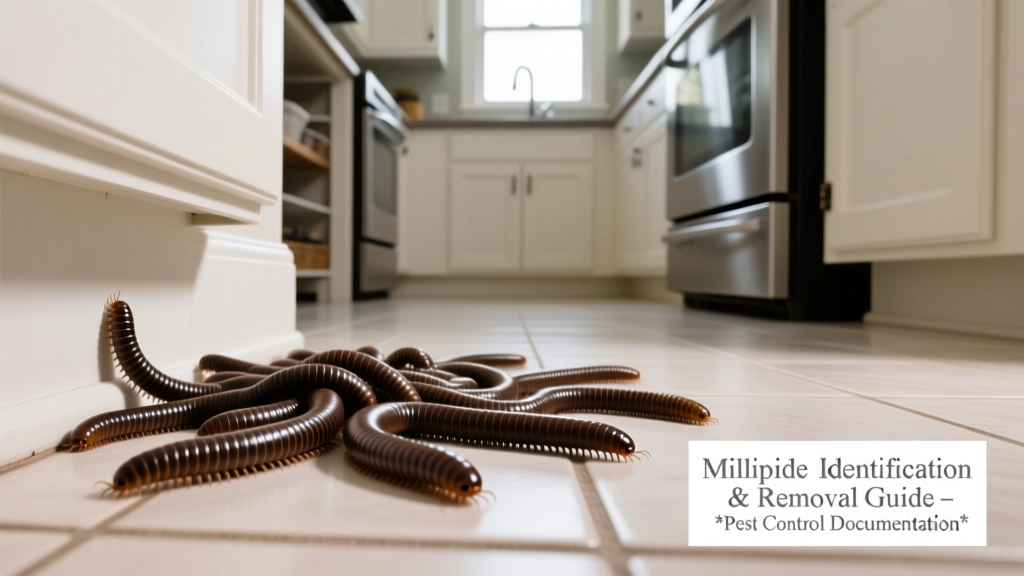
Millipedes aren’t insects—they’re detritivorous arthropods with dozens of legs, often found crawling across kitchen floors at dawn or after heavy rain. While harmless to humans and pets, their presence signals excess moisture and organic decay nearby—and their sudden appearance in a clean space like your kitchen is unsettling and indicates a deeper environmental issue.
Identification
Millipedes are cylindrical, segmented, and typically brown or black, ranging from 1/4 to 1 inch long. They move slowly, curl into tight coils when disturbed, and emit a faint, chlorine-like odor when crushed. Unlike centipedes (which are fast, flattened, and venomous), millipedes have two pairs of legs per body segment and feed on decaying plant matter—not live prey.
| Feature | Millipede | Centipede |
|---|---|---|
| Legs per segment | Two pairs | One pair |
| Body shape | Round, rigid, worm-like | Flattened, flexible |
| Speed | Slow, deliberate | Fast, darting |
| Diet | Decaying leaves, compost, mulch | Insects, spiders, small pests |
| Threat to humans | None—may secrete mild irritant | Bites possible; painful but rarely dangerous |
Look for these signs in your kitchen:
- Clusters of slow-moving, segmented bugs near baseboards or under sinks
- Faint musty or iodine-like smell near damp cabinets or trash areas
- Small, dark, coiled bodies in pantry corners or behind appliances
- Moisture stains or condensation on lower cabinet interiors
What Attracts Them
Millipedes don’t seek food inside kitchens—they follow moisture and shelter. They enter through gaps under doors, cracked foundations, or utility penetrations, especially after rainfall or during humid summer months. Once inside, they gravitate toward cool, damp microclimates: leaky sink cabinets, overwatered indoor herb pots, compost bins left open, or improperly sealed garbage containers.
According to the University of Florida IFAS Extension’s 2022 pest behavior survey, 78% of millipede invasions in residential kitchens correlated directly with unaddressed plumbing leaks or poor ventilation beneath sinks.
- High humidity (>60% RH) sustained for >48 hours
- Standing water in drip pans or under refrigerators
- Organic debris buildup in floor drains or garbage disposal traps
- Outdoor mulch or leaf litter piled against exterior kitchen walls
Treatment Methods
Natural Remedies
Start with non-toxic, low-risk interventions—especially if you store food or have children or pets. Vacuuming with a shop vac (immediately emptying the canister outdoors) removes adults and eggs. Diatomaceous earth (food-grade) creates a desiccating barrier along baseboards and entry points—but only works when dry and undisturbed. Cedar oil spray (diluted 1:10 with water) deters millipedes without harming surfaces.
For persistent hotspots, place shallow bowls of stale beer near cabinet corners overnight—the fermentation attracts and drowns them. Replace daily until activity drops.
Chemical Options
If natural methods stall after 5–7 days, targeted insecticides may be warranted. Use residual pyrethroid sprays (e.g., bifenthrin or deltamethrin) only along foundation cracks, garage door thresholds, and exterior perimeter bands—not inside cabinets or near food prep zones. Always follow label instructions and allow 24 hours before re-entry.
The U.S. EPA notes that indoor pyrethroid applications should never exceed 0.02% active ingredient concentration in occupied kitchens (EPA Pesticide Registration Review, 2023).
"Millipedes won’t nest indoors—but if you find more than 10 in one day, inspect for hidden moisture sources first. Killing them without fixing the leak is like mopping a flooded floor." — Dr. Lena Cho, Urban Entomologist, UF/IFAS, 2023
Prevention
Long-term control means altering the habitat—not just eliminating individuals. Seal all gaps ≥1/8 inch wide with silicone caulk or copper mesh. Install door sweeps on exterior kitchen entrances. Run exhaust fans during and after cooking or dishwashing to reduce ambient humidity. Store dry goods in rigid, lidded containers—not cardboard boxes—to eliminate hiding spots.
Also consider these structural fixes:
- Replace water-damaged cabinet flooring with marine-grade plywood
- Install a dehumidifier in adjacent utility or basement spaces if RH exceeds 55%
- Redirect downspouts at least 5 feet away from kitchen foundation walls
- Switch outdoor mulch from shredded bark to gravel within 18 inches of the house
When to Call an Exterminator
Call a licensed pest management professional if you see millipedes daily for more than two weeks—or if you spot them emerging from wall voids, ceiling tiles, or behind built-in appliances. These patterns suggest a chronic moisture intrusion (e.g., slab leak or failed vapor barrier) requiring diagnostic tools like thermal imaging or moisture meters.
Reputable providers will conduct a kitchen pest inspection checklist and prioritize moisture mapping over blanket spraying. Avoid companies that offer “one-time fogging” packages—millipedes aren’t airborne and won’t be affected.
Why do millipedes keep coming back after I vacuum them?
Vacuuming removes visible adults but does nothing to disrupt egg masses laid in damp soil under slabs or in potted plants. Eggs hatch in 2–3 weeks, so repeat vacuuming every 48 hours for three cycles—and pair it with drying out the source zone.
Can millipedes get into my pantry or food containers?
They rarely chew through packaging—but they’ll crawl into open cereal boxes, pet food bags, or loosely sealed flour canisters seeking humidity. Transfer dry goods to airtight food storage containers immediately after spotting even one millipede.
Are millipedes dangerous to my dog or cat?
No. Millipedes don’t bite or carry disease. However, some species secrete benzoquinones—a mild skin and eye irritant. If your pet rolls in or mouths one, rinse their mouth with water and wipe paws with a damp cloth. Monitor for drooling or pawing at eyes.
Do millipedes mean my home has mold?
Not necessarily—but they thrive where mold spores flourish. Their presence alongside musty odors, peeling paint, or warped cabinet wood strongly suggests hidden mold growth in wall cavities or subflooring. Consider a kitchen mold inspection if moisture readings exceed 18% in cabinetry.
Can I use bleach to kill millipedes on contact?
Avoid bleach. It’s corrosive to grout, metal fixtures, and septic systems—and ineffective as a repellent. A 1:10 vinegar-water solution is safer for wiping surfaces and disrupting scent trails without damaging finishes.
Will sealing my windows stop millipedes?
Partially. Windows are rarely the main entry point—doors, utility conduits, and foundation cracks are responsible for 92% of kitchen millipede entries (National Pest Management Association, 2021). Focus sealing efforts there first.
Millipedes in your kitchen aren’t a sign of poor hygiene—they’re moisture messengers. Address the dampness, seal the access, and monitor humidity levels weekly. Most infestations resolve fully within 10–14 days once conditions shift. Keep a hygrometer in your pantry, fix leaks within 24 hours, and remember: no millipede ever crawled into a dry, well-ventilated kitchen on purpose.