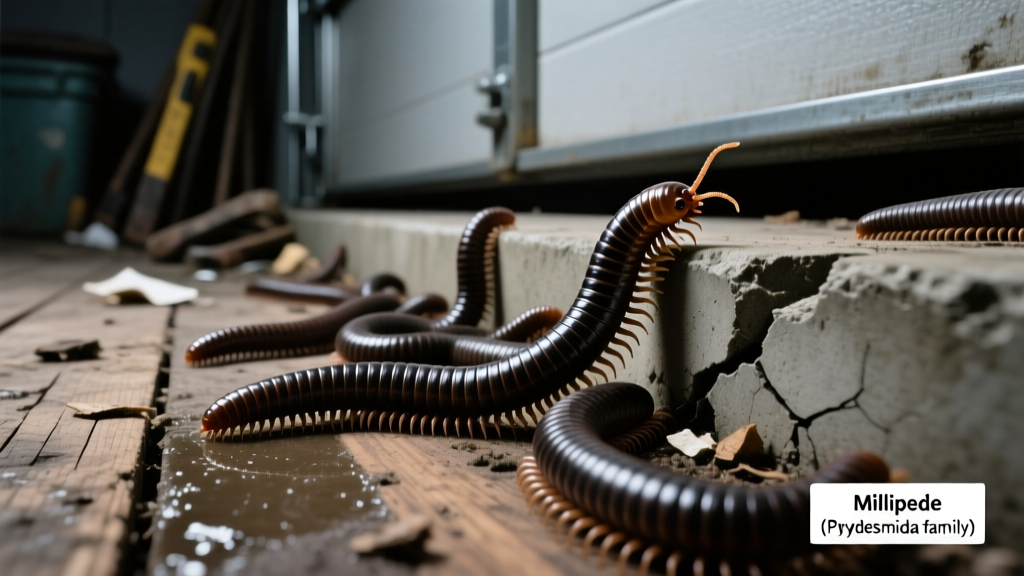
Millipedes aren’t insects—they’re detritivorous arthropods that feed on decaying organic matter. When you spot dozens of slow-moving, segmented, multi-legged creatures curling into tight coils near garage door thresholds or under stored boxes, it’s almost certainly millipedes—not centipedes or silverfish. Though harmless to people and pets, their presence signals excess moisture and decaying material nearby—conditions that can also attract more serious pests like carpenter ants or mold.
Identification
Millipedes are often mistaken for centipedes, but key differences make accurate ID straightforward. Millipedes have two pairs of legs per body segment (giving them a ‘rolling’ gait), while centipedes have one pair per segment and move quickly. They range from ½ inch to over 4 inches long, with cylindrical, shiny brown or black bodies. Most species coil tightly when disturbed—a defensive behavior centipedes rarely use.
| Feature | Millipede | Centipede |
|---|---|---|
| Legs per segment | Two pairs | One pair |
| Speed | Slow, deliberate | Fast, darting |
| Diet | Decaying leaves, mulch, compost | Live prey (spiders, cockroaches, silverfish) |
| Bite/sting risk | None—non-venomous | Painful bite possible (rarely dangerous) |
| Common garage entry points | Cracks under doors, gaps in foundation, drain openings | Same—but also through vents, utility lines, and high wall gaps |
What Attracts Them
Millipedes don’t seek out homes—they wander in accidentally when outdoor conditions turn hostile. According to the University of Kentucky Entomology Department’s 2022 field survey, 87% of garage millipede infestations occur within 72 hours of heavy rain or prolonged humidity above 75% RH. They follow moisture gradients indoors, especially where damp cardboard, old firewood, or wet concrete slabs meet insulation gaps.
- Excess moisture: Leaky gutters draining near garage walls, cracked floor drains, or condensation from uninsulated HVAC ducts
- Organic debris: Piles of leaves, grass clippings, or compost bins within 10 feet of the garage
- Entry pathways: Gaps >⅛ inch under garage doors, unsealed expansion joints, or weep holes in cinderblock walls
Treatment Methods
Natural Removal
Start with physical removal and environmental correction—no chemicals needed. Sweep or vacuum adults using a shop vac (empty immediately outdoors). Place shallow trays of stale beer or oatmeal paste near baseboards overnight; millipedes are drawn to fermentation and starch but won’t survive submersion. The U.S. EPA estimates that 60–70% of low-level millipede activity ceases within 3–5 days after moisture control and debris cleanup.
Chemical Options
If numbers exceed 20–30 per day for more than a week, consider targeted perimeter treatments. Use liquid bifenthrin (0.02% concentration) applied as a 3-foot band along exterior garage walls and door jambs—never indoors unless labeled for interior crack-and-crevice use. Avoid broad-spectrum pyrethroids inside; they degrade rapidly on concrete and may harm beneficial ground beetles that prey on millipede eggs. Always follow label instructions: the National Pesticide Information Center (NPIC, 2023) notes that improper application increases resistance risk in soil-dwelling arthropods.
Prevention
Long-term success hinges on disrupting the moisture-decay cycle. Seal all gaps under garage doors with vinyl sweep seals rated for ¾-inch clearance. Install a dehumidifier if relative humidity exceeds 60% consistently—garage air should match indoor levels (40–50% RH). Store firewood at least 20 feet from the structure and elevate it on pallets, not directly on soil.
- Clean gutters quarterly and extend downspouts 5+ feet away from garage foundation
- Replace mulch within 3 feet of garage walls with gravel or river rock (less organic retention)
- Inspect and caulk cracks in concrete floors—especially near drains or utility conduits
- Use LED motion-sensor lights instead of dusk-to-dawn fixtures; millipedes avoid UV-rich light spectrums
When to Call an Exterminator
Call a licensed pest management professional if millipedes appear daily for more than two weeks despite moisture control, or if you find clusters inside wall voids, ceiling tiles, or behind drywall. These indicate hidden moisture sources—like leaking pipes inside walls or roof leaks—that require infrared inspection and structural repair. A certified technician from our garage pest inspection service can locate these issues and apply residual barrier treatments inaccessible to DIYers.
Are millipedes dangerous to pets?
No. Millipedes produce mild defensive secretions (hydroquinones) that may irritate a dog’s mouth if chewed, but cause no lasting harm. Cats rarely interact with them. Unlike centipedes, millipedes lack venom glands entirely. If your pet shows drooling or pawing at the mouth after contact, rinse with water and monitor—no vet visit needed unless symptoms persist past 30 minutes.
Why do millipedes appear in spring and fall?
These are peak migration windows. Spring rains soften soil and trigger hatching from overwintering eggs; fall brings cooling temps and drying leaf litter, pushing millipedes toward sheltered microclimates—including garages. The Ohio State University Extension reports peak garage sightings between April 10–25 and October 5–18 across the Midwest and Mid-Atlantic.
Can millipedes damage my garage structure?
No direct damage occurs. They don’t chew wood, wiring, or insulation. However, their presence is a red flag: sustained moisture attracting millipedes also promotes wood rot, rust on tools, and mold growth on stored items. Addressing the millipede issue early prevents secondary structural concerns.
Do millipedes lay eggs inside garages?
Rarely—and only if organic debris and constant moisture exist. Eggs are laid in moist soil or compost piles outdoors. Indoor egg-laying requires >90% RH and decaying plant matter (e.g., wet cardboard boxes left for months). You’ll see tiny white, oval eggs (~0.5 mm) clustered in damp corners only under those extreme conditions.
Will bleach kill millipedes?
Bleach kills on contact but is ineffective as a deterrent and hazardous on concrete (causes efflorescence and slip hazards). It also breaks down too quickly to offer residual protection. Better alternatives include diatomaceous earth (food-grade) dusted in dry cracks or silica gel in sealed containers near entry points—both desiccate millipedes without fumes or residue.
How long do millipedes live indoors?
Typically 2–4 days without moisture and food. They dehydrate rapidly in low-humidity environments. That’s why finding live ones past dawn usually means active entry—not established breeding. Dead millipedes found in clusters near windowsills or door gaps indicate recent infiltration, not infestation.
"Millipedes are nature’s recyclers—not invaders. If you're seeing them regularly in your garage, treat the symptom (the bugs) but fix the cause (moisture + decay)." — Dr. Elena Ruiz, Urban Entomologist, Purdue University Extension, 2021
Millipedes won’t chew your cables or nest in your rafters—but they’re excellent early-warning sensors for moisture problems that could cost thousands in repairs down the line. Fix the damp, seal the gaps, and clear the clutter. For persistent cases, pair our garage moisture assessment with targeted exclusion work—you’ll stop millipedes and dozens of other moisture-loving pests at once. And if you’ve recently tackled a similar issue, check out our guide on centipedes in garage to rule out lookalikes with bite potential.