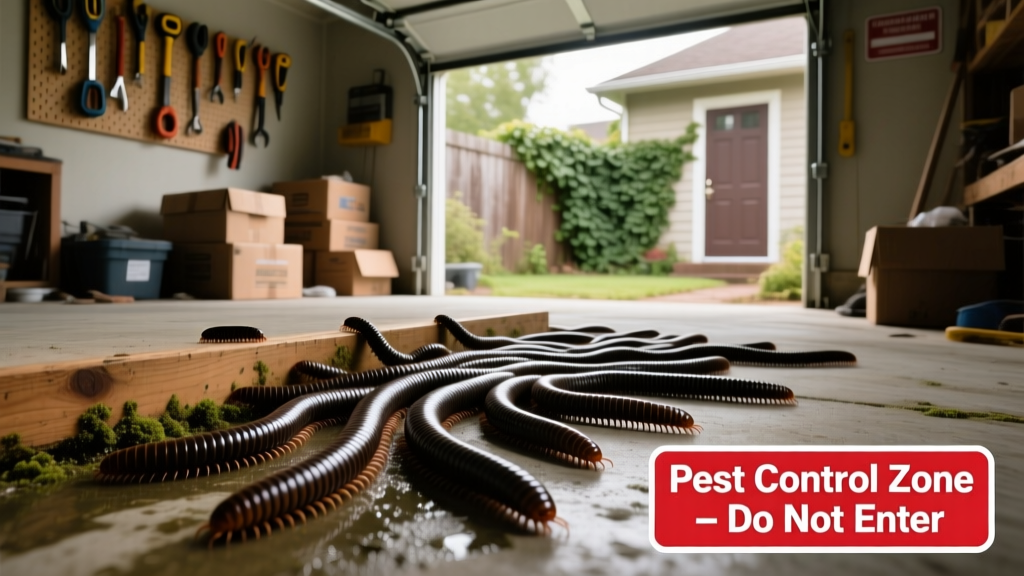
Millipedes aren’t insects—they’re detritivorous arthropods with dozens of legs, slow movement, and a preference for damp, decaying organic matter. In garages, they’re rarely harmful to people or pets, but their presence signals excess moisture and hidden decay—and large numbers can trigger disgust or concern, especially when they curl up in corners near stored boxes or tools.
Identification
Millipedes in garages are typically brownish-black, cylindrical, and 1–2 inches long. They move slowly in a wave-like motion, have two pairs of legs per body segment (unlike centipedes), and emit a faint, musty odor when disturbed. Unlike centipedes, they don’t bite and lack venom—but they may secrete irritating defensive fluids that stain surfaces.
| Feature | Millipede | Centipede | Earthworm |
|---|---|---|---|
| Legs per segment | Two pairs | One pair | None |
| Movement speed | Slow, deliberate | Fast, erratic | Slow, muscular undulation |
| Habitat preference | Damp concrete cracks, under debris | Behind baseboards, in wall voids | Soil only—won’t survive on dry garage floors |
| Defensive behavior | Curls into coil; releases foul-smelling fluid | Bites if handled (rarely serious) | Secretes mucus; no odor |
What Attracts Them
Millipedes don’t seek out garages—they follow conditions. The top three attractants are moisture, organic debris, and shelter. A single leaky faucet or condensation from uninsulated pipes can raise localized humidity above 70%, creating ideal habitat. Piles of cardboard boxes, old mulch bags, or stacked firewood against the garage wall provide both cover and food (decaying cellulose).
- Cracks in concrete floor joints (especially near foundation walls)
- Overflowing gutters directing water toward garage slab
- Unsealed gaps under garage doors—often wider than ¼ inch
- Cluttered storage blocking airflow and trapping humidity
Treatment Methods
Natural Removal
Start non-toxic: sweep or vacuum adults (dispose bag immediately outdoors), then reduce moisture. Use silica gel desiccant packs in toolboxes or storage bins where millipedes cluster. Diatomaceous earth (food-grade) applied in 1/8-inch bands along baseboards and entry cracks dehydrates them on contact—but reapply after rain or washing.
Chemical Options
Only consider targeted insecticides if populations exceed 20+ individuals weekly. The U.S. EPA’s 2022 Residential Pest Control Guide recommends bifenthrin (0.02% concentration) as effective against millipedes when applied as a 6-inch band along interior perimeter walls and garage door thresholds. Avoid broad-spectrum sprays—millipedes don’t respond well to pyrethrins alone, and overuse risks contaminating stored items like paint cans or gardening supplies.
Prevention
Long-term control hinges on environmental correction—not killing. Fix leaks within 48 hours of detection. Install a dehumidifier rated for at least 30 pints/day if relative humidity exceeds 60% (measure with a $12 hygrometer). Raise stored items 6 inches off the floor using plastic pallets—not wood—since millipedes feed on rotting lumber.
"Millipedes are bioindicators—not invaders. If you’re seeing more than five per week in your garage, it’s not a pest problem—it’s a moisture management failure." — Dr. Lena Cho, Entomologist, University of Florida IFAS Extension, 2023
- Seal garage door gaps with adhesive-backed vinyl weatherstripping (replace annually)
- Install French drains or slope soil away from garage foundation by at least 6 inches per 10 feet
- Replace cardboard moving boxes with ventilated plastic totes labeled "dry storage only"
When to Call an Exterminator
Call a licensed professional if millipedes appear daily for three weeks despite moisture control and sealing efforts—or if you find clusters inside attached living spaces (e.g., laundry room or basement). Reputable providers will conduct a moisture audit first, not just spray. Check credentials via the state pesticide applicator database before booking.
Do millipedes damage garage structures?
No—they don’t chew wood, wiring, or drywall. Their presence correlates with rot, but they don’t cause it. However, persistent moisture enabling millipedes also supports mold growth behind insulation and subfloor decay—so treat the symptom as a warning sign.
Can millipedes survive winter in a garage?
Yes—if temperatures stay above 40°F and humidity remains high. Unheated garages in northern climates often drop below this threshold, forcing millipedes to retreat outdoors or die off. But insulated or attached garages frequently sustain viable populations year-round.
Why do I see them after rain?
Rain saturates soil, flooding millipede burrows. They migrate upward seeking drier air—and your garage slab, especially near exterior walls, becomes a temporary refuge. This is normal seasonal behavior, not infestation.
Are millipede secretions dangerous to pets?
Not life-threatening, but the quinone-based fluid can irritate mucous membranes. Dogs who mouth millipedes may drool or paw at their mouths. Rinse with water and monitor. Keep pets away from areas where millipedes cluster—especially near dehumidifier drip pans, which collect standing water.
Do ultrasonic repellents work?
No. Independent testing by the National Pesticide Information Center (2021) found zero statistically significant reduction in millipede activity using ultrasonic devices. Save your money and focus on moisture control instead.
Can I use borax to kill millipedes?
Not reliably. Borax has low efficacy against millipedes—it works best on ants and cockroaches. It’s also hazardous if tracked into living areas or ingested by pets. Skip it; use diatomaceous earth or targeted bifenthrin instead.
Millipedes in your garage aren’t a sign of neglect—they’re a signal your building envelope needs fine-tuning. Address moisture, seal entry paths, and shift storage habits. Most homeowners resolve recurring sightings within 10 days of implementing these steps. For deeper moisture issues, consult a foundation moisture inspection—it’s often cheaper than repeated pest visits.