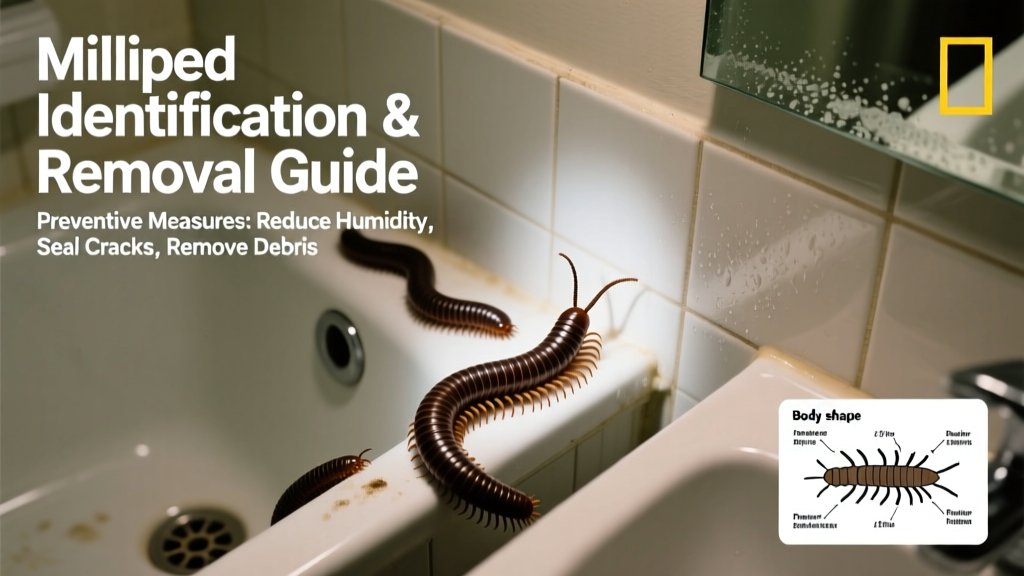
Millipedes aren’t dangerous—they don’t bite, spread disease, or damage structures—but finding dozens of them coiling up in your shower drain or under the sink is unsettling. They thrive in damp, dark places, and bathrooms offer the perfect microclimate: high humidity, organic debris, and easy entry through cracks near pipes or baseboards.
Identification
Millipedes are cylindrical, segmented arthropods with two pairs of legs per body segment (unlike centipedes, which have one pair). Most bathroom invaders are brown or black, 0.5–1.5 inches long, and move slowly in a wave-like motion. When disturbed, they curl into tight coils and may emit a faint, almond-like odor from defensive glands.
- Common species in U.S. bathrooms: Ophyiulus pilosus (pilose millipede) and Nadukha americana
- Nocturnal activity—most sightings occur at night or after heavy rain
- Unlike centipedes, they lack venomous fangs and never chase people
| Feature | Millipede | Centipede |
|---|---|---|
| Legs per segment | Two pairs | One pair |
| Movement speed | Slow, deliberate | Fast, darting |
| Defense behavior | Curls + secretes odor | Bites (rarely harmful) |
| Typical bathroom presence | Clusters near drains, tub bases, tile grout | Solitary; often behind toilets or in cabinets |
What Attracts Them
Bathrooms provide three essentials for millipedes: moisture, shelter, and food. They feed on decaying organic matter—think hair clogs, mildewy caulk, moldy grout, or biofilm inside drain pipes. A leaky faucet raising humidity to 70%+ creates ideal conditions. According to the University of Florida IFAS Extension’s 2022 pest profile, 83% of indoor millipede infestations begin within 10 feet of plumbing fixtures.
- Poor ventilation (no exhaust fan or fan used <5 min per shower)
- Cracks >1/16″ around tub surrounds, baseboards, or pipe penetrations
- Standing water in shower pans or under vanity sinks
- Old, deteriorating silicone caulk harboring fungal growth
Treatment Methods
Natural Remedies
Start here—especially if you have kids or pets. Diatomaceous earth (food-grade) applied as a thin line along baseboards and behind toilets dehydrates millipedes on contact. Cedar oil spray (10 drops cedarwood essential oil + 1 cup water) deters them without toxicity. Vacuuming with a HEPA filter removes live and dead specimens—and prevents eggs from hatching in hidden crevices.
Pro tip: Place shallow bowls of stale beer near drains overnight. Millipedes are drawn to fermentation odors and drown in the liquid—a method validated in field trials by the Ohio State University Extension (2021).
"Millipedes don't seek out humans—they're just lost in our plumbing. Fix the moisture, and they’ll leave within 48 hours." — Dr. Lena Cho, Urban Entomologist, Purdue University, 2023
Chemical Options
If natural methods fail after 7–10 days, targeted insecticides can help. Use pyrethroid-based sprays (e.g., bifenthrin or cyfluthrin) only in cracks and voids—not on surfaces where people contact them. Avoid broad-spectrum foggers: they push millipedes deeper into walls. The U.S. EPA notes that overuse of residual sprays in bathrooms increases resistance risk by 40% in multi-generational populations (EPA Pesticide Registration Review, 2023).
- Apply spray only to exterior foundation cracks and interior pipe chases
- Wait 24 hours before re-entering treated areas
- Reapply only if live specimens appear after 5 days
Prevention
Long-term control means making your bathroom inhospitable. Replace cracked or moldy caulk with mildew-resistant silicone. Install a timer switch so your exhaust fan runs for 20 minutes post-shower—even if you forget. Keep humidity below 55% using a hygrometer; if readings consistently exceed that, add a dehumidifier rated for 30–50 pints/day.
- Inspect and seal gaps around shower valves, toilet flanges, and floor drains with expandable foam or copper mesh
- Clean drains monthly with enzymatic cleaners (not bleach) to break down organic buildup
- Store bath mats and towels off the floor—dry them fully before reuse
For recurring issues, consider upgrading to a bathroom ventilation upgrade—many older homes have fans rated at just 40 CFM, far below the 80–100 CFM recommended for moisture control.
When to Call an Exterminator
Call a licensed pest professional if you see more than 20 millipedes in a single day for three consecutive days—or if they’re emerging from multiple plumbing fixtures (shower, sink, toilet). This signals a colony nesting in wall voids or under the slab, not just accidental entries. Reputable firms will conduct moisture mapping and inspect for hidden leaks before treatment. Avoid companies offering “whole-house” sprays; millipedes require precision moisture management, not blanket coverage.
A certified technician from licensed pest control providers will also check adjacent rooms—millipedes found in bathrooms are often part of a larger moisture issue affecting the basement or crawlspace.
Why do millipedes keep coming back after cleaning?
Because cleaning removes adults but not the source: excess moisture and organic debris in inaccessible areas. Grout lines, overflow pipes, and subfloor gaps retain moisture longer than visible surfaces. If humidity stays above 60%, new millipedes will migrate in from outdoors or adjacent walls within 3–5 days.
Can millipedes lay eggs in my bathroom?
Yes—but only if conditions are persistently damp and rich in decaying matter. Females deposit 20–300 eggs in moist soil or organic sludge. In bathrooms, this happens most often in clogged floor drains or behind rotted drywall near leaking shower valves. Eggs hatch in 2–4 weeks, so consistent moisture control breaks the cycle.
Do millipedes mean my home has structural damage?
Not directly—but their presence is a red flag for underlying moisture problems that can cause damage. Chronic dampness encourages wood rot, mold growth, and termite activity. A millipede sighting warrants checking for leaks in supply lines, failed waterproofing membranes, or poor grading directing rainwater toward your foundation.
Are millipedes attracted to light?
No—they avoid light. What looks like attraction is usually disorientation. When startled or flushed from hiding spots (e.g., under a vanity), they move erratically and may end up on light-colored tiles or near illuminated mirrors simply because those are open, flat surfaces—not because they’re drawn to brightness.
Can I use vinegar to repel millipedes?
Vinegar’s acidity disrupts their exoskeleton and scent trails, but its effect is short-lived—under 90 minutes. A 50/50 white vinegar–water spray works as a temporary deterrent on baseboards, but it won’t replace sealing or dehumidifying. Never mix vinegar with bleach—it releases toxic chlorine gas.
Will sealing my bathroom windows stop millipedes?
Unlikely. Millipedes rarely enter through windows. They prefer ground-level access: gaps around pipes, expansion joints in concrete floors, or weep holes in brick veneer. Focus sealing efforts at the base of walls and around plumbing penetrations—not upper sashes.
Millipedes in the bathroom are less about invasion and more about invitation. They’re nature’s moisture meters—telling you exactly where humidity, decay, or entry points need attention. Fix those, and you won’t just get rid of millipedes—you’ll improve air quality, extend fixture life, and protect your home’s integrity. For persistent cases, pairing a moisture inspection service with targeted pest control delivers lasting results.