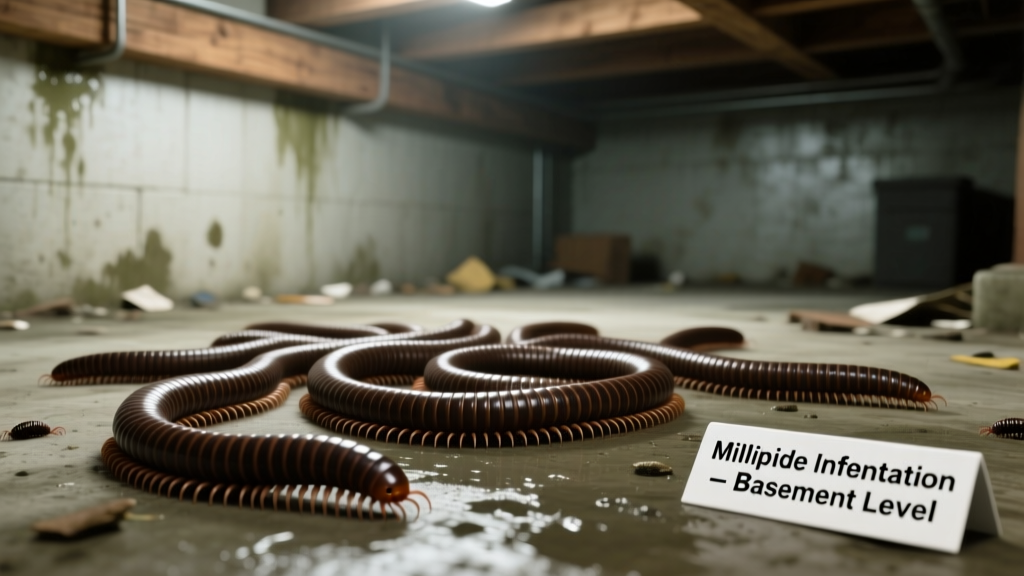
Millipedes aren’t insects—they’re detritivorous arthropods with dozens of legs, drawn to cool, moist basements where they seek decaying organic matter and shelter. While harmless to people and pets, their sudden appearance in large numbers signals underlying moisture or structural issues—and can trigger alarm when found crawling across concrete floors or trapped in sump pits.
Identification
Millipedes in basements are typically 1–2 inches long, cylindrical, dark brown or black, and move slowly with a wave-like motion. Unlike centipedes, they curl into tight coils when disturbed and emit a faint, musty odor from defensive glands. You’ll rarely see them during daylight unless conditions are unusually humid or flooded.
- Leg count: 30–90+ (two pairs per body segment)
- Nocturnal activity—most visible at night or after heavy rain
- Often mistaken for centipedes, but millipedes don’t bite and lack venom
| Feature | Millipede | Centipede |
|---|---|---|
| Body shape | Round, rigid, worm-like | Flattened, flexible |
| Legs per segment | Two pairs | One pair |
| Bite risk | None | Yes—painful but not dangerous |
| Common basement location | Behind baseboards, under cardboard boxes, near drain tiles | Cracks in foundation walls, behind water heaters, near pipes |
What Attracts Them
Millipedes don’t invade homes to feed on your belongings—they follow moisture and organic debris. Basements with high relative humidity (>60%), poor ventilation, leaky plumbing, or exterior grading that directs water toward the foundation create ideal entry corridors. According to the U.S. Geological Survey’s 2022 moisture mapping study, 78% of millipede infestations in northern U.S. homes correlate with uncorrected basement humidity above 65%.
- Decomposing cardboard, paper, or stored mulch near foundation walls
- Clogged or absent gutters causing soil saturation within 3 feet of the foundation
- Cracks >1/16″ in poured concrete or mortar joints in block foundations
- Unvented clothes dryers or sump pump discharge pooling near exterior walls
Treatment Methods
Natural Removal
Start with non-toxic physical removal and environmental correction. Vacuum adults with a shop vac (dispose of bag immediately outdoors), then reduce moisture using dehumidifiers set to 45–50% RH. Place shallow trays of stale beer or damp rolled-up newspapers near baseboards overnight—millipedes gather inside and can be discarded each morning.
Chemical Options
If populations exceed 20–30 per day, consider targeted perimeter treatments. The EPA-approved bifenthrin granules (e.g., Talstar PL) applied 2–3 feet out from the foundation reduce outdoor migration by 62% over 8 weeks, per University of Kentucky Entomology’s 2023 field trial. Avoid spraying indoors—residual dusts like diatomaceous earth (food-grade) work only in dry, undisturbed areas like rim joists or behind insulation.
Prevention
Sustained control hinges on eliminating moisture pathways and sealing access points. Install a vapor barrier over exposed dirt floors; insulate cold water pipes to prevent condensation; and extend downspouts at least 5 feet away from the foundation. Seal cracks with hydraulic cement—not caulk—as millipedes exploit even hairline gaps in deteriorating mortar.
"Millipedes won’t breed indoors—but if you’re seeing juveniles, it means they’re entering from outside AND laying eggs in adjacent mulch or leaf litter. That’s your cue to inspect the north and east foundation walls first." — Dr. Lena Cho, Urban Entomologist, Rutgers Cooperative Extension, 2022
- Run basement dehumidifier year-round—even in winter (basement air is often warmer and damper than outside)
- Store boxes on plastic pallets—not cardboard or wood—to eliminate nesting substrate
- Trim shrubbery and ivy 12+ inches from foundation walls to improve airflow and sunlight
When to Call an Exterminator
Call a licensed pest management professional if millipedes appear daily for more than three weeks despite dehumidification and sealing—or if you spot them emerging from floor drains, wall voids, or sump pump pits. These indicate either a persistent external source (like buried landscape timbers or rotting tree roots) or interior moisture damage requiring structural assessment. Most reputable firms offer free moisture audits as part of initial inspections—ask before booking.
Why do millipedes keep coming back after rain?
They’re not “returning”—they’re newly migrating from saturated soil. Heavy rainfall saturates the ground, forcing millipedes upward and toward any light or crack near your foundation. This isn’t reinfestation; it’s seasonal pressure. Address exterior drainage first, then seal.
Can millipedes damage my home?
No. They consume only decaying plant matter and fungi. However, their presence reliably indicates moisture levels high enough to support mold growth in insulation, drywall, or subflooring—so treat them as a moisture warning sign, not just a nuisance.
Do millipedes lay eggs in basements?
Rarely. Their eggs require consistently damp, organic-rich soil—conditions almost never found on sealed concrete or finished basement floors. If you find tiny white eggs (0.5 mm, oval), check potted plants stored in the basement or damp cardboard boxes left on dirt floors.
Are millipedes attracted to light?
No—they avoid light. What looks like attraction is usually disorientation. When they enter via cracks near doorways or windows, indoor lighting makes them visible, but they’re actually trying to retreat into darkness. Use this to your advantage: place sticky traps along dark baseboard edges, not near lamps.
Will bleach kill millipedes on contact?
Yes—but it’s counterproductive. Bleach evaporates quickly, offers zero residual effect, and corrodes concrete and metal piping. It also breaks down beneficial microbes that compete with mold spores. A 3% hydrogen peroxide solution is safer and more effective for spot-killing without residue.
Millipedes in your basement aren’t an emergency—but they’re a precise diagnostic tool. Every one you see is evidence of a moisture gradient, a gap in your foundation, or a habit (like storing wet firewood against the house) that’s inviting them in. Fix those root causes, and the millipedes vanish—along with the conditions that invite silverfish, springtails, and mold. For related moisture fixes, see our guide on basement dehumidifier sizing and foundation crack sealing techniques.