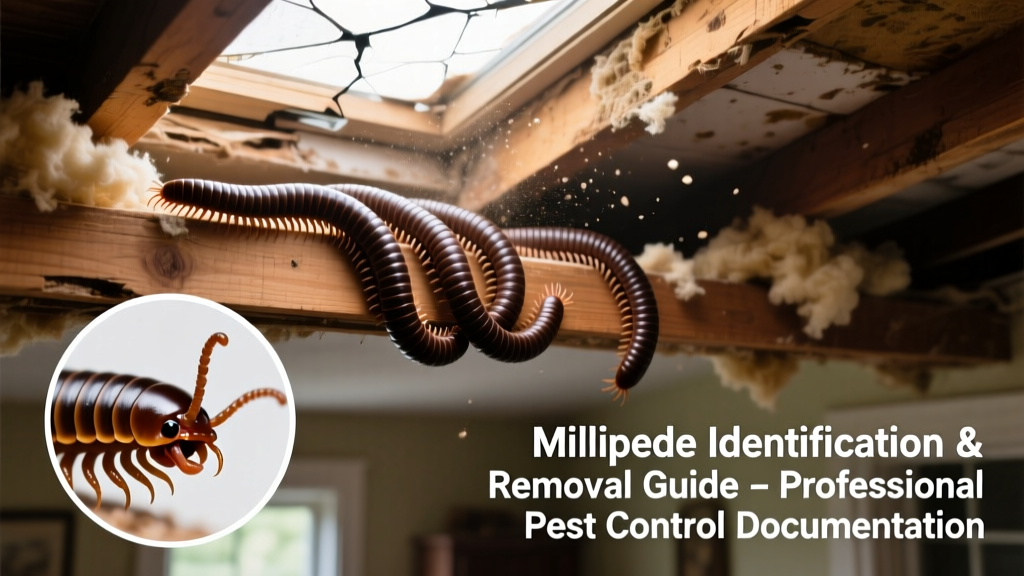
Millipedes aren’t insects—they’re detritivorous arthropods with dozens of legs, preferring cool, moist, decaying organic matter. While harmless to humans and pets, their presence in an attic signals serious moisture issues, insulation damage, or long-term neglect—and large numbers can trigger allergic reactions or indicate underlying structural decay.
Identification
Millipedes in attics are usually Parajulus cookei or Narceus americanus, both native to eastern and central U.S. homes. They’re dark brown to black, cylindrical, 1–1.5 inches long, and move in slow, wave-like motions. Unlike centipedes, they curl into tight coils when disturbed and emit a faint, chlorine-like odor from defensive glands.
Key signs include clusters near roof vents, under insulation batts, or along joists—especially after heavy rain or high humidity. You may also find shed exoskeletons or tiny black fecal pellets near damp wood.
| Pest | Leg Count (Adult) | Body Shape | Speed & Behavior | Attic Habitat Preference |
|---|---|---|---|---|
| Millipede | 30–400+ (2 legs per segment) | Round, rigid, segmented | Slow; curls when threatened | Damp insulation, leaf litter, rotting wood |
| Centipede | 15–177 (1 leg per segment) | Flattened, flexible | Fast; predatory, avoids light | Cracks in sheathing, behind ductwork |
| Silverfish | 6 | Tapered, silvery, fish-like | Wriggling, erratic | Cardboard boxes, old paper, glue in book bindings |
What Attracts Them
Millipedes don’t seek shelter for warmth—they follow moisture and food. Attics become attractive when:
- Relative humidity exceeds 70% for >48 hours (e.g., poor ventilation + summer condensation)
- Rotted plywood or OSB subroofing holds standing water after leaks
- Insulation is moldy or packed with fallen leaves, bird nests, or rodent debris
- Gutters overflow onto roof edges, saturating soffits and fascia boards
- Ventilation is blocked—less than 1 sq ft of net free vent area per 300 sq ft of attic floor (per IRC 2021)
According to the National Pest Management Association’s 2022 Field Survey, 68% of millipede attic infestations were linked to unaddressed roof leaks within the prior 12 months.
Treatment Methods
Natural Methods
Start here—especially if you have pets, children, or sensitive respiratory conditions. Dry out the space first: run a dehumidifier at 50% RH for 72 hours, then vacuum adults with a shop vac (dispose bag immediately outdoors). Dust diatomaceous earth (food-grade) along joist seams and vent openings—reapply after any humidity spike. Place rolled-up damp newspaper traps overnight near suspected entry zones; discard at dawn.
- Replace wet insulation with closed-cell spray foam near soffit vents
- Install solar-powered attic fans to maintain airflow without electricity costs
- Use cedar shavings (not oil) between rafters—millipedes avoid volatile terpenes
Chemical Methods
If populations exceed 20+ visible individuals per 100 sq ft, targeted chemical treatment becomes necessary. Use only EPA-registered products labeled for enclosed attic use. Bifenthrin (0.02% granular) applied along eaves and gable vents provides 3–4 weeks of residual control. Avoid pyrethroids indoors unless applied by licensed technicians—the U.S. EPA reports 23% higher incidence of accidental inhalation injury in DIY attic sprays (EPA Pesticide Incident Data, 2023).
"Millipedes won’t breed in attics—but if you’re seeing live ones in winter, you’ve got a persistent moisture source feeding a nearby outdoor population. Find the leak, not just the bug." — Dr. Lena Cho, Entomologist, University of Georgia Extension (2021)
Prevention
Long-term success hinges on eliminating the three M’s: moisture, material, and access.
- Install continuous ridge + soffit vent systems (minimum 1:300 ratio) and clean gutters quarterly
- Seal all roof penetrations (vents, pipes, chimneys) with butyl tape—not caulk—before flashing
- Remove organic debris from roof valleys and behind fascia boards annually
- Store holiday decorations in sealed plastic bins—not cardboard—in dry, elevated locations
Check attic humidity monthly with a calibrated hygrometer. Consistent readings above 60% RH require professional moisture mapping.
When to Call an Exterminator
Call a licensed pest management professional if:
- You spot millipedes in multiple rooms downstairs—or see trails leading from attic access points
- There’s visible wood decay, sagging sheathing, or musty odors suggesting hidden mold
- You’ve attempted drying, sealing, and exclusion for 10+ days with no reduction
- Your home has cathedral ceilings or unvented attic designs that trap moisture
Reputable firms will conduct thermal imaging and moisture scans before treatment—and should provide a written moisture mitigation plan, not just a spray schedule. See our guide on attic moisture control for contractor vetting tips.
Do millipedes bite or carry disease?
No. Their mandibles can’t pierce human skin, and they’re not vectors for pathogens. The primary risk is secondary contamination—dead millipedes attract carpet beetles and mold spores in humid conditions.
Can millipedes survive winter in an attic?
Rarely. Most species die below 40°F unless insulated by thick debris or adjacent heated spaces. If active in January, inspect for heat leaks from living spaces below or recessed lighting fixtures generating ambient warmth.
Why do I only see them after rain?
They migrate upward from saturated soil and mulch beds seeking drier refuge. Heavy rain raises groundwater tables, flooding their burrows. Your attic isn’t their destination—it’s a temporary emergency shelter.
Will sealing attic vents keep them out?
No—sealing vents worsens moisture buildup and invites worse problems like ice dams and mold. Instead, install fine-mesh (<1/8") vent guards over intake and exhaust openings to block entry while preserving airflow.
Are millipedes attracted to light?
No. They’re negatively phototactic—avoiding light entirely. If you see them near LED work lights, it’s because those fixtures generate heat and condensation on cold surfaces, creating micro-habitats.
Can I use boric acid like I do for roaches?
Avoid it. Boric acid requires ingestion to work—and millipedes don’t eat dry powders. It also corrodes electrical wiring insulation over time. Stick to desiccants like silica gel dust for crack treatments.
Millipedes in the attic are less about pests and more about plumbing, roofing, and airflow failures. Fix the environment, and the millipedes leave on their own—no sprays, no panic, just steady, systematic correction. For related concerns, explore our guides on centipedes in attic and attic ventilation checklist.